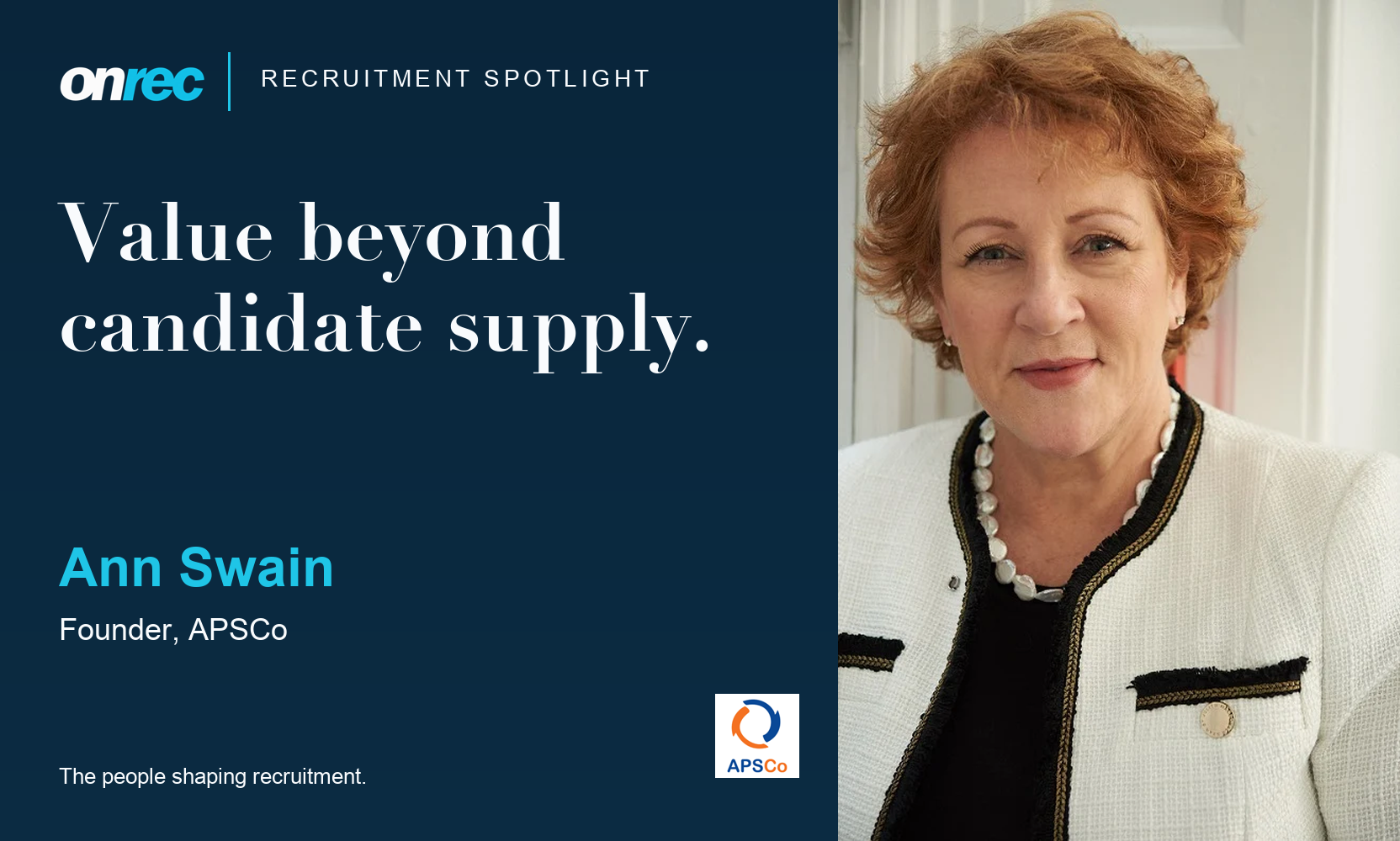
APSCo founder Ann Swain discusses the changing recruitment market, international growth, AI and the importance of building businesses that create value beyond candidate supply.
“Build a business that creates value beyond candidate supply.”
Ann Swain, Founder, APSCo
Building APSCo and navigating change
What led you to establish APSCo, and what has surprised you most about the journey since?
Starting as a graduate trainee, I built extensive experience in IT recruitment and HR, before holding senior roles with multinational staffing firms, owning and selling talent development organisation Learning Curve, and establishing APSCo in 1999. Having worked across the sector and IR35 legislation being drafted, I could see the need for a professional body that would champion recruitment businesses and help raise standards across the market.
What has been particularly rewarding is seeing how APSCo has grown from its UK roots into an international organisation, supporting members across different markets and helping them navigate a rapidly changing workforce landscape.
What is the biggest concern you are hearing from recruitment leaders at the moment?
The UK economy and the impact on the sector from UK and global politics. Not so much a concern, but the effective use of AI within their businesses and the future potential to improve productivity and efficiencies and change the nature of the client/recruitment company relationship – is definitely an area that is a constant topic of discussion for our members.
Where do you see the strongest opportunities for professional staffing businesses over the next few years?
International expansion – particularly the US. The majority of our members now do some international business, either from the UK or an overseas office. Also, the continued development of AI will provide huge opportunities for those companies who embrace the change and embed it within their business.
What is the one change you would most like policymakers to make to support a healthy recruitment market?
There isn’t one thing, there have been a number of policy changes in the last two years, that have destabilised the UK labour market. The NICs increase had a significant negative impact on the UK labour market. The ERA is also set to have an impact – in general this Government has made using contract/temp staff more expensive and is making companies more wary about the recruitment of permanent staff. This, along with the changes AI has brought, has had an impact particularly on the younger workforce.
Growth and client partnerships
How can agencies demonstrate the value of professional recruitment beyond simply filling a vacancy?
Many members are moving to a more consultative and less transactional relationship with their end clients. Providing more value-add services as part of a strategic partnership – taking over various aspects of the workforce strategy that would have been managed internally. Also, we find our members are looking at aligned services that solve a problem their client base has.
What should a recruitment business have in place before expanding internationally?
It’s important to consider the why, the where and the how. Why are you expanding? do you have capacity in time? resources and capital? how will it affect your core business? and is your management team on board? When choosing a market, look at economic growth, political stability, the local candidate base, recruitment legislation, employment protections and the competition, as well as whether your business model will translate. Finally, consider how you’ll enter the market, whether that’s through a local office or from the UK, acquisition, joint venture or partnership, and make sure you have the right advice and ownership in place.
AI and the next generation of leaders
How do you think AI will change the skills and standards clients expect from recruitment partners?
AI is already changing skills in the workforce. Our members are seeing less requirements for lower level more repetitive roles. There is a bit of a lag however - AI is taking over these more repetitive roles, but there is a delay in the rise of new skill sets. We think these will emerge eventually but not yet. We are seeing a real increase in the demand for AI and digital infrastructure skills – as you’d expect.
Clients won't necessarily primarily pay recruiters for access to candidates or information anymore. AI is making both of those increasingly available. Instead, they'll expect recruitment partners to provide judgement, insight, and business impact. Recruitment partners will be expected to advise on workforce planning, skills shortages, perm vs contingent workforce models, employer value propositions and talent retention.
What can the industry do better to develop the next generation of recruitment leaders?
We need to invest more in developing people, rather than assuming that being a good recruiter automatically makes someone a good leader. Leadership requires a different set of skills, and people need the right training, support, and opportunities to develop those skills.
The market is changing quickly, particularly with the impact of AI and new technology, so development can’t be a one-off exercise. We need to encourage continuous learning and make sure emerging leaders have access to mentoring, practical experience, and support from people who have been there before. Supporting the next generation is important not just for individual businesses, but for the future of the whole sector.
Looking ahead
If you could give every recruitment founder one priority for the next 12 months, what would it be?
Build a business that creates value beyond candidate supply. Clients have more tools than ever available to them to source candidates themselves. LinkedIn, AI search, talent intelligence platforms and internal recruitment technology are all reducing the value of simply finding people. What remains genuinely valuable is helping clients make better workforce decisions. The firms that will grow fastest will likely be those that can sit credibly in conversations about workforce planning, skills shortages, talent strategy, leadership capability, organisational change etc.
Quick fire with Ann Swain
Tea or coffee — and how do you take it?
Nescafé at desk (strictly no tea – unheard of in UK, I know)
Gold blend coffee with milk and half a canderel.
Early start or late finish?
With offices across Southeast Asia and Australia, early starts are the norm for me. However, with so many APSCo events and exec dining to attend, I often find myself having a late finish, which is where my Nescafé in the morning comes in handy.
A good book or a good box set?
I’m always found with both a business book and a novel on the go. I’m also a sucker for a binge watch of a decent crime series like a lot of us!
Which place would you happily visit again and again?
My favourite place to visit would have to be South of France. We have had a holiday home there for the past 22 years and always make time to visit every summer.
What's your favourite way to spend a completely work-free Sunday?
Go and watch Tottenham Hotspur beat anybody, of course! As a season ticket holder, I go to every game and couldn’t think of a better way to spend my Sunday.