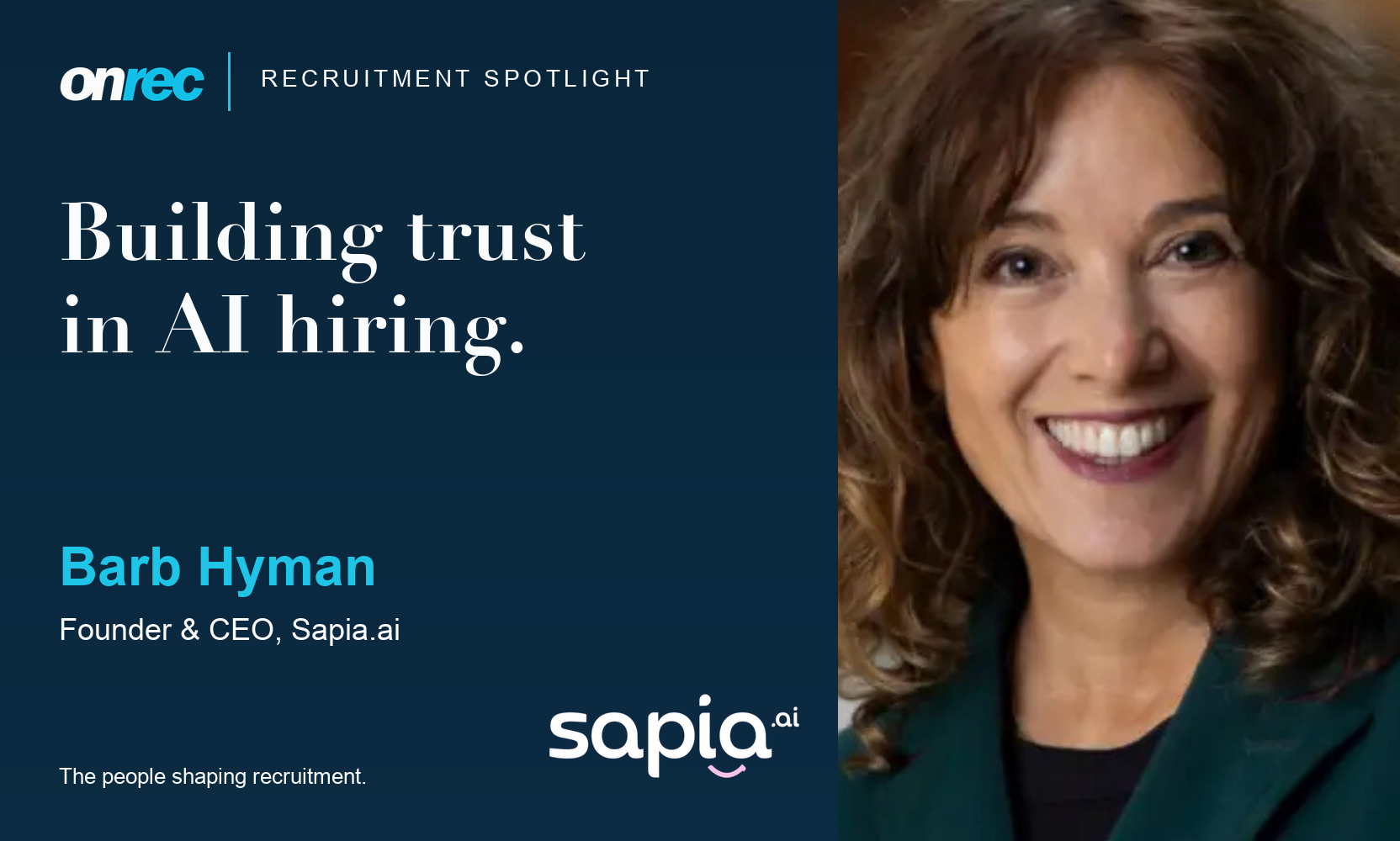
What would it take for candidates to understand, question and trust the AI used to assess them? Barb Hyman discusses Sapia.ai’s approach to transparency, the questions candidates are asking, and why explainability needs to be part of the hiring process.
“Fairness cannot be bolted on as an afterthought; it has to be part of the foundations.”
Barb Hyman
The case for a different hiring experience
What problem did Sapia.ai set out to solve?
When we set out to change hiring for good in 2018, our mission was – and still is- to build ethical AI that makes hiring fair, transparent and equitable. At its core, conventional hiring through CVs, unstructured interviews and subjective screening wasn’t designed with fairness in mind, instead favouring employer convenience where ultimately both business and candidate were failed. But with Sapia.ai’s structured, untimed conversational AI interview, every candidate gets the opportunity to express themselves in their own words, with no CV bias or demographic inference. To date, we’ve given agency to over 10 million candidates, who rate the experience an average of 9.05 out of 10, with over 81% volunteering unprompted feedback.
Why has AI adoption accelerated in high-volume hiring?
Talent acquisition teams are under immense pressure to hire at speed and scale. Across the board, organisations are overwhelmed with applicant volumes for countless roles, and traditional screening methods simply cannot keep pace. When the traditional tactics fail to uncover top candidates, it costs organisations in overlooked talent, employee churn and trust. They’re left with a system that unintentionally sacrifices fairness and accuracy in the name of efficiency. AI, when designed and applied responsibly, changes that dynamic and brings consistency and scale to a process that has long relied on restricted processes and human judgment alone.
What prompted you to build Ask Sapia.ai?
AI is now embedded in recruitment processes across many organisations, but while adoption has accelerated rapidly, it is often treated as a black box - where inputs and logic are hidden, and outputs are simply presented. Instead, Ask Sapia.ai works as a “glass box” for AI hiring and enables users to ask questions about the system in plain language and receive clear, grounded answers. Users - candidates and hiring teams - can explore how the system works and ask questions about how candidates are assessed, how scoring works, how fairness is defined and measured, how data is used, and what research and validation underpin the system.
From the black box to candidate trust
What does a “glass box” approach mean in practice?
A black box is where inputs and logic are hidden, and outputs are simply presented. A glass box means the system can be explored, questioned and understood - how candidates are assessed, how scoring works, how fairness is defined and measured, and what validation underpins the system. For candidates, it means meaningful feedback through My Insights reports and confidence that they were evaluated on their responses, not proxies like name or employment history. For hiring teams, it’s AI recommendations that are explained in plain language and able to be interrogated. For organisations, it makes compliance with regulation like the EU AI Act and NYC Local Law 144 demonstrable by design.
How can employers improve candidates’ trust in AI?
One of the main drivers of distrust is that candidates do not understand what AI does during the hiring process, or the exact data points that it’s pulling from in order to pass judgement on capability and fit. As it stands, most organisations aren’t transparent enough about their approaches. When they are able to ask how a system works, what it measures, how fairness is tested and why recommendations are made, they are more likely to trust it, which is what we see in our candidate data.
What are people asking Ask Sapia.ai?
The volume and range of questions have been one of the most revealing things about the use of Ask Sapia.ai to date, where, across hundreds of conversations, a few clear themes have shown up.
The most common questions from candidates are about data: how their answers are used, whether responses are stored, and whether the AI is being trained on their interview. They want to know, specifically, that they won't be judged on who they are rather than what they said. That tells us the important message that candidates are arriving at AI hiring tools already sceptical, already alert to the possibility of a black box. The fact that they're questioning how their data is being used at all, and staying in the conversation to get answers, shows us that transparency is critical to winning candidate trust.
For researchers and governance-focused stakeholders, accountability on the carbon footprint of the models, ISO certifications, how bias testing is conducted, and what documentation exists is key.
What surprised us? Two things. First, a meaningful number of people tested the bot's limits in a bid to get it to abandon its persona, reveal its configuration, or respond as an unrestricted system. None of it worked. Being genuinely interrogable means being tested, and we think that's exactly right.
Second, a significant portion of the traffic came from candidates who'd arrived here mid-application and who simply wanted to know whether a human would eventually review their application. They weren't asking about ethical AI. They were anxious about a job. That's a different kind of insight: it tells us how important it is that AI vendors can provide humane, clarifying answers for candidates at a critical moment in their application journey.
Fairness, accountability and what comes next
What are the risks of adopting AI without understanding it?
Too many companies have rushed to deploy AI without thinking it through, buying on brand or surface-level capability without interrogating what the system actually measures. There’s a significant risk associated with this approach, as if AI is trained on third-party or historical data, it will simply automate the same bias that existed in those decisions. As AI outputs become more polished and confident, there’s a greater risk of employers being lulled into a false sense of reassurance. Career trajectories shape identity, financial security and long-term wellbeing, so getting this wrong has real consequences.
How do you define and measure fairness?
Fairness cannot be bolted on as an afterthought; it has to be part of the foundations. For example, our SAIGE™ scoring engine focuses on the behaviours and competencies to help performance in a specific role, so outputs are founded in observable evidence, not inferred details such as name, address or education. From there, outcomes are continuously tested across demographic groups for adverse impact, and we deliver unusually high voluntary DEI data capture (95% gender, 84% ethnicity, 83% disability), turning a DEI black hole into a measurable system you can monitor and prove.
Why is explainability becoming more important?
The regulatory landscape is moving from “voluntary ethics” to “mandatory audits.” Recent legislation, such as NYC’s Local Law 144, requires employers to conduct independent bias audits on automated hiring tools.
Relying on third-party data (historical databases, external profiles) introduces “garbage in, garbage out” bias. If the external data was collected through biased human processes, the AI will simply automate that prejudice. Because measurement-based AI relies on first-party data (the candidate’s actual interview responses), it is inherently more defensible and easier to audit for “Impact Ratio” compliance required by new laws.
What comes next for transparent AI hiring?
AI is already influencing hiring, but leaders can either choose AI that exacerbates existing inequality or AI that corrects it. The technology to do this well already exists; employers now need the commitment to use it responsibly, with the rigour and transparency that decisions about people’s lives rightly deserve. Leaders who adopt responsible, transparent AI will hire faster, but critically, they’ll also build trust, widen access and compound performance gains over time.
Quick fire with Barb Hyman
Black box or glass box — which one wins and why?
Glass box, every time. AI in hiring should not be trusted by default as it needs to be understood. You can’t interrogate what you can’t see, and in a decision as consequential as hiring, that’s not a risk worth taking.
One myth about AI in hiring you’d love to bust?
That AI removes human judgment from hiring. The right AI removes inconsistency from areas of hiring where human judgment is less reliable
The judgment that matters: who to hire, whether to make an offer, stays with people. What changes is that by the time a recruiter sees a candidate, they're working with evidence rather than a gut feel or whoever applied last.
Biggest mistake companies make when adopting AI?
Rushing to deploy without thinking it through. Every organisation should be asking: what does this measure, how is fairness tested, and can I audit this independently? If the vendor can’t answer clearly, that’s a red flag.
One word to describe the future of recruitment?
Accountable.
If candidates could ask AI one question, what should it be?
"What did you actually measure?" Not "Am I good enough?". The latter is the wrong question to ask any hiring system. But if candidates know how they’re being measured, they can understand whether their assessment is relevant, defensible, and fair. A system that can't answer that question clearly shouldn't be trusted with hiring decisions.