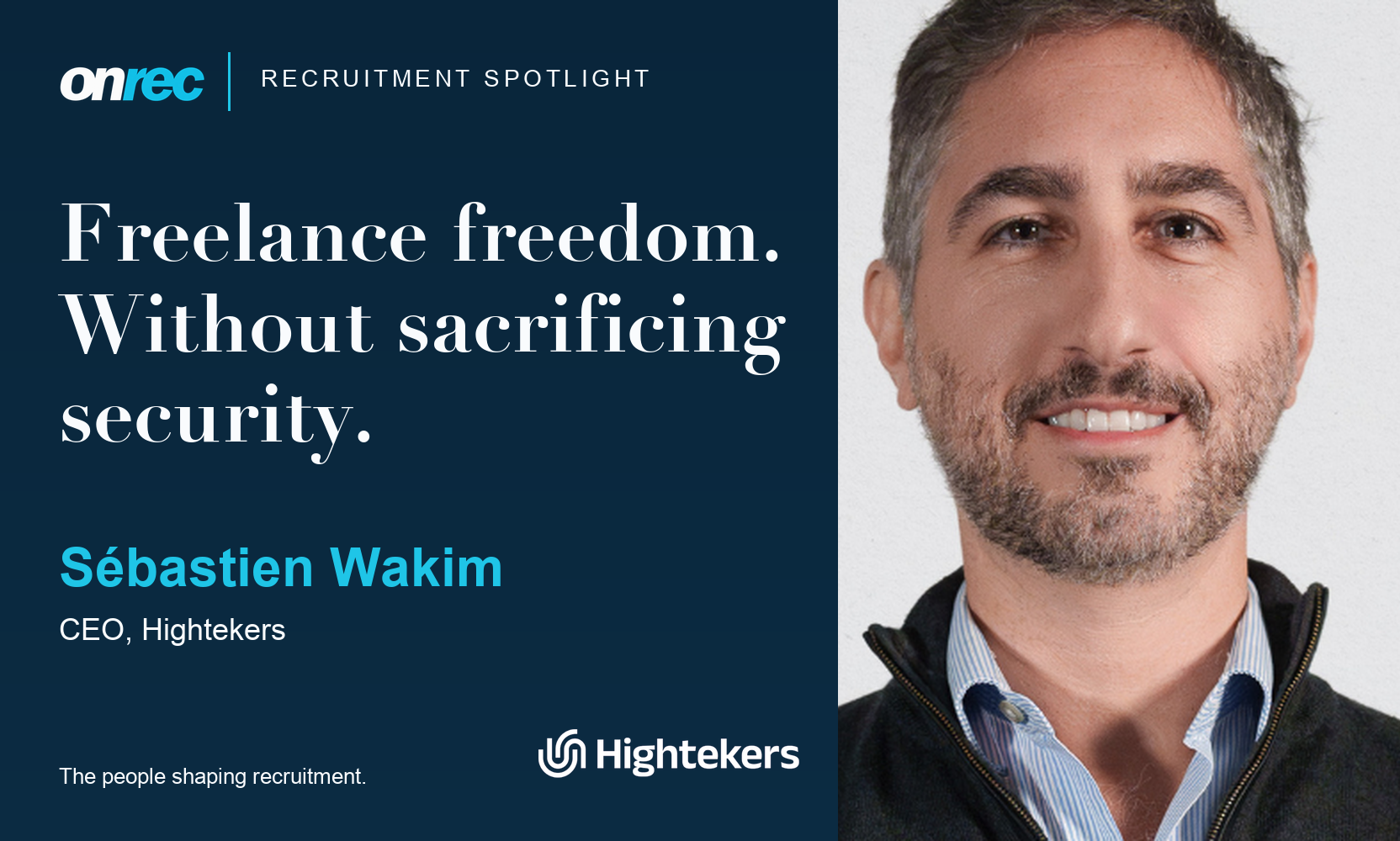
Can independent professionals keep the freedom to choose their projects without giving up the security of employment? For Hightekers, that question sits at the heart of its business — and has implications for the recruitment agencies competing to attract them.
Founded in 2016, the company works with freelancers, staffing agencies and technology consultancies. In this Recruitment Spotlight, Hightekers explains its approach to employment, why international placements need local expertise, and how AI could change the work consultants take on.
“We do it by separating two things that used to be bundled together: how someone works, and how they’re employed.”
Sébastien Wakim, Chief Executive Officer, Hightekers
A different way to support independent talent
What problem did Hightekers set out to solve?
Hightekers operates two related business lines. On one side, we help individual freelancers and consultants, especially in the IT sector, combine autonomy over their work with the pay, benefits and security normally reserved for employees — we are their employer, handle payroll, contracts and admin, and pass on the savings as higher take-home pay, pension contributions, insurance and other perks.
On the other side, we partner directly with staffing agencies and technology consultancies, by giving them a structural advantage over their competitors. We help them improve their margins, win more projects and provide agility in scaling their consultant base up and down by handling their payroll, benefits, and HR administration end to end — while the agency keeps its own client relationship and mission. The problem we set out to solve is that agencies were often balancing winning projects with losing good consultants over pay and benefits, when the real issue was how the employment and cost structure was set up.
For both our individual and business customers the value we provide is the same: we level the playing field by removing the tradeoffs that typically come with freelancing.
How has the freelance market changed since 2016?
When Hightekers started in 2016, freelancers had far fewer options for combining autonomy with real financial security, and staffing agencies had little room to differentiate beyond the daily rate. Since then, freelancers have become much more deliberate about the benefits they see in full time employment, and agencies have come to see that as a genuine lever for attracting and keeping talent, not just a back-office detail. Hightekers has grown alongside that shift — from a France-first business to one operating in multiple countries, and more than 4,000 freelancers have partnered with us along the way.
How can freelancers keep their freedom and gain employment security?
We do it by separating two things that used to be bundled together: how someone works, and how they're employed. A Hightekers consultant keeps choosing their own clients and projects, with the same autonomy over how they work day to day. What changes is the legal and administrative layer underneath — a genuine employment contract, unemployment entitlements, pension contributions, and access to insurance and other benefits. None of that requires giving up the autonomy that drew them to independent work in the first place.
Making international work possible
What still stands in the way of international careers?
The biggest barrier is usually compliance — knowing which contract structure, tax treatment and social security rules apply when a freelancer wants to take a mission in another country, or a client wants to engage someone based elsewhere. Most freelancers and the agencies placing them don't have the in-house expertise to navigate that safely, so international missions get avoided even when there's a good match on both sides. Businesses can overcome that by working with a partner, like Hightekers, who already operates compliantly across multiple countries, rather than building that expertise mission by mission.
How does your model differ from Employer of Record?
EOR is a great fit for placing someone directly as a client's employee abroad. Our model is different: we partner with the staffing agency or technology consultancy itself, not with the end client. When an agency places a consultant on a project, Hightekers becomes that consultant's employer — handling the contract, payroll and benefits — while the agency keeps its own commercial relationship and margin with the client. It solves a different problem to EOR: instead of removing the client's need for a local entity, it removes the agency's need to carry the consultant as a direct employee, cutting admin and bench-time risk, and letting the agency offer stronger pay and benefits without changing what it charges. We expect both models to keep growing in parallel, each solving a different part of the international workforce puzzle.
Where do businesses go wrong with international hiring?
The most common mistake is treating contractor status as a formality rather than a legal reality — engaging someone as an independent contractor when local rules would actually classify them as an employee. The second is assuming a contract structure that works in one country will translate directly to another; social contributions, notice periods and benefits entitlements all vary. The safest approach is building international workforce plans around local compliance from the start, not adapting a domestic template afterwards. It's actually part of why our own model exists — with Hightekers, the contractor status question disappears altogether, because the freelancer becomes a full-time employee of Hightekers in the relevant country rather than an independent contractor of the agency or client. That removes the misclassification risk at the root, instead of managing it case by case.
What freelancers and agencies need next
What do freelancers and recruiters want from each other today?
Freelancers are looking for the same things they always have — interesting missions, fair pay, and increasingly, real benefits and financial security without losing their autonomy. What's changed is that they now expect a partner to help them get there, rather than sorting it all out themselves. Businesses and recruiters are focused on reliability, margin and controlling costs — they want confidence the consultant is compliantly engaged, and they want to offer competitive packages without eroding what they earn on the placement. Increasingly, they're also looking to avoid bench time — paying a consultant who's sitting idle between projects — so having the flexibility to scale their consultant base up and down as demand shifts matters just as much as the placement itself. Both sides are, in effect, asking for the same reassurance: that the admin, compliance and cost side is being handled properly.
How will AI change independent work?
We think AI will change the nature of the work itself more than it reduces the need for independent expertise. Routine, lower-complexity tasks will increasingly be automated, so freelancers and contractors will spend more of their time on judgement-heavy, specialised problems — often moving between more clients and shorter, faster-changing engagements as businesses adapt to what AI can and can't do well. That shift doesn't make a partner like Hightekers less relevant — if anything, the opposite. As freelancers take on more variable projects and income, having an employer behind them to handle contracts, benefits and admin becomes more valuable, not less.
Can international hiring help agencies access specialist skills?
Yes — and this is really where our international reach helps. When an agency wants to engage with a specialist based in another country, it would otherwise need to open a local entity or piece together a fragmented mix of local providers to do it compliantly. Because we can employ consultants directly across multiple countries under local, compliant contracts, agencies can say yes to those placements instead of turning them down, which matters a lot for specialist technology skills where the talent pool in any one country is often small.
What comes next for Hightekers?
We want to help even more professionals get the security and benefits of employment without giving up their autonomy, in more countries around the world, and we want to continue expanding the value we bring to agencies, improving their margins, helping them retain talent, expanding internationally, and taking admin off their plate. As international and independent work keeps growing, our ambition is for Hightekers to be the structural layer that makes that growth easier for agencies, rather than something they have to solve on their own.
Quick fire with Hightekers
Office, hybrid or fully remote?
There's no single answer anymore — the bigger trend we see is work becoming freer of location altogether, whichever mix of office, hybrid or remote a consultant and their client land on.
One recruitment trend you’re most excited about?
The rise of compliant international placements — it's opening up talent pools that used to be off-limits.
One thing you would change about the freelance market tomorrow?
Make employee-level benefits the default for freelancers, not the exception.
What skill will be most valuable in the workforce of 2030?
Specialised technical expertise that's hard to automate, paired with the adaptability to work across borders.
Complete the sentence: The future of work is…
autonomous, but not unsupported.