1. Let's start at the beginning! How did you first get into recruitment, and what did you enjoy most about the industry?
Like a lot of people, I didn't grow up dreaming of becoming a recruiter!
I found my way into the industry and ended up spending over 20 years in it. I worked at Computer Futures, became a top biller, moved into in-house recruitment at Conchango / EMC and eventually set up my own business.
What I loved most was the people. Recruitment is such a brilliant industry for building relationships. You're constantly meeting people, solving problems, making things happen and, if you're doing it properly, genuinely changing people's lives.
I also loved the pace, the competition and the fact that you could see the results of your hard work.
And I made some incredible friends along the way. Some of the people I met through recruitment are still a huge part of my life today.
It's an industry that gave me so much, and despite everything I'm about to say about the pressures, I still love it.
2. You went on to run your own successful recruitment business. What was that experience like, and looking back, do you think the pressures of running a business contributed to what happened next?
Running my own recruitment business was brilliant. I loved building something, hiring people, developing a team and having the freedom to make my own decisions.
But there's another side to it.
When it's your business, everything ultimately comes back to you. The clients, the team, the money, the problems, the decisions. Even when you're not working, you're often thinking about work.
And because I genuinely loved what I did, I didn't necessarily see that as a problem.
“I was very good at looking after the business. Not quite so good at looking after myself.”
— Michelle Flynn, Certified Health & Performance Coach
Looking back, I think that's where things can become dangerous. When you're ambitious, capable and used to getting things done, you can convince yourself that being constantly busy is just part of being successful.
Do I think the pressure contributed to what happened next? I can't say exactly what caused my health problems as I don’t know, but I absolutely believe I wasn't paying enough attention to what my body was telling me.
I was very good at looking after the business.
Not quite so good at looking after myself.
3. You've been very open about the health scares you experienced when, on paper, everything seemed to be going brilliantly. Can you tell us a little about that time and what it taught you?
On paper, I was doing everything right.
I was successful, active, exercising and generally considered myself pretty healthy.
Then I started collapsing.
Over a period of around three years, I experienced repeated health scares, including discovering I had a cyst on my heart.
It's quite frightening when your body suddenly stops doing what you expect it to do.
And the really frustrating thing was that I looked fine. I was still getting on with life, still doing all the things I'd always done.
But something clearly wasn't right.
That experience completely changed how I thought about health and performance.
I realised that being healthy on paper and actually feeling well are two very different things.
I also realised how easy it is to ignore the warning signs when you're busy getting on with life.
Eventually, I decided to retrain as a coach.
I didn't want to wait for another health scare before changing how I lived, and I wanted to help other people avoid getting to that point.
One of the biggest messages I share now is that you don't have to collapse to know something's off.
I wish I'd understood that a lot earlier.
4. Recruitment is an industry where people are often constantly switched on. Why do you think so many recruiters and business owners find it difficult to slow down or recognise when they're doing too much?
Because recruitment rewards being busy!
There's always another call to make, another candidate to speak to, another client to chase and another deal that might happen if you just do one more thing.
And let's be fair, there's a real buzz to it.
“The problem is that we can start confusing being busy with being productive.”
— Michelle Flynn, Certified Health & Performance Coach
We celebrate the big billers, the long hours, the people who are always available. We don't necessarily celebrate the person who switches off at six, gets eight hours' sleep and comes back the next morning feeling brilliant.
There's also that fear that if you stop, you'll miss something.
But you can't perform at your best indefinitely if you're constantly running on empty.
I spend a lot of time reminding recruiters that recovery isn't a reward for finishing everything.
It's part of being able to perform well in the first place.
And your inbox will still be there tomorrow. Unfortunately!
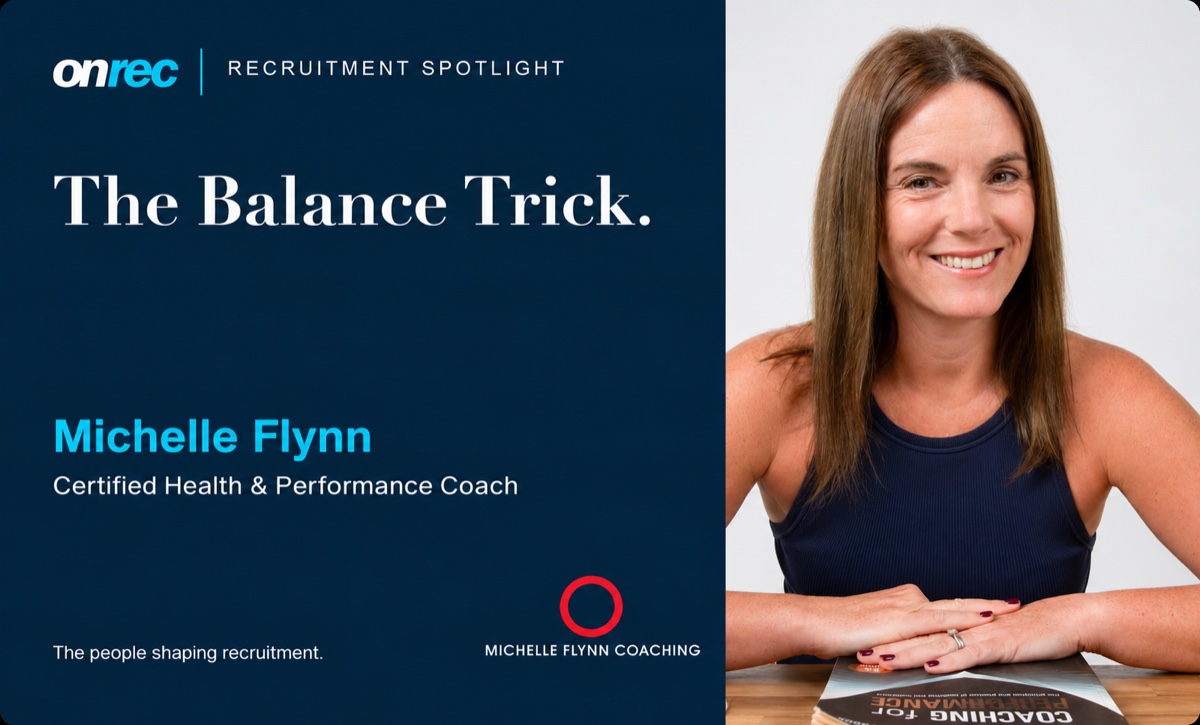
5. Your new book, The Balance Trick, has just launched! Huge congratulations! What inspired you to write it, and how does it feel to finally have it out there?
Thank you! I'm still slightly amazed that I can say I've written a book.
The Balance Trick came from everything I've learned through my own experiences and the work I now do with coaching clients.
I kept seeing the same thing.
People were doing brilliantly in certain parts of their lives but struggling in others. They might have fantastic careers but no energy. They might be physically fit but constantly stressed. Or they might be so busy looking after everyone else that they'd completely forgotten about themselves.
And I wanted to create something practical that would help people work out where they were and what to do next.
Not another book telling you to get up at 5am, meditate for an hour and completely reinvent your life.
Because, frankly, who has time for that?
The book looks at 20 areas of life and gives people practical ideas, exercises and small changes they can actually make.
Seeing people send me photographs of themselves holding it has been wonderful.
I've spent years helping other people achieve their goals, so it's been rather nice to tick off one of my own.
And yes, I still get ridiculously excited every time someone tells me they've bought a copy.
6. One of the messages in the book is that balance isn't about splitting your time equally between work and life. What does a healthy balance actually look like to you?
I think the idea that everything needs to be perfectly balanced is part of the problem.
Life doesn't work like that.
There will be times when work needs more of your attention. Other times, family, health, relationships or something completely different will take priority.
And that's fine.
For me, balance is about being aware of what's important to you and making sure you're not consistently sacrificing one part of your life for another.
If you're working incredibly hard because you're building a business, brilliant. But if that means you never see your friends, you're permanently exhausted and your relationships are suffering, something probably needs to change.
Balance isn't about getting everything right every day.
It's about noticing when things are getting out of kilter and doing something about it.
And remembering that what matters to you might be completely different from what matters to someone else.
7. You talk about your Life Audit in the book, which looks at 20 different areas of life. Can you explain how it works and why you think it's so useful?
The Life Audit is probably one of my favourite coaching tools.
It looks at 20 different areas of your life, including work, health, energy, relationships, friendships and finances.
You score each area based on how satisfied you feel with it right now.
And when you see all those scores together, you get a really interesting picture of what's going on.
Quite often, people are surprised.
They might think work is their biggest problem, but when they look at the results, they realise it's actually their sleep, their friendships or the fact that they never have any time for themselves.
The important thing is that you're not trying to get 10 out of 10 in everything.
That would be exhausting!
You're looking for the areas that matter most to you and where a small change could make a real difference.
My approach is simple.
“Score. See. Fix.”
— Michelle Flynn, Certified Health & Performance Coach
Score where you are, see what needs attention and choose something small to change.
You can do the Life Audit for free at:
www.michelleflynncoaching.com/lifeaudit
And the book helps you work through what to do with those results.
8. Having worked in recruitment and now coaching individuals and business leaders, what are some of the biggest mistakes you see people making when it comes to looking after themselves?
Waiting until something goes wrong.
That's probably the biggest one.
People tell themselves they'll slow down after the next deal, the next quarter, the next holiday or when the business is a bit more settled.
But there's always something else coming.
Another mistake is thinking that looking after yourself has to involve a massive lifestyle overhaul.
People decide they're going to start exercising five times a week, stop drinking, eat perfectly, get eight hours' sleep and never look at their phone again.
All starting Monday.
And by Wednesday, it's all fallen apart.
I see this all the time.
Small changes that you can actually stick to are far more useful than an ambitious plan that lasts three days.
I also think we underestimate the impact of our phones.
I've been experimenting with a device called Brick, which blocks my social media apps in the evening.
I thought I was pretty good at managing my phone use.
Turns out I wasn't!
Since using it, I'm reading more, I'm more present and I'm spending less time mindlessly scrolling.
Sometimes the simplest changes have the biggest impact.
9. If a recruitment business owner or consultant reading this is feeling completely overwhelmed, what's one small thing they could do today to start making a difference?
Stop for ten minutes.
Seriously.
I know that sounds ridiculous when you've got a million things to do, but that's exactly when you need to do it.
Get away from your desk, put your phone down and write down everything that's going round in your head.
Then ask yourself:
What actually needs my attention today?
Not everything that's shouting the loudest. Not everything someone else has decided is urgent.
What genuinely matters?
Choose the most important thing and start there.
When we're overwhelmed, we often respond by trying to do more, faster.
But sometimes the most productive thing you can do is stop long enough to work out what you should be doing in the first place.
I always say, stop time to take control.
It sounds counterintuitive, but it works.
10. Finally, what's next for you? Now the book is finished, what's on the horizon for Michelle Flynn?
Well, apparently writing a book wasn't enough to keep me busy!
I'm continuing to grow my coaching and speaking work, particularly with recruitment businesses and corporate teams.
I love getting back into recruitment rooms because I understand the industry, the people and the pressures. And it's brilliant being able to combine that experience with everything I've learned about health, energy and performance.
I'm also doing more conference sessions, including my Performance Reset breathwork experiences.
There's something quite entertaining about watching a room full of business leaders realise they're about to do breathwork to big dance music!
And I'm really excited about getting The Balance Trick into more people's hands and seeing what they do with it.
Ultimately, I want to help more people perform brilliantly without sacrificing the rest of their lives to do it.
And who knows? There might even be another book.
Although perhaps I should recover from this one first.
Quickfire questions
1. Early bird or night owl?
Early bird. I love getting up and out of my house before the day takes over.
2. What's your ultimate guilty pleasure?
Proper, uncontrollable belly laughing. The sort where you can't breathe, your face hurts and you're desperately hoping you don't wet yourself.
3. If you could disappear anywhere for a weekend, where would you go?
A gorgeous country pub. Log fire, amazing food, brilliant company and absolutely nothing in the diary. Ideally somewhere with no phone signal so I can pretend it's not my fault I'm ignoring everyone.
4. What's one thing you absolutely couldn't live without?
Matt, my family and my friends. And, embarrassingly, my phone. Which is slightly awkward considering I've just written a book about getting your life back.
5. And most importantly... now the book is finished, what's the first thing you're doing with all that spare time?!
Spare time? What's that?
I'm already working on my next big idea, which, if it comes off, will be even bigger than the book.
Clearly I've learned absolutely nothing from my own advice.
Perhaps I should read my book.