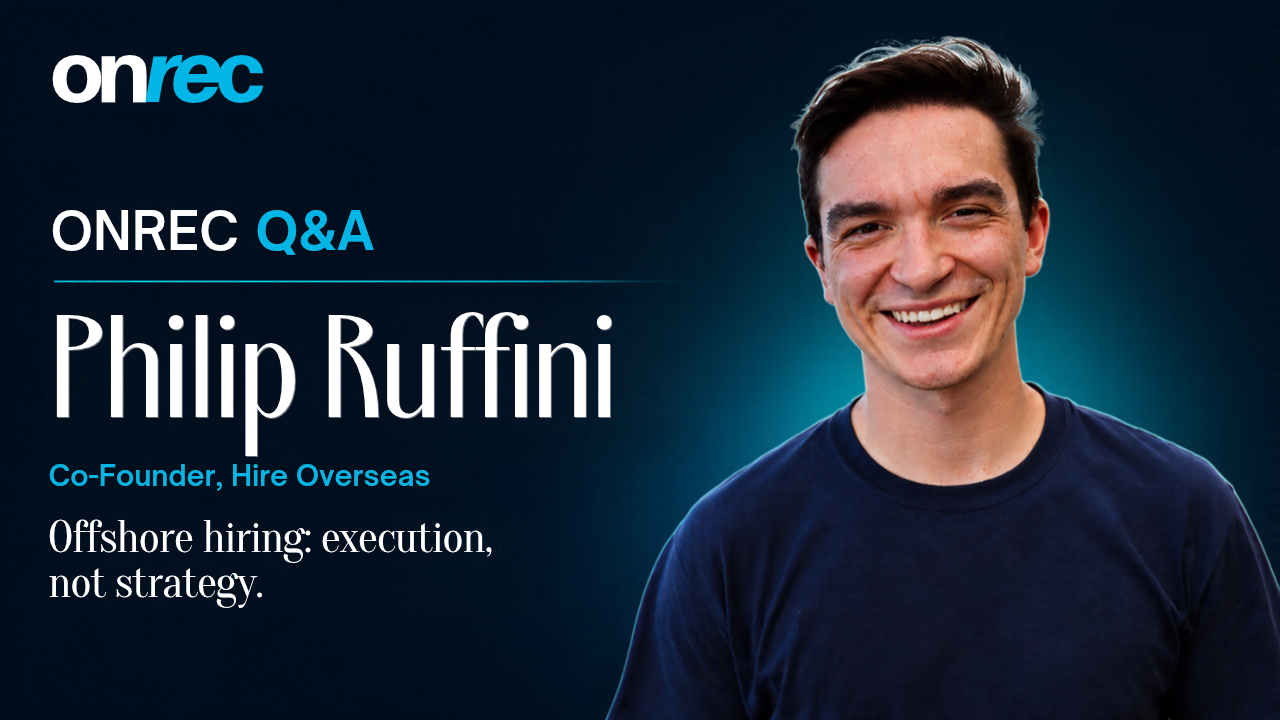
Offshore hiring can give growing companies access to specialist capability and dedicated support, but Philip Ruffini believes it works best when employers are clear about what should stay in-house and what can be executed remotely.
In this Recruitment Spotlight Q&A, the Co-Founder of Hire Overseas shares practical advice on choosing roles, supporting new hires and using AI without losing the human judgement that makes a team effective.
What prompted you to start Hire Overseas, and which hiring problems do you help employers solve?
I was head of growth at Rupa Health, a Series A functional-medicine lab-testing marketplace. We couldn't afford a US team for everything we needed, so I built one overseas instead: 20-plus people across the Philippines, Latin America and Nigeria doing SEO, video editing, graphic design, web development, podcast management, customer support, executive assistance, even Nigerian doctors writing our healthcare content. That team was the engine behind the largest blog in functional medicine and saved the company roughly $1.2M a year. Rupa was acquired by Fullscript in October 2024, and by then every founder I knew was asking me to help them do the same thing. Harlan and I started Hire Overseas that fall.
The problems we solve are the ones I hit myself. First, volume without signal: post a bookkeeper role in the Philippines and you'll have 100 applicants overnight, 90 of them poor. We see 10,000-plus applicants a month and hire under 1%. Second, most employers don't know what excellent looks like for an offshore role or which region fits which job, so they hire cheap, get what they paid for, and conclude offshore doesn't work. Third, the administrative layer: contracting, payroll across countries, compliance, time-off, performance management. We're the contracting party, so the client gets one invoice and one person who only works for them. The positioning that stuck is "your offshore headhunter and outsourced HR department."
The last problem is the agency trap. Pay an SEO or marketing agency under $10K a month and you're really getting a contractor who is juggling five to twenty accounts. We cut the agency out and put that same person on your team, dedicated, at a lower cost, where you can actually give them feedback.
“Your offshore headhunter and outsourced HR department.”
— Philip Ruffini, Co-Founder of Hire Overseas
How can an employer tell whether a role is a good fit for offshore hiring?
My rule: strategy stays in-house, execution goes offshore. The moment something in your business has become systematized, repeatable and process-oriented, that's the moment to hire overseas for it. If you can hand someone a playbook, offshore talent will run it exceptionally well. If you need someone to invent the playbook, be a driver, or think like an owner, that is very hard to find offshore, and I tell people that on the first call. Founders come to me saying "I want to grow my Instagram to 100,000 followers." That's a strategy problem; nobody I place is going to solve it for you. But once you know the content cadence, formats and workflow, an overseas content assistant will execute it better and more consistently than most US hires.
A few practical tests:
- Does the role support an existing team member or replace one? Offshore talent is best at supporting US employees, not replacing them. The structure I recommend is five to ten overseas contractors per US employee, with the US person owning strategy and management.
- How does your company communicate? If everyone lives in Slack and work is digital, an offshore EA or ops hire works great. If you need someone physically in the room, travelling with you, or fielding a hundred verbal questions a day, hire locally.
- Time zone. Latin America runs on US hours at roughly 30% higher cost than Southeast Asia. The Philippines is cheaper, but if the job requires live US-hours coverage, you're asking someone to work until 4 or 5 AM their time and quality degrades. We started in the Philippines; about 70% of our placements are now Latin America, largely for this reason.
- Is it a full-time job? There are four kinds of offshore workers: Fiverr, Upwork, part-time and full-time. We only place full-time. The full-time people want a stable job with people who treat them well, and that's who stays.
The roles where this works reliably: executive assistants, customer support, bookkeeping and finance, SEO and content, design and video, SDRs and cold callers, project management, and increasingly technical roles like forward-deployed engineers and data labeling. Most land between $2,000 and $4,000 a month all-in.
What should employers look for when assessing an offshore recruitment partner?
Start with the question most people never ask: how many clients will my person work for? Many agencies staff you with someone split across several accounts. You want one person, full-time, yours.
Then look at how they vet. Ours is three interviews, a real task in the actual tools the role uses (not a quiz), two to three reference checks and a background check. Fake profiles and borrowed portfolios are a real problem in this market, and a partner who skips reference checks is passing that risk to you.
Ask what happens after the placement. The sale is easy; the first ninety days are where it works or doesn't. We run a kickoff, have the contractor write a 30/60/90-day plan and a one-pager defining what success and failure look like in the role, collect daily and weekly reports, and our ops team does structured check-ins through the first month, then every other week. If a partner's answer is "we'll send you an invoice," keep looking.
Ask how they treat the people they place. Most of this industry pays as little as possible, tracks keystrokes and monitors screens. We pay about 20% above market and don't do that. It's not charity; it's why our contractors stay, and retention is the whole product. Ask the agency what their contractor churn is.
Finally, check the commercial terms and whether they'll tell you no. Month-to-month contracts, no deposit, a money-back window and a replacement guarantee mean the agency carries the risk of a bad match. And a good partner will tell you when a role isn't a fit. We've sent prospects to Upwork because what they needed didn't justify a full-time hire, and one of our clients told us the thing he valued most was that we pushed back when he wanted to move faster than the quality would allow.
What does a good first month look like for an offshore hire and their manager?
Our data is blunt: the majority of churn happens in the first month, and when a placement fails, both sides usually know within two weeks. The first month is not a trial for the contractor; it's a test of whether the employer is ready to manage someone remote.
Before day one, four things should be true: tool access is granted, a communication channel is set, working hours are agreed, and the first three tasks are defined. We run that as a readiness check on every placement. The pattern that kills engagements is the contractor sitting in "waiting mode" because the client hasn't decided what they should do yet. By week two the client is wondering why they aren't seeing value, and the contractor is losing interest. Both are the manager's fault.
A good first month looks like this:
- Day one: a direct kickoff call between the manager and the hire. Onboard them exactly as you would a US employee: accounts, systems, context on the business.
- Week one: the contractor drafts a 30/60/90-day plan and a one-pager on what success and failure mean in the role. The manager edits it. Now you're accountable to each other in writing.
- Daily: beginning-of-day and end-of-day updates, async. This is how I ran my team at Rupa; some people I didn't get on a video call with for over a year because the daily reports and the work were that good.
- Weekly: one short call and a written weekly report. Monthly, a performance report against the plan.
- Communication style: if you're working across time zones, write longer messages that pre-empt the follow-up questions rather than one question at a time. Use Loom for anything that doesn't need to be live. Set explicit response-time expectations for the hours you don't overlap.
And if there are red flags in the first two weeks, tell your agency immediately. The best outcomes we've seen come from managers who built a structured onboarding doc with objectives and treated the hire as a real member of the team from the first hour.
Can you share an example of a hire that worked well, and what the employer did to make it work?
Bland Labs. Josh Collin founded it as a solo, bootstrapped voice-AI implementation agency and built the entire team through us, starting with an executive assistant in late 2024 and expanding to a team of forward-deployed engineers from the Philippines, Nigeria and Latin America. These engineers built production voice agents for enterprise customers, scoped requirements with public-company stakeholders, and iterated live. One of them, Delaine, worked the company's largest account and helped generate over $40M in ROI in year one. Josh sold the company roughly a year in.
What he did right:
- He hired for judgment, not just skills. Voice agents interact with tens of thousands of people a day, so he screened for emotional intelligence and empathy as hard as technical ability.
- He gave people room to grow. Ahmad came in as a strong but shy builder; Josh deliberately pushed him into customer-facing work and he became one of the team's best stakeholder managers.
- He treated AI as a tool, not a threat. The team used Claude Code and similar tools to ship things like a full outbound dialer system in a fraction of the expected time.
- He let us hold the line on quality. When he wanted to hire faster than we could vet, we said no, and he's said that's one of the things he valued most.
A smaller example I like just as much: Zach, a marketing director at a physical therapy practice in Pennsylvania, had never managed anyone overseas. He hired an SEO specialist from us, Thomas, twelve hours away. Within the first weeks Thomas had surfaced KPIs the practice didn't know it had. Zach set overlap hours, had Thomas send beginning- and end-of-day updates plus a weekly report, held one or two calls a week, and then emailed us asking what else he should be doing. That instinct, asking how to be a better manager rather than waiting for the hire to fail, is the single best predictor of success we see.
What is changing in offshore hiring, and what advice would you give an employer considering it for the first time?
Three things are changing.
AI is compressing the bottom and expanding the top. When I started this, friends asked why I'd build a VA business when AI was about to automate the work. The low-level, $5-an-hour task work is getting automated, and I wouldn't want to run a general VA shop right now. But AI doesn't replace people; it makes being average much easier. Offshore talent that was held back by English or by tool gaps is now far more effective, and an overseas person fluent in AI tools is at parity with, or better than, their US counterpart at a fraction of the cost. Our fastest-growing clients are AI-enabled companies using offshore teams, including AI companies with twenty contractors reviewing their models' output. I tell our own internal team: learn Claude, build automations, or you'll be working for a company that gets out-competed by one that did.
Titles matter less than thinking. Skills can be learned in a week; critical thinking and work ethic can't. The roles we place are collapsing into three buckets: go-to-market (outbound, SDR, cold calling), content and inbound (design, video, writing, SEO), and operations. We hire for the person, not the resume.
The map is shifting. We started in the Philippines and now place mostly in Latin America because time-zone alignment beats a small cost saving. Regulation is moving too: AI is now banned from making cold calls, which has made human overseas calling teams one of our best-performing offers.
For a first-timer:
- Pick one role that is already systematized and that supports someone on your team. Don't offshore strategy.
- Hire full-time and pay properly. $2,000 to $4,000 a month gets you excellent people; $5 an hour gets you turnover.
- Write the first three tasks, the success criteria and the working hours before day one. If you can't, you're not ready to hire.
- Run a kickoff, insist on daily async updates, and have the hire write a 30/60/90 plan in week one.
- Expect to know within two weeks. Use a partner whose contract lets you act on that.
- Ask for someone who already uses AI tools daily, and give them permission to automate their own job.
About Philip Ruffini
Philip Ruffini is co-founder of Hire Overseas, which recruits and manages full-time offshore talent for founders and growth-stage companies across the Philippines, Latin America and Africa. Before that he was head of growth at Rupa Health, where he built a 20-person overseas team that saved the company about $1.2M a year ahead of its acquisition by Fullscript. He is a former Microsoft product manager and a Schwarzman Scholar.