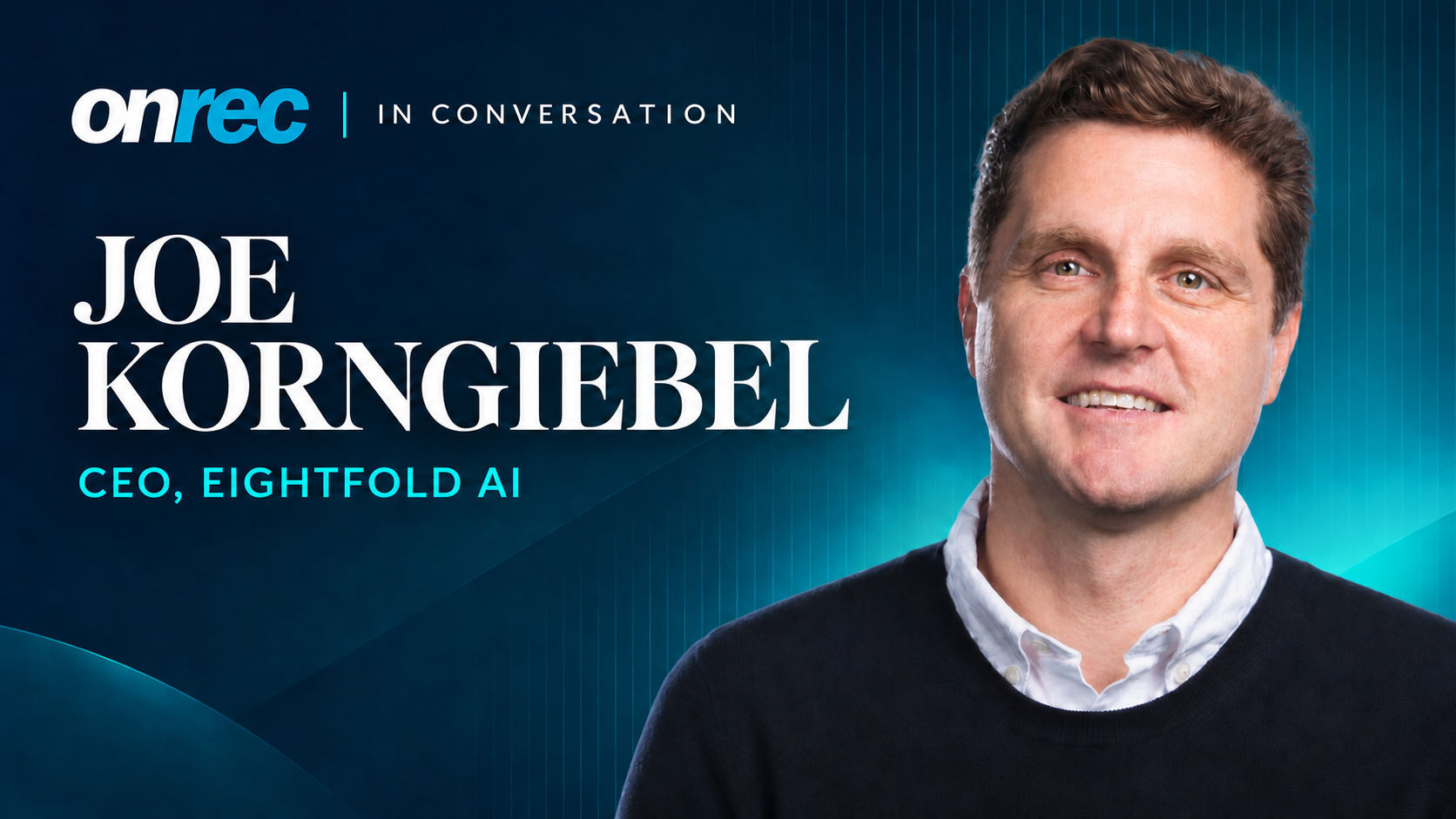
AI is rapidly changing recruitment, but are recruiters being freed to do their best work or simply being handed more systems to manage? In this Onrec Q&A, Joe Korngiebel, Chief Executive Officer at Eightfold AI, discusses AI Recruiting Teammate, where human judgment must remain central and how agencies can introduce AI without surrendering control.
We’ve seen an explosion of AI tools in recruitment over the past couple of years. Are recruiters now spending too much time managing technology rather than actually recruiting?
Both the pace and explosion of AI tools in recruitment have brought a patchwork of disconnected agents. Each solved a specific problem, but most replicated the old way of working: completing one task at a time, disconnected from shared context and coordination. That leaves recruiters responsible for connecting everything, such as briefing different tools, switching between systems, managing workflows and figuring out what happens next.
For example, a candidate gets an interview invitation for a role they’re excited about, then a second email with a link from the AI interviewing platform for the same role, and then a third from a scheduling platform with a calendar invite in the wrong time zone. When the interview starts, the hiring manager is toggling between one system for the résumé, the interview tool for the AI-generated notes, and a separate form for the scorecard. Ten minutes in, no one has talked about the role. The candidate feels like they’re troubleshooting software instead of meeting a future employer. With this many tools, the experience breaks down, and people are no longer the focus.
So yes, recruiters are spending too much time managing the technology and coordinating the work around it, rather than doing what we actually need recruiters to do: engage talent, partner with hiring managers and make better hiring decisions.
“AI can surface the intelligence, but people need transparency to understand it and ultimately make the final decision a human one.”
— Joe Korngiebel, Chief Executive Officer at Eightfold AI
Eightfold is introducing AI Recruiting Teammate, which takes a different approach to individual AI agents. What problem are you trying to solve, and how will this change the recruiter’s day-to-day experience?
We’ve seen the expansion of individual AI agents designed to solve individual recruiting tasks, which can make individual tasks more efficient. Now, with so many agents available, what we’re seeing is a gap for recruiters in how that work is coordinated across the hiring process. Individual agents have helped automate tasks, but they haven’t reduced the complexity of managing the overall hiring process.
That’s where AI Recruiting Teammate takes a different approach. It’s goal-driven, coordinating AI agents and work across the hiring process toward the hiring outcome, so the recruiter doesn’t have to. That means recruiters can spend less time managing the process and more time finding, engaging and ultimately choosing the right people.
Picture a recruiter opening a new requisition. Instead of having to manage a series of individual tools and tasks, they set the hiring goal with the Teammate. It develops the plan, helps calibrate the role, identifies candidates, coordinates outreach, screening and scheduling, and keeps that work moving. When a decision or approval is needed, it brings the recruiter back in with the context they need to decide what happens next.
Day to day, the Teammate keeps track of progress and coordinates the appropriate agents, tools and workflows, grounded in Eightfold’s Talent Intelligence. It brings the recruiter back in when their judgment or approval is needed, giving them more time to focus on candidates, hiring managers and the decisions that lead to a great hire.
That’s the shift to the left: less time managing the process, more time with candidates and hiring managers, and more time focused on the decisions that lead to a great hire.
There’s a lot of discussion about AI taking over recruitment tasks, but where do you believe human judgement must always remain central?
AI is transforming everything, but I’ve always believed its value will only be realized by great people. As AI continues to innovate and take on more of the work in recruiting, I strongly believe that we have to be very deliberate about what AI does well and what people do well.
AI can take on repetitive work, coordinate activities across the hiring process, and give recruiters deeper intelligence into a person’s skills, capabilities and potential. The purpose of that intelligence is to give recruiters better context and evidence to exercise human judgment, not replace it.
In recruiting, human judgment must remain central because decisions about who moves forward, who is right for the role and who ultimately gets hired are consequential decisions about people. AI can provide better intelligence and evidence, but people have to apply the judgment that ultimately leads to the right hiring outcome.
One of the biggest concerns around AI recruitment is transparency. How can employers understand why an AI system has recommended a particular candidate, and what safeguards should be in place to prevent bias?
When an AI system recommends a candidate, a recruiter should not only get a suggestion, but they also should understand the reason behind it. A recruiter is still in the driver’s seat and must understand the skills, experience and capabilities of the person that helped form the recommendation and how they map to the role. AI can surface the intelligence, but people need transparency to understand it and ultimately make the final decision a human one.
Preventing bias starts at the design of a system. Fairness has to be designed in from the start, not bolted on later. It is important to test for fairness from the start, monitor it continuously and have independent validation that the technology is performing the way it should. As AI continues to advance in the hiring process, the expectations around transparency and fairness need to increase with it. It is critical that organizations continue to assess systems and ask whether they are fair, secure, transparent, as those are the standards enterprise AI has to meet.
Many recruitment businesses have already invested heavily in technology but aren’t necessarily seeing the productivity improvements they expected. What do you think they’re getting wrong?
Simply investing in technology does not automatically create productivity. When you take the same recruiting processes and just add more technology, it may make individual tasks faster, but you have not changed how the work actually gets done. You have to start by rethinking the work itself, specifically understanding what AI should do, where people add the most value and what outcome you are trying to achieve.
Part of the problem is also treating productivity as the goal. Faster tasks are nice, but no CEO invests in recruiting technology to save recruiters a few clicks. They invest because hiring drives growth. Every critical role that sits open is revenue not generated, a product not shipped or a customer not served. So the real question isn’t just whether recruiters are more productive. It’s whether the technology is helping you hire the right people quickly enough to grow the business.
I also think focus matters. Organizations do not need to apply AI everywhere at once, rather we need to identify the outcomes that matter most, understand where the work is getting stuck, and focus the technology there. Simply, we need to prove that it is creating value, learn from it and then expand.
At the end of the day, it comes down to outcomes. Otherwise, why did you buy the technology. Start with the outcome you want to change and work backwards from there: what does AI do, what do people do and where is the work actually getting stuck.
For smaller recruitment agencies without large technology budgets or dedicated AI teams, what practical steps would you recommend when introducing AI into their recruitment processes?
To get started, I would recommend small recruitment teams identify one problem that is getting in the way of their recruiters doing their best work. For an agency, that could mean looking at something very tangible, like placements per recruiter or time to submit a shortlist, and asking what is getting in the way of improving that outcome. Every hour spent on administrative work is time that could be spent placing candidates or working with clients. Then evaluate where their team is spending time on repetitive work, decide what AI can take on for efficiency and what needs to stay with people. You don’t need to introduce AI across the entire recruiting process at once. Start with a real workflow where it can immediately reduce work for the recruiter, whether that is candidate engagement, screening, scheduling or follow-up.
For example, if scheduling and candidate follow-up are slowing down how quickly a recruiter can get a shortlist in front of a client, that’s a very practical place to start. AI can take on more of that coordination and follow-through, while the recruiter spends that time with candidates and clients.
The important thing is to put clear boundaries around what the AI can do. It should operate within the guardrails you set, bring people in when judgment is required, and give recruiters the ability to review, redirect or take over. That gives even a small team a practical way to introduce more automation without giving up control.
And you don’t need to build all of this yourself. Smaller agencies should be able to take advantage of AI capabilities within the technology they already use and build from there as they learn what works for their business.
Looking ahead to 2027, how do you see the role of the recruiter changing as AI becomes capable of managing more of the hiring process?
Looking ahead to 2027, I expect recruiters to spend less time keeping the hiring process moving and more time shaping hiring outcomes. As AI takes on more of the repetitive coordination and follow-through, recruiters can focus on the work where human judgment and relationships matter most: understanding what a hiring manager really needs, connecting with candidates and making the talent decisions that matter.
People are worried that AI agents are going to take away work in recruiting, but I see the opportunity with AI as empowering recruiters, not taking people out of hiring. AI can equip recruiters with more knowledge about a candidate, so that when the recruiter has that next conversation, they have more information to make a better decision. Better intelligence and less administrative work can give them more time to understand the person behind the application, build the relationships that are central to recruiting, and allow them to do the thing they love to do, which is to connect with people and find the right person for the right role.
That’s how we’re thinking about AI Recruiting Teammate: AI helps keep approved work moving, while recruiters set the direction and stay in control. They can review, redirect or take over whenever they need to. Instead of asking recruiters to manage every step of the process, the Teammate coordinates the work toward the hiring goal, so recruiters can focus on the decisions that ultimately lead to a great hire.
The opportunity in 2027 is to redesign the work around what AI does well and what people do well, giving recruiters more capacity and better intelligence to focus on the work that leads to great hiring outcomes.
About Joe Korngiebel
Joe Korngiebel, Chief Executive Officer at Eightfold AI, has spent more than three decades building enterprise HR software. Most recently, he was EVP, Chief Strategy, Product and Technology Officer at Dayforce, where over six years he helped grow the company from a payroll and workforce management provider into a global HCM leader. Before Dayforce, Joe spent 14 years at Workday. He joined as an early employee in 2006, led product, engineering, mobile, and user experience, helped take the company through its 2012 IPO, and served as Chief Technology Officer from 2016 to 2020. Before that, he spent 10 years at PeopleSoft. At Eightfold, Joe is focused on delivering more customer value through innovation, building an enduring culture and team, and leading the company's next chapter of growth as AI agents take on more of the work inside the enterprise.