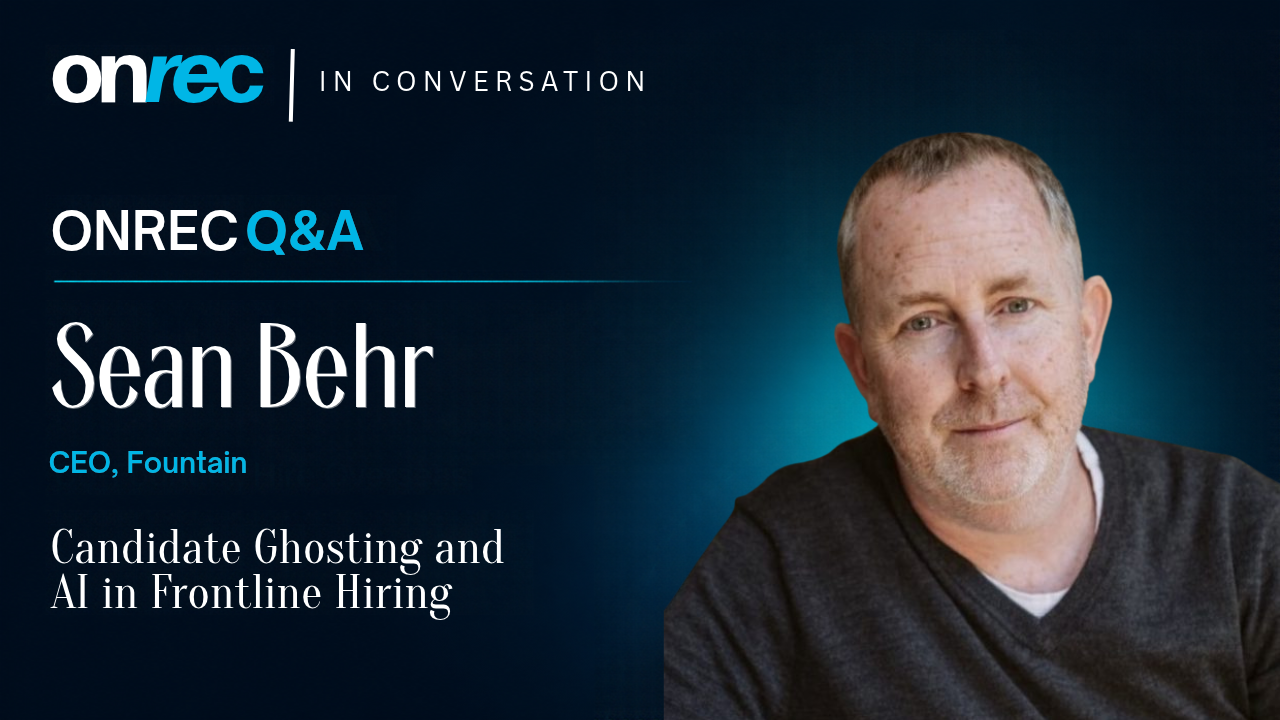
Fountain analysed 12.5 million frontline job applications. Onrec asked CEO Sean Behr what the findings reveal about the candidate experience and how employers should use AI in the first stages of hiring.
1. Your latest research analysed 12.5 million frontline job applications. What surprised you most about the findings, and what do they tell us about the state of frontline recruitment today?
The thing that surprised me most wasn't about AI. It was silence.
In 2025, about 881,000 applications in our data simply timed out. Nobody said yes. Nobody said no. Those are real people who did everything we asked and never heard back.
The second surprise was where the funnel breaks. Everyone assumes candidates give up halfway through the form. They don't. 78.5% finish it. The drop comes after, when three in four completed applications never get a conversation.
So the state of frontline recruitment is pretty simple. Candidates are doing their part. The system is where they get lost. And for a workforce where more than half couldn't cover a month without income, waiting isn't neutral. Workers aren't asking companies to slow down. They're asking not to be left in the dark.
2. Only 8% of applicants were hired, while just 19% reached an interview. Are employers making it too difficult for frontline candidates to get through the recruitment process, and where are the biggest problems occurring?
I don't think most employers are making it hard on purpose. I think they're making it slow.
The front door works. The problem is the gap between a finished application and a first conversation. That's a capacity problem. Frontline employers hire at enormous volume with small recruiting teams and store managers who have a shift to run. Applications go cold while someone fully intends to get to them.
It also looks different by industry. In food service, 53% of applicants get interviewed and 4.1% get hired. There's no licence to check and not much work history that tells you anything, so the interview is the screen. That's a sector filtering in person, on purpose. Healthcare is the opposite. It has the least interview contact, at 10.7%, because the bottleneck is verification. A background check takes as long as it takes, however fast you talk to someone.
There isn't one fix. Find where your own funnel stalls and start there.
3. Candidate ghosting has become a major frustration for jobseekers. Why are so many applicants still being left without a response, particularly when recruitment technology is supposed to make communication easier?
Because most of the technology made it easier to apply, not easier to respond.
A candidate can apply to ten jobs from their phone in one evening. The number of people who can read those applications and make a call hasn't grown anywhere near that fast. Volume went up. Response capacity didn't.
Nobody chose to ignore those people. They fell into the gap between the systems and the busy humans running them.
Timing makes it worse. The typical hire in our data happens in 10 to 11 days. But a quarter wait six weeks or more. Frontline candidates can't wait six weeks. Most can't wait one. To them, silence isn't a delay. It's a no. And often it's a no to someone the employer really wanted.
The good news is this is the most fixable problem in hiring. A fast no beats no answer at all.
“Time to fill is the wrong metric. It tells you how fast a seat got filled. It tells you nothing about the thousands of people you talked to along the way.”
Sean Behr, CEO, Fountain
4. Your research suggests AI's share of first interviews has increased from 2% to 14% in just a year. Is this a positive development for candidates, or are we at risk of removing too much human interaction from recruitment?
It depends where you use it. Used in the right place, it's very positive.
The shift is real. AI-led first interviews went from about 59,000 across the whole of 2025 to 293,000 in the first nine months of 2026. And completion went up, from 50% to 60%. That's the number I'd watch. If a candidate can do a first interview at 10pm after a shift, they're far more likely to do it at all.
One honest caveat. About two-thirds of that 2026 volume came from just two large employers. That's early movers, not a whole industry yet.
Workers are clear about where the line sits. Only about one in four object to an AI interview. But 64% wouldn't trust AI with their pay or promotion, and three quarters want a human reviewing their application. That's the model. AI gets people faster answers and a real chance to be heard. People stay accountable for the decisions that change someone's life.
5. There's a lot of discussion about AI making recruitment faster and more efficient. But how should employers measure whether it's actually improving the candidate experience rather than simply processing more applications?
Time to fill is the wrong metric. It tells you how fast a seat got filled. It tells you nothing about the thousands of people you talked to along the way.
Measure what the candidate feels. Three things.
How many applicants get a clear answer, and how fast. If the share of applications that time out isn't going down, nothing else matters.
Whether people finish. Completion tells you if the process got easier or just faster for you.
How long people wait at each step. An average hides the candidates stuck for weeks. Look at the slowest quarter, not the middle.
Then ask them. About 74% of the workers we surveyed said transparency shapes whether they trust the process. If you can't explain what happened to someone's application, you already have your answer.
6. For businesses recruiting large numbers of frontline workers, what practical changes could they make today to improve communication, reduce candidate drop-off and make the hiring process feel more personal?
Start with the silence. Every application should end with an answer, even if it's no. If one is going to sit, tell the candidate what happens next and when. That alone changes how people feel about you.
Fix the stage that stalls. For most frontline employers it isn't the form. It's the gap before the first conversation. Let candidates take that first interview when it suits them. People working shifts can't take a call at 2pm on a Tuesday.
Cut the wait. Look at your slowest hires and find what's holding them up. Usually it's scheduling, a background check, or a manager who hasn't had five minutes.
Be clear about who decides. Workers are open to technology handling the routine steps. Most want a person reviewing their application. Say plainly where each one sits.
Personal doesn't mean slow. It means people know where they stand.
7. Looking ahead to 2027, how do you see frontline recruitment evolving, and where do you believe human judgement and accountability must remain central as AI takes on more of the hiring process?
2025 was the year of the copilot. 2026 was the year of pilots. 2027 is when AI in hiring scales, and frontline hiring is where you'll see it first.
That doesn't mean fewer frontline jobs. AI is not making hamburgers. It's not delivering your packages. Demand for frontline workers is growing, especially in healthcare.
What changes is how those people get hired. Screening, scheduling, first conversations and follow-up will increasingly be handled by technology. Done well, that levels the playing field. Today a role can get thousands of applications and only a handful get a conversation. The rest never get to shoot their shot. When you can talk to every applicant, the person without the usual resume signals finally gets one.
But AI isn't hiring anybody in 2027. Who gets hired, what they're paid, whether they're promoted: those calls belong to a person. And employers will need to show a record of what their technology did and why. That's not a constraint on AI in hiring. It's what will let it scale.
Key takeaways for employers and recruiters
- Give every application a clear outcome.
- Track waiting times and completion at each stage.
- Keep people accountable for hiring decisions.