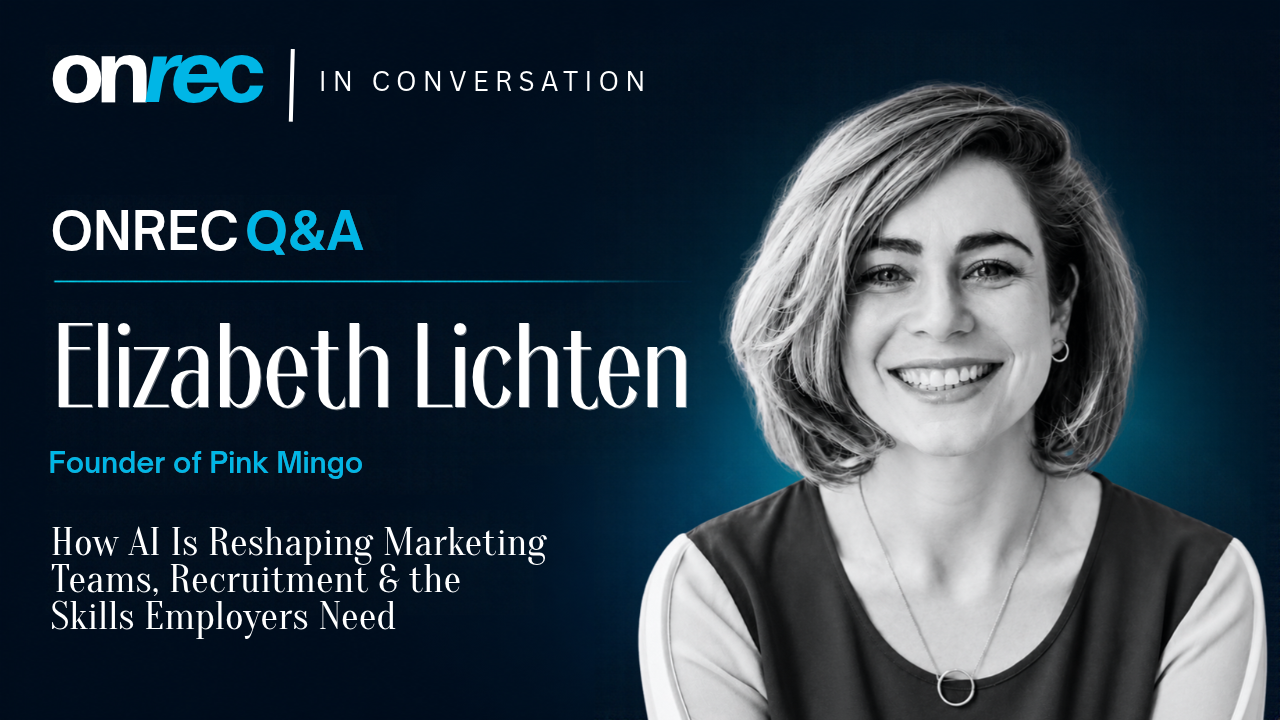
Q1 Your research suggests AI isn't necessarily going to make marketing teams smaller, but it will change the skills employers need. What do you think those changes will look like over the next few years?
I expect considerable changes in team composition, capabilities and responsibilities, with organisations needing to rethink how work is organised rather than simply assuming they'll need fewer people.
Marketing teams have traditionally been organised around specialist disciplines: strategy, content, design, digital, campaigns, operations and analytics, often supported by agencies and freelancers.
Generative AI can already undertake substantial elements of that work, while agentic AI is increasingly able to coordinate activities across systems and workflows.
Marketing has experienced successive waves of technological transformation, from desktop publishing and the internet to social media, marketing automation and digital advertising - each has fundamentally changed how marketers work, the skills required and the roles within teams, without necessarily reducing overall team sizes.
That's why I agree with the direction of our research. In the Future CMO study, 30 of 51 leaders anticipated similarly sized but more productive teams, while only nine selected smaller teams.
We're also some way from realising AI's full commercial value. McKinsey's 2026 research found that 80% reported individual productivity improvements, but only 37% reported a positive contribution to enterprise earnings.
Q2 Strategic thinking and commercial acumen came through strongly in the findings. How should employers and recruiters be assessing these skills when hiring?
When I've worked with internal talent teams on marketing recruitment strategy, I've helped define the capabilities required, develop assessment criteria and explore how candidates connect marketing decisions to commercial outcomes.
In B2C, particularly FMCG, marketers are often closely tied to sales, market share and commercial performance. In large, complex B2B organisations, that connection can be harder to demonstrate.
A mid-market sales cycle might take four months, an enterprise deal ten months, and in sectors such as construction, opportunities can take several years to convert. Marketing's contribution is therefore often indirect, shared with sales and difficult to attribute to a single campaign.
“Ask for examples of trade-offs, stakeholder influence and business impact.”
Elizabeth Lichten
In terms of assessment - I'd explore how candidates understand the buying journey, create demand, influence commercial decisions and measure progress over time. Ask for examples of trade-offs, stakeholder influence and business impact.
Marketing's purpose is to drive demand and growth. In complex B2B markets, that requires much more than generating short-term leads.
Q3 With so many businesses still experimenting with AI, what are the biggest mistakes organisations are making when deciding which roles and skills they need?
Our research found that 98% of marketing leaders use AI at least daily, yet 86% describe their organisations as still experimenting.
A major mistake is updating individual job descriptions or making headcount decisions before understanding how AI could change the function as a whole.
When I work with clients on this, we start by agreeing the purpose of the marketing team: what it needs to achieve for the business and where it should create commercial value.
We then map the work required to deliver that purpose, assess existing capabilities and examine the AI tools already available within the organisation. We look at how employees are currently using AI, identify relevant market offerings and consider where technology could improve or automate workflows.
That gives us a basis for reconsidering responsibilities, skills, processes and team structures.
Crucially, we also consider where productivity gains will go. Will the business reduce costs, increase output, improve quality or redirect capacity towards more valuable work? These decisions should shape the future operating model and recruitment strategy.
Q4 Two-thirds of respondents are concerned that AI could erode critical thinking. How can employers encourage AI adoption without losing the human judgement their teams rely on?
I'm a strong believer in intentional adoption. Just providing the tools and a bit of training isn't enough. I've helped clients audit marketing workflows, identify appropriate AI use cases and establish where human judgement must remain central.
I advocate the 20/60/20 rule as a rough guide: the first 20% is human thinking to establish objectives, context and evidence; the middle 60% uses AI to accelerate development and execution; and the final 20% is human judgement to challenge assumptions, verify outputs and improve quality.
Employers should be clear about where AI is encouraged, where it should be restricted and which decisions require human ownership. This is the intentionality I'm talking about. Even organisations that are relatively mature in their AI adoption aren't necessarily providing this clarity to their teams.
They also need to decide how the time saved will be reinvested. AI should create opportunities for deeper customer understanding, more original creative thinking, stronger relationships and better strategic decisions.
The ambition should be to elevate standards and accelerate processes, with people spending more time on work where their expertise makes the greatest difference.
“AI should create opportunities for deeper customer understanding, more original creative thinking, stronger relationships and better strategic decisions.”
Elizabeth Lichten
Q5 If AI takes over more routine tasks, how can businesses make sure junior employees still get the experience and development opportunities they need?
Junior employees have traditionally developed judgement through research, drafting, analysis, repeated practice and learning from more experienced colleagues. Greater remote working has already made some of that informal learning and observation more difficult, and AI has the potential to further damage those foundational skills.
So, it's important to create opportunities for juniors to participate in strategy discussions, customer conversations, creative development and decision-making earlier, supported by mentoring, feedback and exposure to senior colleagues.
There's also what I call the human premium. As AI makes content and routine production increasingly easy, genuine creativity, empathy, original thinking, personal relationships and human experiences can create greater value for brands. Customers and clients crave authentic connections, distinctive ideas and experiences that feel personal.
Employers should celebrate and develop these qualities, both because they strengthen the brand and because they ensure human judgement and critical thinking remain valued and rewarded.
AI literacy is equally important. Training should cover effective briefing, fact-checking, recognising weak evidence, challenging outputs and understanding limitations. Junior employees still need opportunities to think and practise independently.
Q6 Are there particular marketing roles or specialist skills you expect to become harder to recruit over the next three to five years?
Knowing the customer remains the single most important quality in a marketing leader. In our research, 71% selected customer insight, data and analytics as their preferred investment area when given a hypothetical additional £1 million.
I expect growing demand for marketers who combine that understanding with commercial judgement, strategic thinking and AI capability.
We're also seeing new specialisms emerge, including generative engine optimisation (GEO), AI marketing operations, agent development and orchestration, AI governance, and specialists who can integrate AI into customer journeys and marketing workflows.
Traditional recruitment hierarchies may become less useful when assessing these capabilities. Whether you're recruiting an early-career marketer or a CMO, both will have had approximately two years' experience with the current generation of AI tools. A CMO might have 20 years' marketing experience, but that doesn't automatically translate into greater AI expertise.
Employers will increasingly need to assess demonstrated capability, adaptability and learning agility alongside conventional experience.
Q7 Finally, what practical advice would you give HR and recruitment professionals who are helping businesses prepare their teams for an AI-enabled future?
I'd encourage recruiters and HR teams to challenge briefs that simply replace an existing marketing role or add AI skills to a familiar job description.
Marketing leaders need to consider the future operating model before deciding which positions to recruit. HR can support that process by partnering with the marketing leadership team or bringing in specialists who understand marketing strategy, organisational design and AI.
In my work, that can include reviewing capabilities, developing role profiles and assessment criteria, supporting internal talent teams with interviews and helping define the recruitment plan.
It's also important to recognise that this will be a transition. Despite widespread AI adoption, McKinsey's 2026 research found that only 37% of respondents reported a positive contribution to enterprise earnings.
I'd caution against premature headcount reductions based on anticipated savings. A phased plan allows businesses to test redesigned workflows, develop existing employees, recruit emerging capabilities and reshape teams as the commercial benefits become clearer.