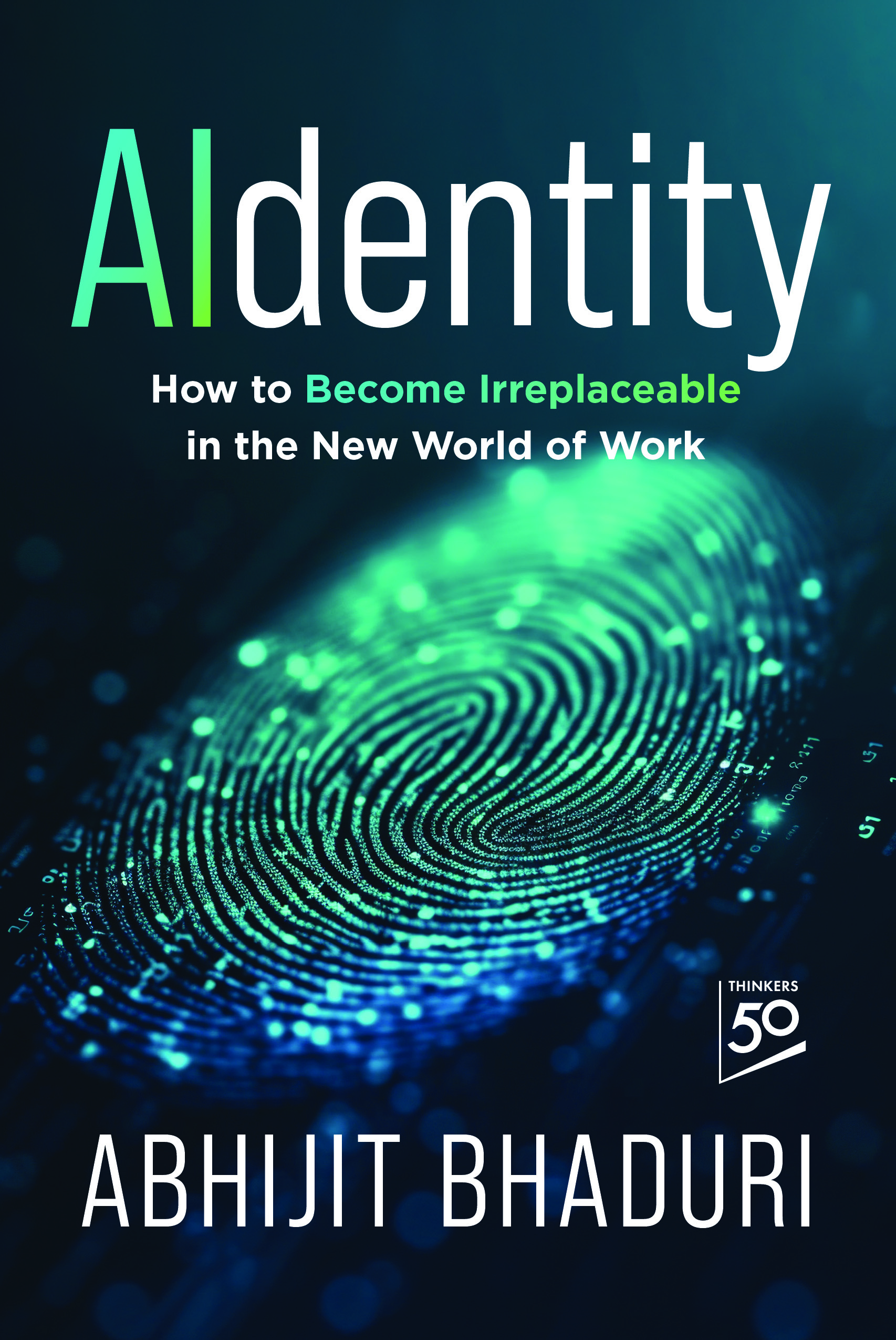
In AIdentity: How to Become Irreplaceable in the New World of Work, author Abhijit Bhaduri argues that organisations need to think beyond skills as AI reshapes work. In this Onrec Q&A, he explains why identity, judgment and human agency should sit at the centre of that change.
In AIdentity, you argue that AI is creating an identity crisis rather than simply a skills crisis. What do you mean by that, and why should HR leaders and recruiters be paying attention?
Skills tell you what someone can do. Identity tells you who they are while doing it. For a century, a job title from the employer answered that second question for us. Now AI does many of the tasks that once proved our expertise.
Our work identity is not defined by the job title or money that we earn. It is designed around five pillars: meaning, belonging, expertise, predictability, and status. Research by David Rock suggests that a threat to status sets off some of the same alarm systems as physical danger. When that alarm rings, clear thinking goes offline.
“HR should pay attention because people feel threatened, they stop learning and innovating. They do what is barely needed to not get fired.”
Abhijit Bhaduri, author of AIdentity
Upskilling and reskilling have become the default response to AI disruption. Why do you believe these approaches are no longer enough, and what should employers be doing differently?
Upskilling assumes the gap is knowledge. Often the gap is identity. You can’t outskill a machine that learns faster than you do. When a skill goes out of date before you finish mastering it, reskilling becomes a treadmill. You keep running, but the floor moves faster. And people learn badly when every new course feels like an audition. What employers can do
- Start with “who,” then “what.” Ask each team to sort its work into two columns: “What AI now handles” and “What only we can do.” Train people for the second column.
- Count what people build, not courses completed. Enrollment feels like progress. A shipped project is progress.
Recruitment has traditionally relied heavily on qualifications, experience and technical skills to assess candidates. As AI makes many of these capabilities easier to replicate, do you think employers need to fundamentally rethink what makes someone a strong hire?
Start by listening to how candidates introduce themselves. “I’m a VP of Marketing” names a title someone else assigned. “I help B2B businesses tell their story”, names the value they create for others.
A clear work identity gives people agency. When the situation is ambiguous, they don’t wait for instructions. They do what is necessary, go beyond the job description, and own the outcome. They draw meaning from the work and enjoy bringing their expertise and relationships to it. Over time, this creates a unique signature in their work output. AI can replicate skills and do what an average person can do. It cannot replicate the unique way you do the work. This is job crafting - but done by the role holder.
You describe how employees can experience a loss of professional identity even while remaining in their jobs. How can HR teams recognise when this is happening, and what practical steps can they take to support people through that transition?
Denise, a systems engineer with thirty years of experience told me that the finance team looks at her as an expensive (not experienced) employee. She no longer feels valued and wonders how long she will have the job. She has financial commitments; she must keep showing up at work with an identity that no longer works the way it used to.
Family therapist Pauline Boss calls this ambiguous loss: a goodbye without leaving. The title remains and the pay continues, but the part of the job that made someone feel skilled has quietly gone.
Watch for the signals. A strong performer goes silent in meetings, collects certificates they never use, turns cynical about “efficiency,” or does just enough to get by. These look like disengagement but is grief waiting to be named.
You can’t grieve what hasn’t officially died, so start by naming it. In a team meeting, ask each person to share one thing they built or solved before AI that they are proud of. Keep the list visible. When people see their past expertise honored, they are more willing to build the next one.
Having led global learning and development at Microsoft during the rise of generative AI, what did that experience teach you about how organisations successfully introduce AI without leaving their people behind?
People rarely resist the tool or technology. They resist feeling diminished by it. Adoption moves faster when people feel safe looking clumsy. Label early AI-assisted work as a draft or better still, “play version”.
“Treat AI as a transition people cross, not software they install.”
Abhijit Bhaduri, author of AIdentity
Pair early adopters with respected veterans so each teaches the other. Reward people who combine AI fluency with deep domain judgment. Treat AI as a transition people cross, not software they install.
There’s growing concern that AI could remove many of the entry-level tasks that traditionally help people develop their careers. How can employers and recruiters ensure the next generation still has opportunities to gain experience, develop judgment and progress?
The real disruption isn’t the jobs lost. It’s the jobs that never get created because AI filled the gap before a human got the chance. Entry-level work was where people sharpened their judgment, by getting things wrong in low impact areas.
Hire on visible work instead of years of experience. Ask them to show what they have built and put in the public domain. The portfolio matters more than years of work experience. Make juniors responsible for checking and improving AI output.
Questioning a machine’s answer is how judgment gets built now.
Finally, if you could give HR leaders and recruitment professionals three practical things they should be doing now to prepare their organisations and workforces for the next five years of AI-driven change, what would they be?
Treat AI adoption as an identity transition, not a training program alone. If leaders treat AI adoption as a training problem, they will get compliance. If they treat it as an identity transition, they will get transformation. Mark the change openly: what is ending, what stays, and who people can become next.
Redesign what earns status. Create a quarterly recognition for the person or pair who best combines AI fluency with seasoned judgment.
Rebuild the talent pipeline around judgment. Hire on visible work, protect entry-level learning, and track how much senior time goes to doing work only humans can do. Aim to grow that share every quarter.
About AIdentity
AIdentity: How to Become Irreplaceable in the New World of Work is written by Abhijit Bhaduri.