
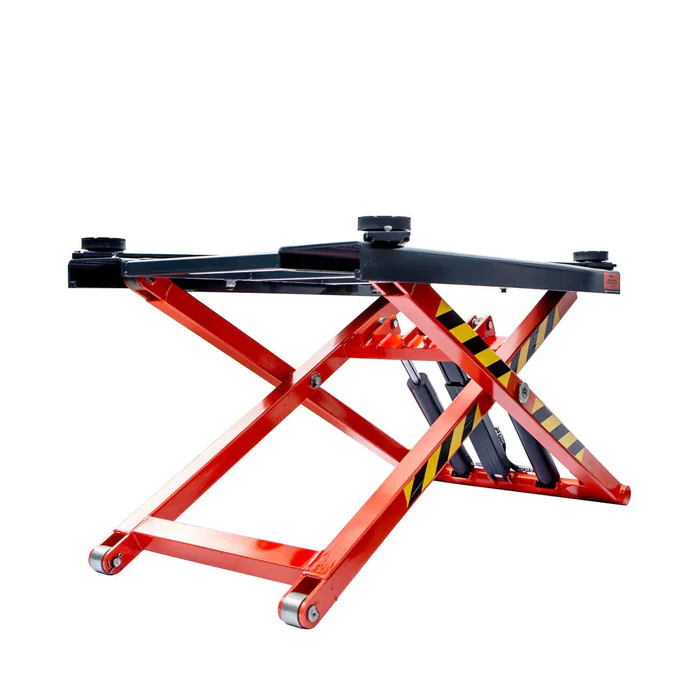
In the United States, vehicle service work is closely tied to efficiency, labour availability, and safe use of workshop space. Warehouses, fleet yards, service departments, and industrial maintenance sites often need practical lifting equipment that can support repair work without requiring a full-size fixed lift system. A Mid-Rise Portable Automotive Scissor Lift is useful in this setting because it offers a compact way to raise vehicles for inspections, brake work, tire service, fluid changes, and light repair tasks while preserving flexibility in how the workspace is arranged.
A product such as the Mid-Rise Portable Automotive Scissor Lift shows why this category matters in daily operations. In this class, a lift with a 6000 pound capacity, 48 inch lift height, dual hydraulic cylinders, and a portable 120 volt power unit can support a wide range of shop tasks while remaining easier to position and store than larger permanent systems.
Why This Equipment Matters in the United States
Across the United States, workshops face pressure to complete more service work with limited floor space and tighter scheduling. Many sites do not need a full-height two-post lift for every task. Instead, they need equipment that supports quick access to the lower half of the vehicle while fitting into smaller service bays. That makes a portable mid-rise scissor lift especially relevant for independent shops, fleet maintenance teams, training environments, and mixed-use industrial service areas.
Common Methods and Use Cases
Fast Access for Routine Vehicle Service
One of the most common uses is routine maintenance. Raising a vehicle to mid height gives technicians better access to wheels, brakes, suspension components, and underbody service points. This can improve working posture and reduce the need to rely on floor jacks and stands for repeated daily tasks.
Flexible Support in Compact Service Bays
Portable scissor lifts are also useful in shops that need flexible layout planning. Because the lift can be moved and stored more easily than a fixed installation, operators can adapt floor space for detailing, repair preparation, or seasonal workflow changes.
Why Efficiency, Safety, and Productivity Matter
Vehicle lifting is not only about getting a car off the ground. It directly affects repair speed, technician fatigue, and workshop safety. When teams rely on slower or less stable lifting methods, work takes longer and setup time increases. A mid-rise scissor lift can improve productivity by creating a more repeatable lifting process for common service jobs.
· Faster setup for light and medium vehicle service
· Better access to lower vehicle components
· Reduced manual strain during inspections and repairs
· More efficient use of compact workshop space
Technical Basics and Capability Considerations
Buyers should review lift capacity, maximum height, minimum collapsed height, platform dimensions, power requirements, and safety lock design. In this equipment class, a 6000 pound capacity and 48 inch maximum height are suitable for many passenger vehicles, sport utility vehicles, and light-duty trucks. A flat, low-profile design can also be important because it affects vehicle approach and storage. Dual hydraulic cylinders and a safety lock bar matter because stable lifting and secure holding are central to safe operation.
Factors That Affect Performance and Effectiveness
Real-world performance depends on correct vehicle positioning, floor level, power unit condition, hydraulic pressure, and operator technique, especially when using TMG Industrial systems. Even a lift with suitable capacity can perform poorly if the load is not balanced correctly or if adapters are not used where needed. Maintenance discipline also matters. Hydraulic wear, damaged hoses, and neglected locking systems can reduce reliability over time.
Safety Considerations and Best Practices
· Confirm vehicle weight and lifting point compatibility before use
· Place the lift on a clean, level, and stable floor
· Inspect cylinders, hoses, locks, and pads before each shift
· Use the safety lock system before working under the vehicle
· Keep bystanders clear during lifting and lowering
Operators should also follow shop procedures for adapter placement, wheel chocking when required, and controlled lowering. Safe lifting depends as much on routine checks as on rated specifications.
Equipment, Accessories, Advantages, and Limits
Common related items include lift adapters, wheel chocks, creepers, tool carts, hydraulic fluid, service trays, and inspection lights. The main advantages are portability, moderate lift height, compact storage, and support for frequent service work. The main limits are that a mid-rise lift does not provide the same full-body access as a higher fixed lift and still requires careful positioning for different vehicle types.
A realistic example is a United States fleet maintenance team servicing light trucks and company vehicles in a smaller workshop with limited bay space. A portable mid-rise lift allows the team to perform brake inspections, tire work, and underbody checks more efficiently while keeping the service area adaptable for other tasks.
Conclusion
A Mid-Rise Portable Automotive Scissor Lift remains a practical tool for operations that need safe vehicle access, efficient workflow, and better use of limited floor space. Its value comes from stable lifting, portability, and suitability for many common repair tasks. Looking ahead, United States workshops are likely to continue favouring equipment that combines safety, flexibility, and efficient use of labour, especially in service environments where adaptability matters as much as lifting power.











