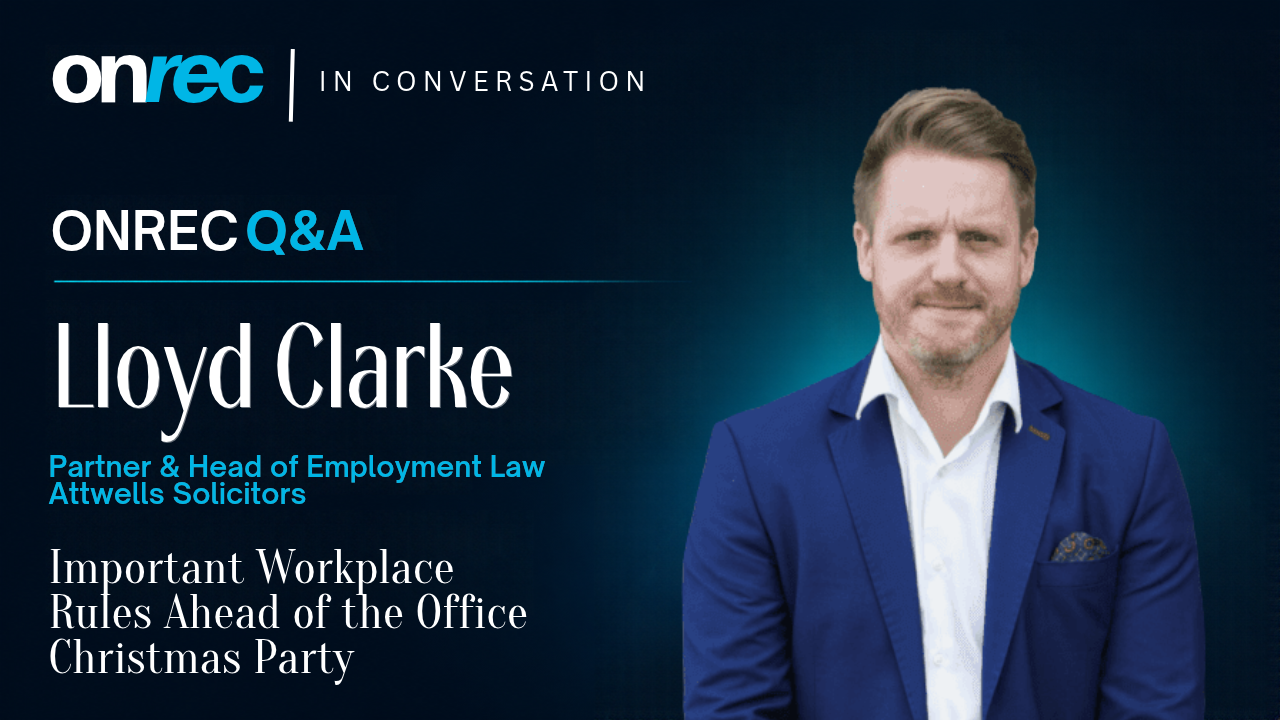
With Christmas parties approaching, employers are being reminded that workplace responsibilities do not end when staff leave the office. Attwells Solicitors Partner and Head of Employment Law Lloyd Clarke explains how HR teams can prepare for work-related social events and respond if something goes wrong.
Clarke says the strengthened duty to prevent sexual harassment means employers must take a proactive, event-specific approach rather than relying on a policy sitting on the intranet.
“Employers should treat the Christmas party as an extension of the workplace for HR and risk-management purposes, rather than regarding it as a completely separate social occasion.”
Lloyd Clarke, Partner and Head of Employment Law, Attwells Solicitors
What are the biggest misconceptions about employers' legal responsibilities at work-related social events?
The biggest misconception is that once employees leave the office, the employer's responsibility ends. It doesn't necessarily. A Christmas party organised or sponsored by the employer is closely connected with employment, even where it takes place in the evening, away from the workplace and outside normal working hours.
Depending on the circumstances, employers can potentially be liable for discriminatory or harassing conduct by employees at work-related social events. Even an informal gathering afterwards can potentially retain a connection with employment, although that will always depend on the particular facts.
Another misconception is that telling staff to “behave responsibly” is enough. The law has moved increasingly towards prevention. Since 30 October, employers now need to think proactively about foreseeable risks and take all reasonable steps to prevent sexual harassment.
Alcohol, power imbalances, junior members of staff, late-night travel and interaction with clients or other third parties are all obvious factors to consider. In short, employers should treat the Christmas party as an extension of the workplace for HR and risk-management purposes.
What practical steps should HR teams take before organising Christmas parties and other work events?
From 30 October 2026, the duty was strengthened so employers must take “all reasonable steps”, rather than simply “reasonable steps”, to prevent sexual harassment of employees. Employers should not simply rely on having an anti-harassment policy sitting on the intranet.
Before an event, sensible HR teams should:
- Carry out and document an event-specific risk assessment;
- Remind employees clearly that normal standards of conduct apply at work functions; and
- Make clear that sexual harassment, discriminatory behaviour and inappropriate “banter” will not be tolerated.
Acas specifically identifies alcohol, work-related social events, power imbalances and work travel, including overnight stays, as potential higher-risk factors which employers should consider. The key is being able to demonstrate afterwards not simply that the business had a policy, but that it identified the particular risks and did something meaningful about them.
How should employers respond when inappropriate behaviour involves a customer, client or another third party?
Since 30 October 2026, employers must not permit employees to be harassed in the course of their employment by third parties. A third party could include a customer, client, supplier, contractor or member of the public. The legislation provides that the employer will be treated as permitting that harassment where it has failed to take all reasonable steps to prevent it.
Importantly, this protection is broader than sexual harassment. The new third-party provisions extend to other forms of harassment covered by the Equality Act 2010, subject to the statutory exceptions.
For HR teams, that means asking in advance: who will our staff be interacting with, what could realistically go wrong and what safeguards can we put in place? If a particular client, customer or other individual has behaved inappropriately previously, the employer should not simply send the employee back into the same situation and hope it does not happen again. Commercial importance is not an excuse for allowing staff to be harassed.
What can employers do to reduce alcohol-related risks without taking away from the celebrations?
Nobody is suggesting that employers need to turn the Christmas party into a dry compliance seminar; it is about sensible risk management.
Employers might limit the number of free alcoholic drinks rather than providing an unlimited bar, make good-quality alcohol-free alternatives readily available, provide food and water, avoid drinking games or promotions encouraging excessive consumption, and ensure someone responsible remains sufficiently sober to deal with an incident.
Employers should also think about transport home, particularly where an event finishes late. Alcohol does not excuse inappropriate conduct. Equally, if an employer supplies unlimited alcohol and positively encourages excessive drinking, it potentially makes foreseeable problems more difficult to defend afterwards.
You can have a very enjoyable Christmas party without creating an environment in which sensible boundaries disappear.
What should an employer do immediately if an allegation is made during a work event?
The first priority should be safety and welfare, not deciding there and then whether somebody is guilty. Separate the individuals if necessary, identify potential witnesses and preserve evidence such as messages, photographs or CCTV where appropriate.
Then deal with the allegation promptly through the organisation's grievance, harassment and disciplinary procedures. The investigation needs to be fair, impartial and evidence-based. Employers should avoid prejudging either party, promising absolute confidentiality, conducting an impromptu disciplinary hearing at the party, or dismissing something as “drunken banter”.
Equally, an allegation is not automatically proof of misconduct. The accused employee must have a proper opportunity to respond. The employer should also consider interim measures where necessary, but suspension should not simply be an automatic reaction.
Finally, HR should look beyond the individual complaint. If the incident exposes a weakness in the employer's risk assessment, training or controls, those measures should be reviewed. The preventative duty is an ongoing obligation.
How can businesses make Christmas parties inclusive?
Not everybody's idea of celebrating Christmas involves alcohol or a late-night party. Attendance should be genuinely voluntary. Employees should not feel disadvantaged because they do not drink, have caring responsibilities, cannot attend because of a disability, or have religious or personal reasons for not participating.
Businesses should consider:
- A genuinely good range of non-alcoholic drinks;
- Dietary requirements, allergies and religious requirements;
- Wheelchair access and other reasonable adjustments; and
- Noise, lighting and sensory requirements.
What are your three most important pieces of advice for HR professionals?
First: assess the risks rather than simply dusting off last year's policy.
Second: communicate expectations before the party.
Third: remember that prevention is now the focus.
About Lloyd Clarke
Lloyd Clarke is a Partner and Head of Employment Law at Attwells Solicitors, leading the firm’s Legal 500-ranked Employment Law Department. He advises employers, employees and businesses on a wide range of workplace matters, including unfair dismissal, discrimination, settlement agreements and employment contracts. Lloyd also specialises in the care, estate agency and insurance sectors. Alongside his legal work, he is Head of Client Care, overseeing service standards and key client relationships.