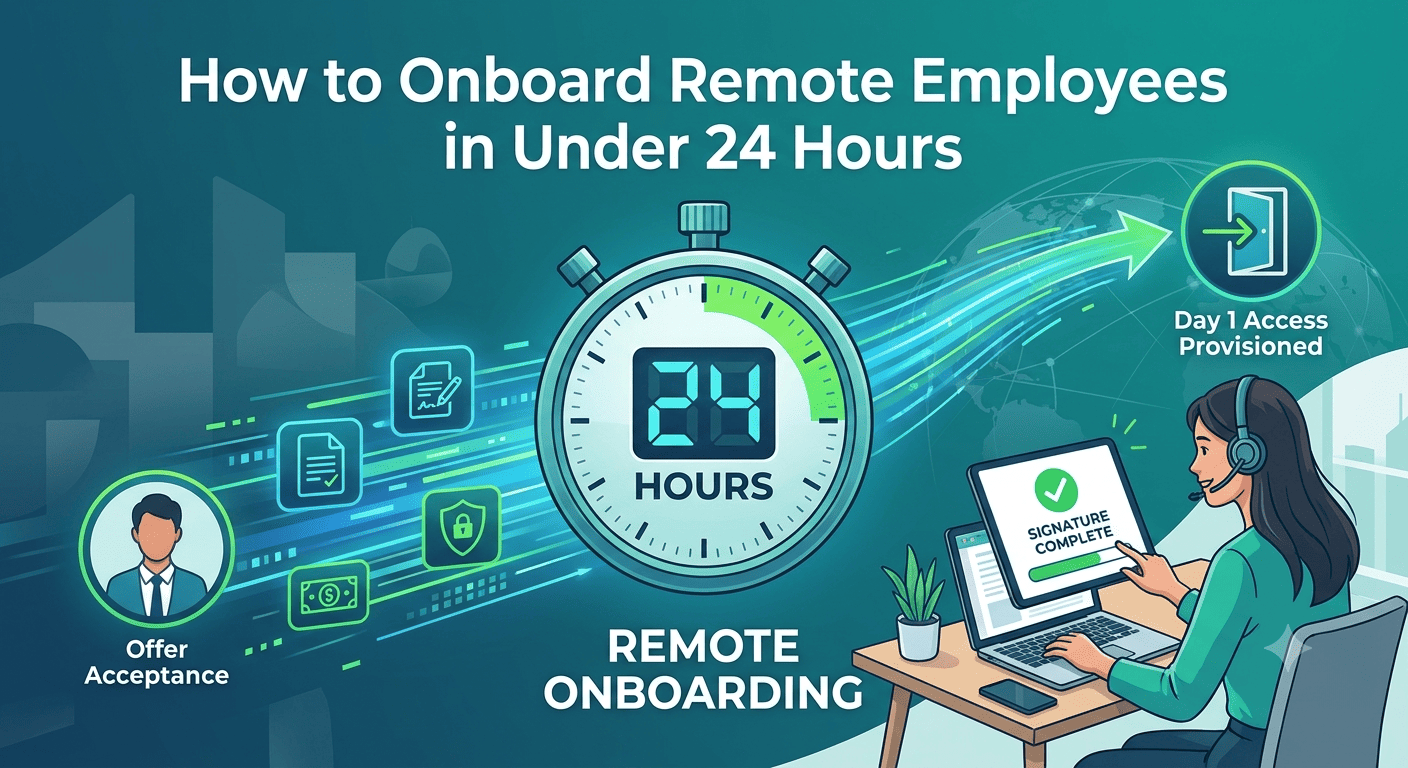
In a remote-first job market, candidate expectations have fundamentally shifted. Top talent expects speed, clarity, and seamless digital interaction from their very first engagement with a company. However, traditional employee onboarding processes remain plagued by administrative friction—relying on static PDF attachments, manual printing, signature scanning, and fragmented email exchanges.
Extended onboarding timelines not only drain HR resources but also create a dangerous window between offer acceptance and Day 1 where candidate drop-off and ghosting peak. To secure top candidates and build an agile distributed workforce, HR leaders must modernize their intake pipelines. By leveraging automated digital workflows, organizations can compress pre-boarding timelines from days down to under 24 hours.
1. The Cost of Slow Onboarding in Remote Recruitment
When a candidate accepts a remote job offer, momentum is at its highest. Requiring new hires to download, print, sign, scan, and email back multi-page W-4s, non-disclosure agreements (NDAs), and direct deposit forms immediately erodes that enthusiasm.
Key Impact of Manual Onboarding Bottlenecks:
-
Increased Candidate Drop-off: Protracted administrative delays leave candidates susceptible to competing counteroffers or second thoughts before their official start date.
-
Administrative Overload: HR teams waste valuable hours manually verifying incomplete paperwork, following up on missing signatures, and manually re-keying data into HRIS systems.
-
Damaged Employer Branding: Clunky, paper-heavy onboarding creates a negative first impression, signaling to remote hires that the company lacks modern operational efficiency.
2. Replacing Static PDFs with Mobile E-Signatures
The fastest way to eliminate onboarding friction is replacing static email attachments with automated, web-based signature links. Remote candidates frequently access their emails on mobile devices, making mobile-first document execution essential for rapid turnaround times.
Deploying automated e-signature solutions enables HR teams to convert offer letters, tax disclosures, and employee handbooks into responsive, fillable digital forms. Candidates can sign legally binding agreements in seconds from any smartphone, tablet, or laptop, automatically triggering the next phase of the onboarding workflow without manual intervention.
|
Onboarding Stage |
Traditional Manual Workflow |
Automated 24-Hour Digital Pipeline
|
|---|---|---|
|
Offer Letter Execution |
Email attachment → Print → Sign → Scan (24–48 hours) |
Instant mobile e-signature link (< 15 minutes) |
|
Compliance & Tax Forms |
Manual PDF entry & physical filing (1–3 days) |
Automated web forms & digital data mapping (< 2 hours) |
|
Identity Verification |
Photocopied IDs sent via unencrypted email |
Encrypted document upload portal (< 1 hour) |
|
IT Provisioning |
Manual notification after paperwork check (Day 1+) |
Automated webhook triggering IT setup (Same day) |
3. Structuring a 24-Hour Digital Pre-Boarding Roadmap
Achieving a 24-hour turnaround requires a structured, milestone-driven execution plan that guides the candidate smoothly from offer acceptance to complete Day-1 readiness.
The 24-Hour Onboarding Timeline:
-
Hours 0–2 (Offer & Core Agreements): Dispatch the official offer letter and mutual NDA via automated SMS or email e-signature link. The system provides real-time tracking so HR can see when the document is viewed and signed.
-
Hours 2–12 (Compliance & Personal Data Collection): Automatically trigger the secondary intake portal containing W-4/W-9 forms, direct deposit authorizations, emergency contacts, and benefit selections.
-
Hours 12–24 (IT & Welcome Activation): Upon form completion, automated webhooks signal IT to provision company email accounts, software licenses, and hardware shipments, while delivering a digital welcome kit and schedule to the candidate.
4. Ensuring Compliance and Data Security in Remote Intake
Accelerating onboarding speed must not come at the expense of data privacy. Remote HR teams regularly collect sensitive Personally Identifiable Information (PII), including Social Security numbers, banking details, and government identification copies.
To satisfy regulatory frameworks (such as GDPR, CCPA, and employment law standards), all candidate data must be protected using 256-bit AES encryption both in transit and at rest. Furthermore, when coordinating with external verification partners or handling offsite record dispatches, evaluating the free online fax platforms offers remote HR teams a secure, cost-effective way to send encrypted documents without exposing sensitive files to email risks.
Focusing on onboarding compliance essentials ensures that digitized record-keeping meets strict legal benchmarks.
5. Measuring the ROI of Accelerated Remote Onboarding
Modernizing onboarding produces measurable operational dividends across the entire talent acquisition ecosystem.
Key Metrics to Track:
-
Time-to-Complete Intake: Measure the hours elapsed from sending the offer letter to receiving fully executed onboarding packages.
-
Offer Acceptance-to-Start Rate: Monitor candidate retention during the pre-boarding window to verify the elimination of drop-offs.
-
HR Cost Per Hire: Calculate administrative time saved by eliminating manual data entry, follow-up calls, and physical paper archiving.
Frequently Asked Questions (FAQs)
Are e-signatures legally binding for remote international hires?
Yes. Electronic signatures executed through compliant platforms are legally binding across major jurisdictions under laws such as the US ESIGN Act, UETA, and EU eIDAS regulations.
How can HR teams safely collect sensitive direct deposit details online?
Always use encrypted digital intake portals featuring 256-bit AES encryption and strict access controls. Avoid requesting banking details or Social Security numbers via standard email attachments.
What happens if a candidate delays completing their paperwork?
Automated onboarding platforms send gentle SMS or email reminders at set intervals (e.g., 6 hours, 12 hours), keeping the candidate on track without requiring manual HR intervention.
Accelerate Your Remote Onboarding Today
In today's fast-moving hiring landscape, your onboarding workflow is a direct extension of your brand. By replacing slow, paper-heavy tasks with instant mobile e-signatures and automated digital pre-boarding pipelines, your organization can secure top remote talent instantly, reduce administrative overhead, and set new hires up for immediate success on Day 1.
Special thanks to Imran Ishaq for contributing in this article.
Imran Ishaq is a freelance writer and SEO professional specializing in digital marketing, search engine optimization, and link building. He has experience creating informative, engaging, and SEO-friendly content for businesses, agencies, and online publications. He is passionate about exploring the latest trends in digital marketing and helping brands strengthen their online presence through quality content and effective SEO strategies. You can connect with him on LinkedIn.