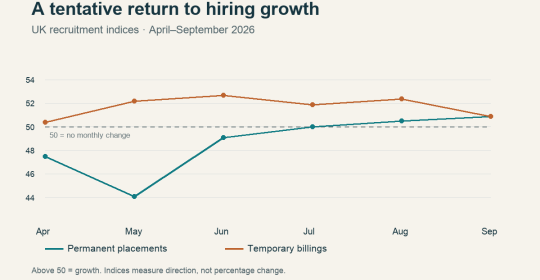
Permanent placements increased in August for the first time since September 2022, while temporary billings recorded their fifth consecutive month of growth, according to QUBA Solutions’ September recruitment market snapshot.
Published by QUBA on 14 September 2026, the snapshot brings together the KPMG and REC UK Report on Jobs, S&P Global UK Services PMI, S&P Global UK Construction PMI and J.P. Morgan Global Manufacturing PMI. It points to improving confidence, although falling vacancies, high candidate availability and weak construction activity show that the recovery remains uneven.
Market snapshot: five key numbers
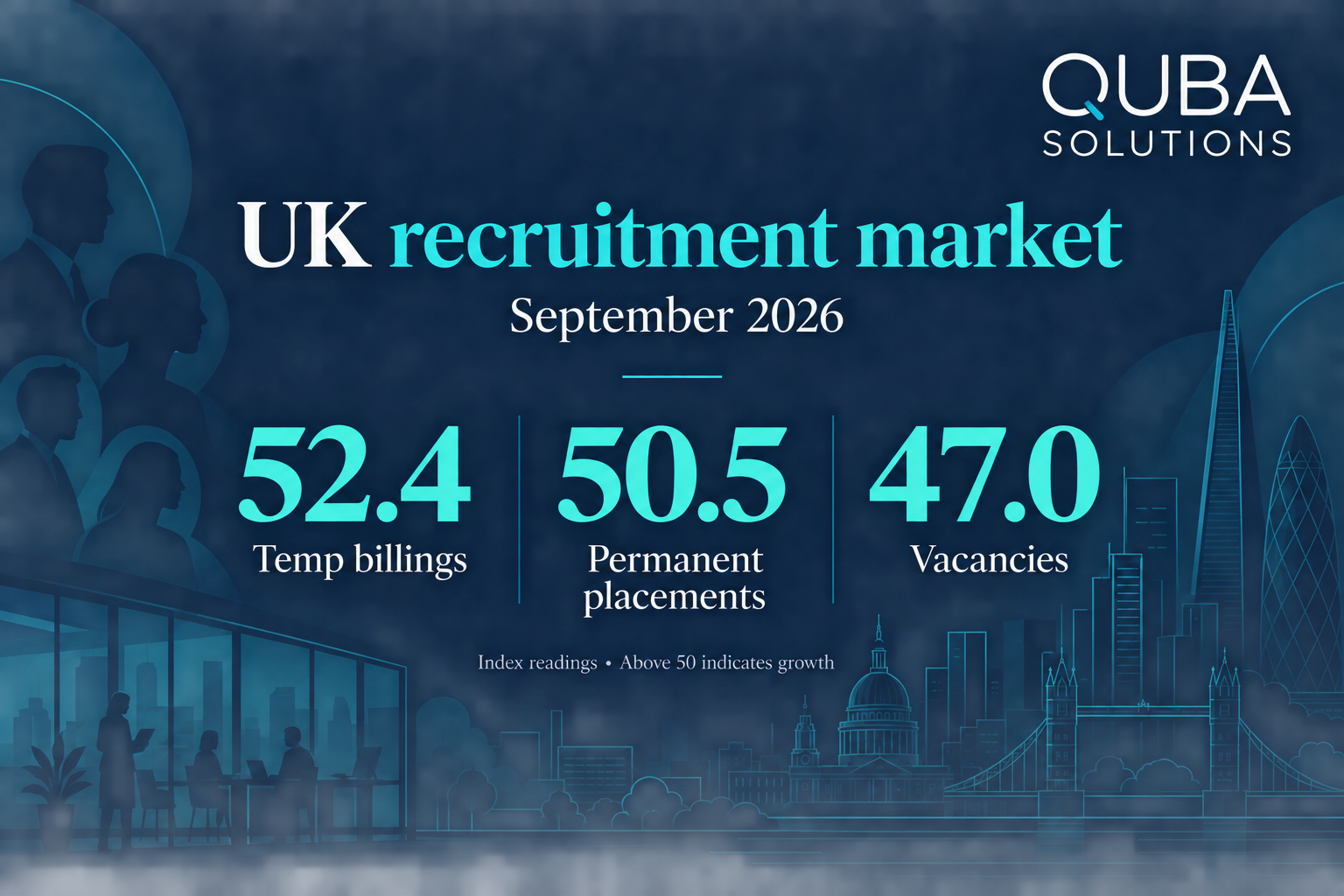
- 52.4 — Temporary Billings Index: a fifth consecutive month of growth, and the second-fastest increase since April 2023.
- 50.5 — Permanent Placements Index: the first increase in permanent placements since September 2022.
- 47.0 — Total Vacancies Index: overall demand for staff continues to decline.
- 52.5 — UK Services PMI: services activity expanded in August, with new work increasing for a second month.
- 44.3 — UK Construction PMI: construction remained in contraction, although reductions in new orders and employment eased.
These are index readings, not percentage changes. Readings above 50 indicate growth; readings below 50 indicate contraction. The September snapshot reports August activity.
Permanent recruitment moves into growth
After permanent placements stabilised in July following a 45-month downturn, August brought a marginal increase. The Permanent Placements Index reached 50.5, marking a significant change in direction after nearly four years without growth.
Recruiters linked the improvement to businesses expanding capacity, new contract wins and greater market confidence. Some clients, however, continued to delay recruitment amid uncertainty about the economy and future government policy.
There were important regional differences: permanent placements increased in London and the Midlands, while the South and North of England continued to report declines.
Temporary recruitment maintains momentum
Temporary billings grew for a fifth successive month, accelerating from July. At 52.4, the index recorded its second-fastest growth rate since April 2023, behind only June 2026. Increased contract work and employers’ preference for temporary staff supported the rise.
Three of the four English regions monitored reported higher temporary billings, led by the North of England. The Midlands was the only region to record a decline.
Temporary vacancies increased in four of the ten sectors monitored, with Blue Collar and IT & Computing leading growth. Hotel & Catering and Retail recorded the sharpest falls.
QUBA’s analysis suggests that temporary recruitment is increasingly complementing an improving permanent market. For permanent-led agencies considering temporary or contract recruitment, the opportunity may be to offer clients both, rather than replace one model with another.
Vacancies are still falling and candidates remain plentiful
Overall vacancies fell again in August, extending a decline lasting almost three years. Permanent vacancies increased in only two of the ten sectors monitored — Engineering and Accounting & Financial. Retail and Hotel & Catering experienced the sharpest reductions.
Candidate availability continued to rise markedly, reflecting redundancies, reduced hiring opportunities and people seeking new roles. Yet plentiful candidates overall do not remove shortages of particular skills and experience.
Permanent starting salary growth reached its strongest level since January, while temporary wages also increased. QUBA sees an opportunity for consultants to add value by advising clients on candidate availability, salary expectations and remaining skills shortages.
Services strengthen while construction remains under pressure
Services
The S&P Global UK Services PMI Business Activity Index increased to 52.5 in August. Improved business and consumer spending helped service-sector output expand at its fastest rate since April, while new work rose for a second consecutive month and business confidence improved.
Stronger activity had not yet translated into broad employment growth. High costs encouraged tighter recruitment policies and service businesses continued to reduce headcount, although job losses slowed to their weakest pace since October 2025.
If workloads and sales pipelines continue to improve while employers remain reluctant to add permanent costs, flexible staffing could continue to play an important role.
Construction
The S&P Global UK Construction PMI slipped from 44.7 in July to 44.3 in August. Residential construction was particularly weak, while commercial activity remained closer to stabilisation. New orders and employment continued to decline, but at slower rates.
Subcontractor usage returned to growth, reaching 51.7 after 47.3 in July. QUBA suggests this may indicate a greater willingness to use flexible resources while overall conditions remain difficult.
Global manufacturing adds to the cautiously positive picture
The J.P. Morgan Global Manufacturing PMI rose from 52.1 to a three-month high of 52.3 in August, remaining above the growth threshold for a thirteenth consecutive month. Output, new business and employment expanded faster, and new export orders increased for the first time in four months. Employment growth reached a three-year high.
These are global manufacturing figures, not UK recruitment statistics. The report also placed the UK among manufacturing economies recording output growth in August, adding context to the improvement in UK services and recruitment placements.
What does this mean for recruitment agencies?
QUBA describes the latest figures as another step forward: temporary billings began to grow, temporary vacancies returned to growth, permanent placements stopped falling, and now permanent placements are growing again.
Nevertheless, falling vacancies, high candidate supply, construction weakness and continuing cost pressures mean agencies should not assume an immediate return to previous high-growth conditions.
Some clients are recruiting permanently again; others want temporary or contract workers; some need both. Agencies able to respond to that mix may find opportunities to deepen existing relationships.
Clients are looking for different ways to access the people they need, and agencies that can offer that flexibility could be in a very strong position as confidence continues to return.
Rik King, Director at QUBA Solutions
The QUBA view
With permanent placements and temporary billings growing together, QUBA believes recruitment demand may be gradually broadening as employers become more confident about projects and investment. Temporary recruitment remains worth exploring for permanent-only agencies whose clients need flexible workforce options.
For agencies held back by funding, payroll, credit control or administration, QUBA provides funding and operational support to help pay workers on time and grow temporary recruitment without waiting for clients to settle invoices.
About QUBA Solutions
QUBA Solutions is a UK provider of recruitment funding, back-office support and technology, supporting start-ups, recruiter-entrepreneurs and established agencies. Its DynamiQ platform provides visibility across operational and financial data, with an optional integrated CRM for candidate, job and compliance management. The business is backed by growth funding from NatWest.
Explore QUBA Solutions’ enhanced Onrec profile to learn more about its recruitment funding and operational support.
Source: QUBA Solutions’ UK recruitment market snapshot, September 2026, drawing on the four market reports named above.