
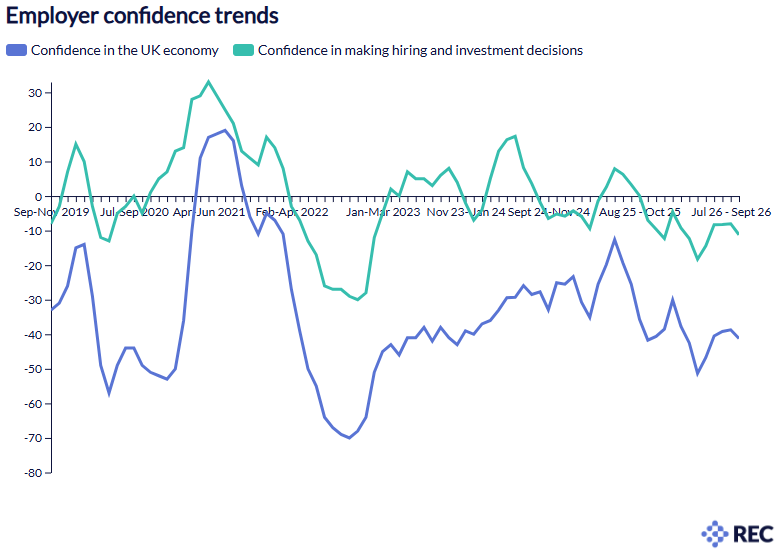
Employers’ perceptions of how the UK economy was performing decreased by two percentage points in the latest quarter (August-October 2026) to -41%, compared with the previous quarter (June-August 2026).
Similarly, confidence in hiring and investment dropped by three percentage points to net: -11% this quarter (August-October 2026) when compared to the previous quarter (June-August 2026).
Of particular concern is that Sentiment on both the economy and hiring and investment confidence was at its lowest point in October 2026.
Today’s evidence of fragile employer confidence comes as separate analysis by Cebr for the REC’s Good Hiring Matters report highlights the economic cost of hiring hesitancy. The Good Hiring Matters report shows unfilled vacancies cost UK businesses an estimated £72.8 billion in 2025, or approximately £14,200 per vacancy instance. The cost of each unfilled vacancy is equivalent to approximately 36.8 days of productive output, the report shows.
Maxine Bligh, REC Interim Chief Executive, said:
“The UK economy will struggle to grow and the jobs market will not gain any momentum if employers remain this hesitant to hire and invest. Today’s data show businesses becoming slightly more cautious about growth prospects and expanding their workforce, amid ongoing high employment costs and regulatory burdens. The data do show some pickup in planned public sector hiring which at least offers some relief in a sector that has faced limited job opportunities in recent years.
“While the latest JobsOutlook data pre-dates the Budget, there was little in the Chancellor’s announcements to act as the smelling salts needed to revive hiring confidence. Firms wanted more help with the high costs of employment and others are still battling with high energy costs which leave less room for hiring and investment in people. The cost of that hesitancy is eye-watering with our Good Hiring Matters research showing unfilled vacancies cost UK businesses more than £72 billion a year.
“The government must create the conditions for employers to build stronger teams, bring more people into work, boost productivity and support economic growth. Alan Milburn’s review, the Office for Budget Responsibility, and the NHS have joined business in warning about the Employment Rights Act weighing on employment and temporary employment in particular. Milburn recommends a test for legislation to see if it helps or hinders youth employment which the guaranteed hours proposals would surely not pass. If the government will not listen to business on this, they should listen to the data and change course quickly on these proposals.”
Public sector employers reported a sharp increase in hiring intentions this quarter, while employers in the Midlands remained the most optimistic regionally about hiring overall.
- The short-term permanent hiring sentiment (next three months) was one percentage point lower in the latest quarter (August-October 2026), at net: +7%, than the last quarter (June-August 2026).
- The balance of medium-term permanent hiring sentiment (next four to 12 months) was stagnant at net: +6% between August-October 2026 compared to June-August 2026.
- Employers of medium-sized companies were most positive about permanent hiring and, regionally, survey respondents in the Midlands were the most positive about permanent hiring. Interestingly, national public sector hiring intentions have shot up this quarter: public organisations’ short-term permanent hiring sentiments improved by 11 percentage points to net: +11%. And medium-term outlook sentiment to hire permanent staff in the public sector increased by 10 percentage points to net: +8%.
- Overall short-term temporary hiring sentiment for August-October 2026 stood at net: +3%, which was up one percentage point from last quarter (June-August 2026).
- The outlook for temporary medium-term hiring in August-October 2026 improved by two percentage points to net: +7%, when compared to the previous quarter (June-August 2026).
- For both measures of temporary hiring, London recorded the strongest sentiment (net: +15%), followed by the Midlands (net: +10%). Medium-sized organisations (50–249 employees) were the most positive in both regards,
- Public sector short-term temporary hiring sentiment improved by seven percentage points to net: +4%.