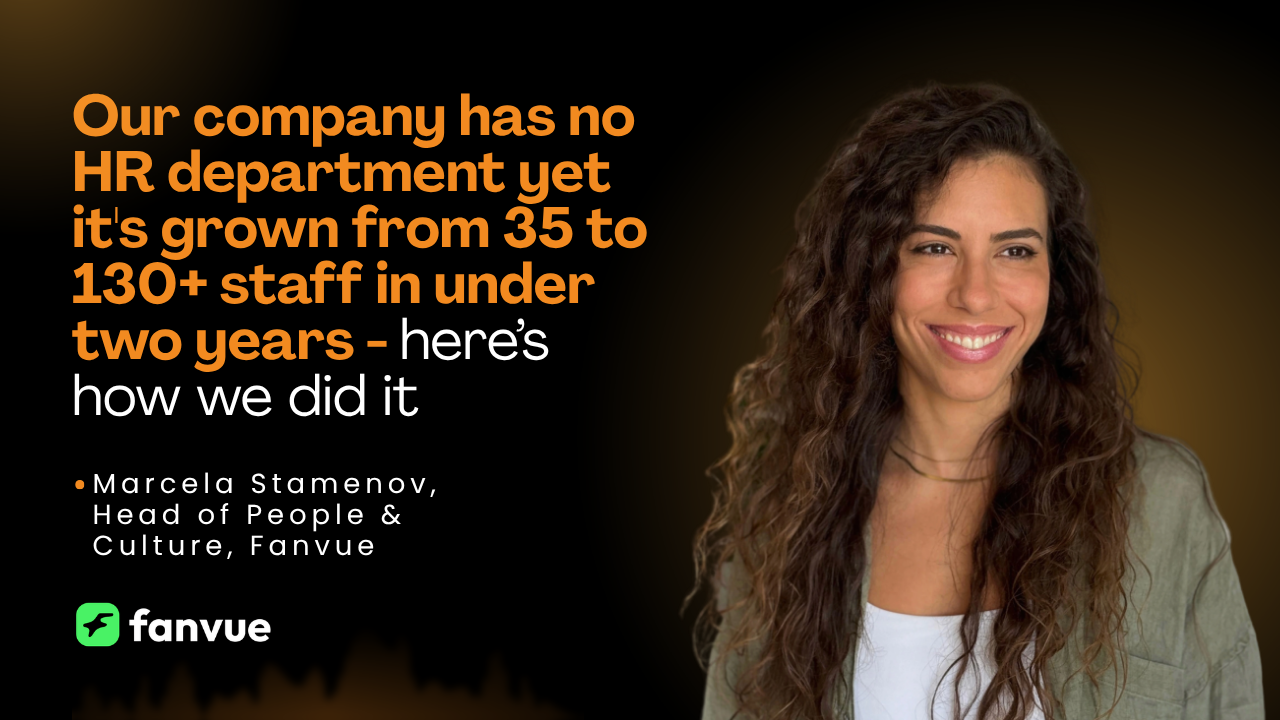
Fanvue, the AI-powered creator platform has no traditional HR department but grew from a team of 35 to 130+ in under two years using a culture-first model, one which just bagged them Gold at the 2026 Stevies Awards for Technology Excellence.
Marcela Stamenov, Head of People & Culture at Fanvue has built a lean, three-person operation that has provided the infrastructure for the hypergrowth, built upon high trust and high ownership from day one.
The approach has just been recognised at the 2026 Stevie Awards for Technology Excellence, where Stamenov won Gold Employee of the Year, and Fanvue took home Gold Tech Company of the Year. Judges credited her ‘strategic people leadership’ as a direct driver of the company's hypergrowth.
Speaking exclusively to OnRec, Stamenov shared insight on her approach to people and culture in the fast growing business:
"We don't have a HR department, we have a culture engine. Every hire, every ritual, every part of how we operate is built to protect what makes Fanvue work, no matter how fast we grow. It’s not about having more people to manage more processes, it’s about having the right people in place who don’t need managing in the first place.’
Rather than treating culture as a soft consideration bolted onto hiring, Fanvue has made it a hard gate. Every candidate sits a dedicated culture interview, run separately from their skills assessment. Fail it, and the process stops there, regardless of technical fit.
The correction also came with a more deliberate approach to hiring, built on an 80/20 principle: 80% of the effort now goes into planning the role, and only the remaining 20% into filling it. New hires are then taken through a structured cultural onboarding, including one-to-one time with the company's founders and rituals designed to embed Fanvue's values from day one.”
Stamenov added:
‘Skills can be taught. Culture has to be protected from the moment someone joins, not managed afterwards once it's already slipping. Culture is what happens when the founders aren’t in the room.
This is how you create culture, because if you bring in just 1 or 2 people (who don’t meet high standards) you demotivate and push the morale down of the whole team.”
The proof is in the pudding. Employee engagement at Fanvue stands at 89%, 16 points above the sector benchmark, with 87% confidence in management and a flight risk of just 6%. Not bad for a business scaling at speed, where rapid growth can often come at the cost of engagement and retention.
Stamenov frames the relationship between the company and its people as a two-way trade, designed to benefit both sides for as long as someone is part of the team.
Marcela Stamenov said:
"When someone joins Fanvue, we want them to experience something really unique, for them to walk away thinking, 'I'm developing personally and professionally in ways I never have before.' It’s not just about a job offer; we invest in people to create opportunities for growth, learning and development. And we want that growth to feel joined up, not siloed, so everyone is developing together, moving in the same direction and growing alongside the business."
It’s why Stamenov is comfortable calling it an engine rather than a department. An HR department manages people once they are in. An engine is what got Fanvue from 35 to 130+ in the first place, and by the look of numbers, it isn’t slowing down.