
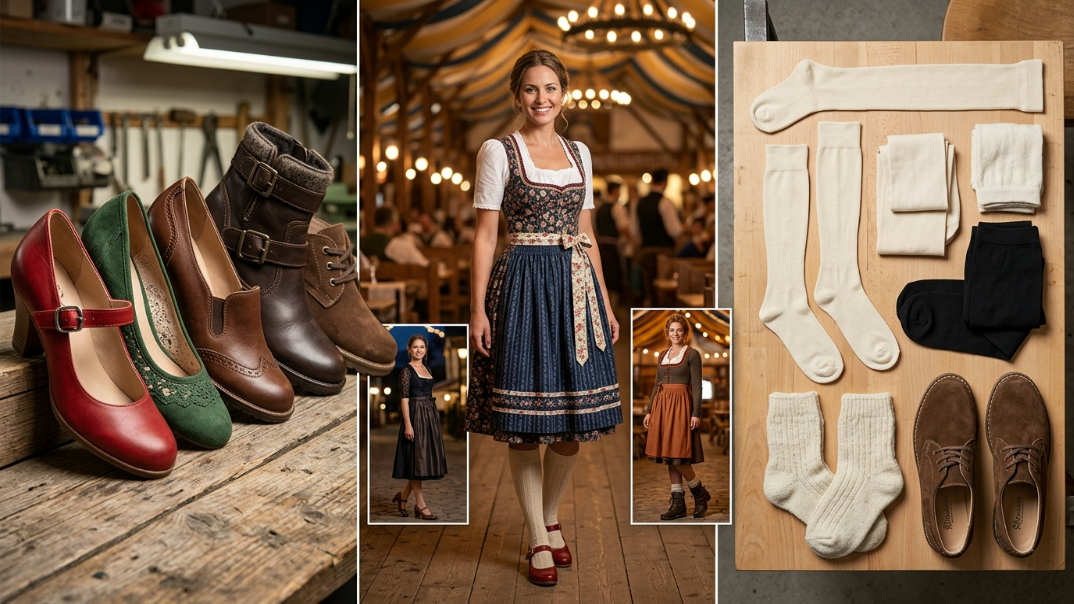
The dress gets chosen with care, the blouse and apron get coordinated — and then the shoes get asked about in a last-minute message that deserves a better answer than "something comfortable." Dirndl footwear is its own settled system: a small family of correct styles, clear rules pairing each to the dress's register, a hosiery layer that bridges hem to shoe, and a comfort specification written by the ten-hour festival day. Once the system is known, the last-minute question never gets asked again — every dirndl in the wardrobe already knows its shoes. This guide lays out the whole system: the answer stated up front, the style family in detail, the register-by-register pairing rules, the hosiery bridge, and the day-proofing that makes the correct choice survive to midnight.
The Answer Up Front
For the reader with a festival tomorrow: the standard answer is a flat or low-heeled leather Mary Jane — the instep-strap shoe in black or warm brown — over cream hosiery, broken in beforehand. It is correct beneath every dirndl at every festival on earth, which is why it's the tradition's default. The full system below refines that answer by register (ballet flats for light daytime, low blocks for evenings, boots for autumn, the sanctioned liberties for casual builds) — but nobody holding a dress and a deadline needs to read further than this paragraph to be correctly dressed.
Everyone with more than a day: the refinements are where the outfit gets good.
The Style Family
Five styles cover the whole tradition. The Mary Jane: the canonical dirndl shoe — leather, instep strap, flat to low heel — the style the tradition's photographs run on and the register-neutral default above. The ballet flat: the light option — leather versions in traditional tones carrying the daytime and warm-weather builds with the softest line. The low block heel: the dressed option — a capped, stable heel (the standing day writes the height limit) lifting the evening and elevated registers without leaving the comfort spec. The ankle boot: the season option — clean leather boots carrying autumn dirndls, cold-weather builds and the contemporary styling register. And the traditional flat cousins: the women's builds of the Alpine shoe family — sturdy, grounded, heritage-correct — serving the rustic registers and the wearers who want the outfit traditional to the floor.
The family's shared rules: genuine leather, warm browns and blacks, matte over shine — the material-and-tone law every member obeys, because the shoes join the outfit's leather story.
The Pairing Rules, Register by Register
The system's core is matching shoe to dress register, and the rules are short. The classic midi (the everywhere dress): the Mary Jane as standard, ballet flats as the light variant — black beneath cool and dark dress colors, warm brown beside the earth tones. The daytime and bright builds: ballet flats and light Mary Janes, the softer line matching the register's ease. The evening and elevated builds (deep colors, taffeta aprons, longer lengths): the low block heel or polished Mary Jane in black — the register where the dressed option earns its place. The autumn and cold builds: ankle boots in the dress's leather family over opaque tights — the seasonal pairing that keeps the outfit traditional while the weather turns. The casual and hometown builds: the sanctioned liberty — clean minimal sneakers pass with the relaxed dirndl styling (sleeves pushed, hair down) at casual festivals — the one modern option the mainstream adopted, honest about its register. And the rule threading all of it: whoever asks what shoes to wear with dirndl outfits is really asking the dress's register — answer that, and the shoe names itself.
The Hosiery Bridge
Between hem and shoe runs the layer that finishes the leg, and it has its own short rules. The standard: cream or ivory hosiery — knee-highs beneath midi lengths, tights where coverage or season calls — the tradition's bridge tone, softening the leg line and tying every shoe in the family to every dress. The seasonal shift: opaque tights (cream, or black beneath the dark evening builds) as the autumn-and-winter answer, paired with the boot register naturally. The white-sock note for the rustic builds: folded cream socks with the traditional flat cousins — the heritage register's own bridge. And the one avoidance the whole system agrees on: bare legs with formal builds and shiny hosiery anywhere — the bridge stays matte and present, because the finished leg is part of what makes the dirndl read complete.
The bridge's quiet function: it makes the shoe decision forgiving — a correctly bridged leg carries any family member gracefully, which is half the reason the system feels effortless once adopted.
Day-Proofing the Choice
The correct shoe still has to survive the festival, and the specification is real. The comfort floor: genuine soles with cushioning and arch presence — the paper-soled ballet tier is the day's classic casualty — with the family's traditional grounded-sole heritage existing for exactly the standing marathon. The height ceiling: flats through low blocks only; the day retires everything taller by mid-afternoon without exception. The break-in schedule: several home wears before festival day — new leather at a ten-hour event being the mistake feet remember. The floor conditions: tent floors run wet and fairgrounds uneven — the leather-and-rubber combination soles serve best, and the grip consideration is why the tradition's shoes were always grounded. And the kit: the blister-strip card in the bag, the hosiery spare, and the shoes broken in enough to be forgotten — because the system's end state is exactly that: footwear correct enough, and comfortable enough, to vanish beneath the dress it was chosen for.
Frequently Asked Questions
What's the one-line answer for dirndl shoes? A flat or low-heeled leather Mary Jane in black or warm brown over cream hosiery — correct beneath every dirndl, everywhere.
Which color — black or brown? By the dress: black beneath cool and dark colors and the evening builds; warm brown beside the earth-toned and rustic registers — always in the outfit's leather family.
Can heels be worn with a dirndl? Low block heels only — the dressed register's option; the ten-hour standing day retires anything taller by mid-afternoon.
What about boots? Clean leather ankle boots are the autumn standard — over opaque tights, in the dress's leather family — carrying the cold-season builds traditionally.
Are sneakers acceptable? The sanctioned casual liberty: clean minimal pairs with relaxed dirndl styling at casual festivals — never in the formal registers.
What hosiery goes underneath? Cream knee-highs or tights as the standard bridge, opaque tights for cold builds — matte always, because the finished leg completes the dress.












