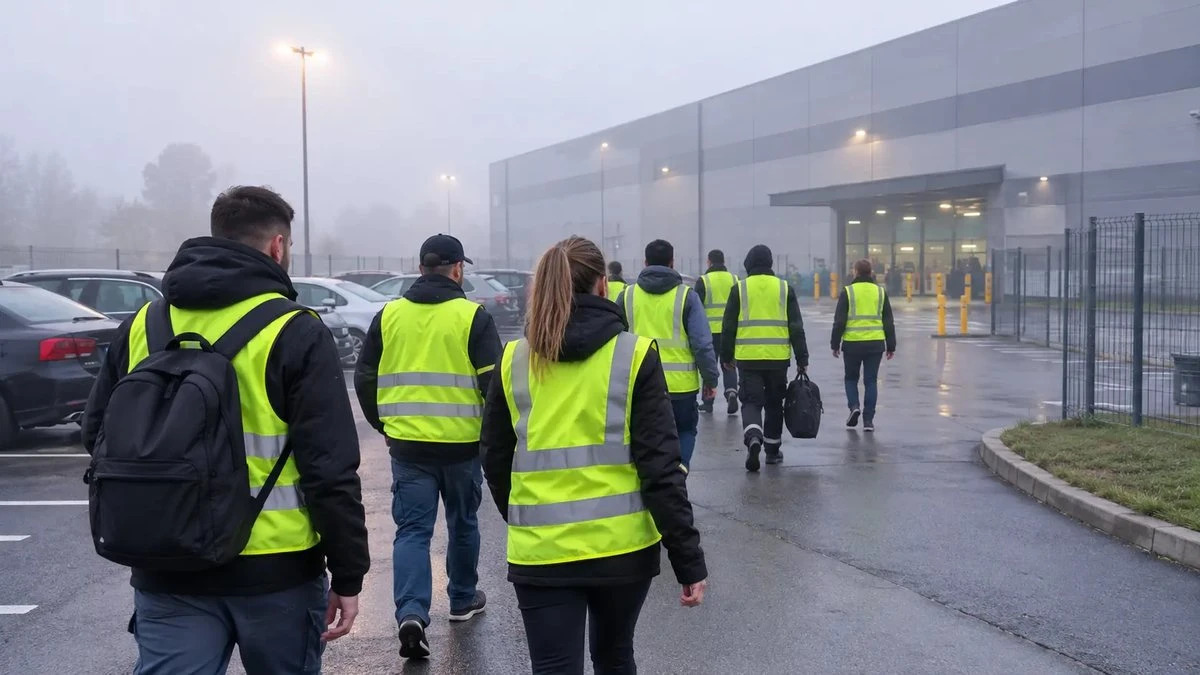
Poland spent the last decade becoming one of Europe's main warehouses. Parcel hubs line the motorways around Warsaw, Poznań and Wrocław, car-parts plants run three shifts in the south, and food factories near Łódź pack products for half the continent. The problem is that the local workforce has not grown with them. Unemployment is low, the population is ageing, and many younger Poles prefer office work or jobs further west. The gap is filled, increasingly, by people from outside Poland.
For recruiters and staffing teams this creates a steady market, but not an easy one. The roles are hands-on, the paperwork depends on nationality, and candidates often compare offers line by line, down to the price of a bed in a shared room. Below is a working overview of what the Polish market looks like in 2026, written for people who place candidates there and for candidates who want to understand what they are being offered.
Where the shortages actually are
Talk to any shift manager in a Polish logistics park and you will hear the same list. The jobs that stay open longest are not exotic. They are the ones that need people to turn up at 6 a.m. and work a full shift on their feet.
-
Warehouse operatives: picking, packing, loading, returns handling. Volume spikes from October to January, and many sites double their headcount before the Christmas peak.
-
Production line workers: food processing, automotive components, household goods, packaging. Repetitive work, often with quality-control checks built in.
-
Forklift operators: in constant demand. In Poland a forklift licence is not just an internal course; operators need a certificate from UDT, the Office of Technical Inspection, which means a course and a state exam.
-
Construction trades: general labourers, rebar fixers, drywall installers, tilers, welders. Experienced tradespeople can negotiate; beginners usually start as helpers.
-
Seasonal agriculture: fruit picking and greenhouse work in spring and summer, mostly in central and eastern regions.
The main hiring cities are the obvious ones: Warsaw, Wrocław, Poznań, Łódź, Kraków, Gdańsk and the Katowice area. But a lot of the volume sits in smaller towns next to motorway junctions, where a single distribution centre can employ more people than the town has working-age residents. That is exactly where accommodation becomes part of the offer, because nobody can commute there from a city 60 km away on a night shift.
What the pay looks like in 2026
Polish wages are quoted gross, and usually per hour for this kind of work. A recruiter coming from the UK market should expect candidates to ask two questions straight away: what is the hourly rate, and how many hours will I really get?
The statutory floor for 2026 is 4,806 PLN gross per month on a full-time contract, or 31.40 PLN gross per hour. On an employment contract that monthly minimum works out at roughly 3,606 PLN net. In practice, most warehouse and factory offers aimed at foreign workers sit somewhere between 28 and 37 PLN gross per hour, with night shifts and weekend work paid more. Anything quoted below 31.40 PLN gross per hour for 2026 should raise an eyebrow, as it is under the legal minimum. Forklift operators with a valid UDT certificate typically earn 30 to 40 PLN, and experienced construction trades can go higher.
Hours matter as much as the rate. A standard Polish shift is 8 hours, and many sites run two or three of them around the clock. Some employers prefer 10- or 12-hour shifts, which suits workers who want to maximise earnings and take longer breaks between blocks of work. A typical month for a foreign worker lands somewhere between 160 and 220 hours. That range is the difference between a modest income and a good one, so candidates are right to ask about it.
|
Role |
Typical gross rate (PLN/hour) |
Common pattern |
|
Warehouse operative |
28–35 |
8 h shifts, 2–3 shift system |
|
Production line worker |
28–37 |
8 h or 12 h shifts |
|
Forklift operator (UDT) |
30–40 |
8–10 h shifts, often nights |
|
Construction helper |
28–35 |
9–10 h days, Saturdays common |
These are indicative ranges seen in current job listings, not a survey. Pay also depends heavily on the contract. An umowa o pracę (employment contract) gives full social insurance, paid holiday and sick pay. An umowa zlecenie (civil-law contract) is more flexible and very common in agency work; the net amount can look higher, but the protections are thinner. One detail recruiters often miss: students under 26 with valid student status who work on an umowa zlecenie pay no social contributions and no income tax, so their net pay is noticeably higher than a non-student's on the same rate.
The first salary is usually paid around the 10th of the following month. That is common practice rather than a legal rule, but it matters: a worker who arrives on the 3rd may wait more than five weeks for the first full payment. Good offers say this upfront, and some employers pay an advance after the first week or two.
Accommodation is part of the job offer
In the UK, accommodation is rarely something a recruiter has to discuss. In Poland it is often the first thing a foreign candidate asks about after the rate. Many employers and agencies offer housing, usually in flats or worker hostels near the site, and charge for it.
Typical numbers for 2026: around 350 to 550 PLN per person per month, in rooms shared by two to four people, with the cost deducted from pay. Some offers include free transport to the site; others expect workers to cycle or use a company bus that runs only at shift change. I once read through a dozen offers for the same logistics park and found the "same" job varying by almost 400 PLN a month in real take-home pay, purely because of differences in housing cost and whether transport was included.
When placing candidates, it helps to give them the full picture in writing:
-
the monthly cost and whether it is deducted from salary or paid separately;
-
how many people share a room and a bathroom;
-
distance to the workplace and how people get there;
-
what happens to the room if the worker changes jobs or leaves early;
-
whether there is a deposit.
Candidates who browse listings of jobs in Poland for foreigners quickly learn to filter by accommodation, and they compare the effective hourly rate after housing. Recruiters who present that calculation themselves come across as more trustworthy, because they are answering the question the candidate is about to ask anyway.
Permits for non-EU workers, in broad terms
Citizens of EU and EEA countries can work in Poland without a permit; they register their stay and start. For everyone else, the rules depend on nationality and change from time to time, so anything below should be treated as an outline, not legal advice. Check the current rules with the relevant Polish authority before promising a start date.
For most non-EU nationals, the route is a work permit (zezwolenie na pracę) applied for by the employer, followed by a national D visa or, for longer stays, a temporary residence card. Processing times vary by region and by season, and delays of several weeks are not unusual. Citizens of a small group of countries, including Armenia, Belarus, Georgia, Moldova and Ukraine, have historically been able to use a simplified procedure based on a declaration (oświadczenie) filed by the employer. The list of eligible countries and the conditions have been adjusted more than once, so this needs checking at the time of hiring.
Once a foreign worker is registered, they get a PESEL, the Polish national identification number. It sounds like a formality, but without it many everyday things become harder: opening a bank account, registering with a doctor, signing a phone contract. Experienced recruiters build the PESEL step into the onboarding plan rather than leaving the worker to sort it out alone in their first week.
Forklift operators are a special case. A UDT certificate is a Polish qualification, so a driver with years of experience abroad may still need to pass the Polish course and exam. Some employers organise this; others will only hire people who already hold the certificate. It is worth clarifying before a candidate travels.
Red flags recruiters and candidates should know
The Polish market has plenty of honest employers and agencies, but it also attracts people who make money from candidates rather than from clients. Two points cover most of the risk.
Charging candidates for a job is illegal. Under Polish law, an employment agency may not take a fee from a jobseeker for finding them work. That includes "registration fees", "document processing" charges and payments for a "guaranteed place". Legitimate costs such as accommodation are a different matter, but they should be clearly stated and connected to actual housing, not to the job itself.
Agencies must be registered. Every legitimate employment agency in Poland has to be listed in KRAZ, the national register of employment agencies (Rejestr Agencji Zatrudnienia). The register is public and searchable. A UK partner agency working with a Polish counterpart should check the registration number before signing anything, and candidates can do the same in a couple of minutes.
Other warning signs worth passing on to candidates:
-
An offer that exists only as a chat message, with no written contract before departure.
-
A rate quoted "per hour" with no mention of whether it is gross or net.
-
Requests to hand over a passport "for safekeeping".
-
Promises that a work permit is not needed when the candidate's nationality clearly requires one.
-
Pressure to decide within hours, especially when the offer includes paid transport to Poland.
None of these automatically means fraud, but each one deserves a direct question. A serious employer will answer without fuss.
How candidates actually find vacancies
Recruiters sometimes assume foreign workers find jobs mainly through agencies. In practice the picture is mixed. Word of mouth is still huge: someone already working at a site tells a cousin there is a vacancy, and the cousin arrives two weeks later. Facebook groups and Telegram channels in Ukrainian, Russian, Georgian and other languages carry a lot of offers, of very uneven quality.
Specialist job sites aimed at foreigners are increasingly the first stop, because they let candidates filter by city, contract type and accommodation, and read the offer in their own language. Platforms such as Jobework publish vacancies from partner employers in several languages, with the rate, the shift pattern and the housing terms stated in the listing. For a recruiter, that format is a useful benchmark: if your own job adverts leave out the hourly rate or the cost of accommodation, candidates will simply scroll past them to an offer that includes both.
A few habits make offers for Poland more effective:
-
Quote the gross hourly rate and the realistic monthly hours, not just a "monthly earnings up to" figure.
-
State the contract type in plain language and say whether holiday pay is included.
-
Describe the accommodation honestly, including the number of people per room.
-
Mention what documents the candidate needs before travelling, and who pays for what.
-
Translate the key terms. A candidate reading a vacancy in their second language will misunderstand at least one detail.
What this means for recruiters outside Poland
For UK-based staffing professionals, Poland is no longer just a source country for workers heading west. It is a destination in its own right, hiring from Ukraine, the Caucasus, Central Asia, India, the Philippines and elsewhere. The demand is real, particularly in logistics and manufacturing, and it is unlikely to fade soon given Polish demographics.
The work that adds value is the unglamorous part: checking that the partner agency is in KRAZ, getting the contract in writing before departure, explaining gross versus net pay, and making sure the candidate knows what their room will cost and how they will get to a 6 a.m. shift. Recruiters who handle those details tend to see fewer early departures and more referrals from the same workers a few months later.
For candidates, the advice is just as practical. Read the offer slowly, ask about hours and housing, never pay a fee to get a job, and keep a copy of every document you sign.