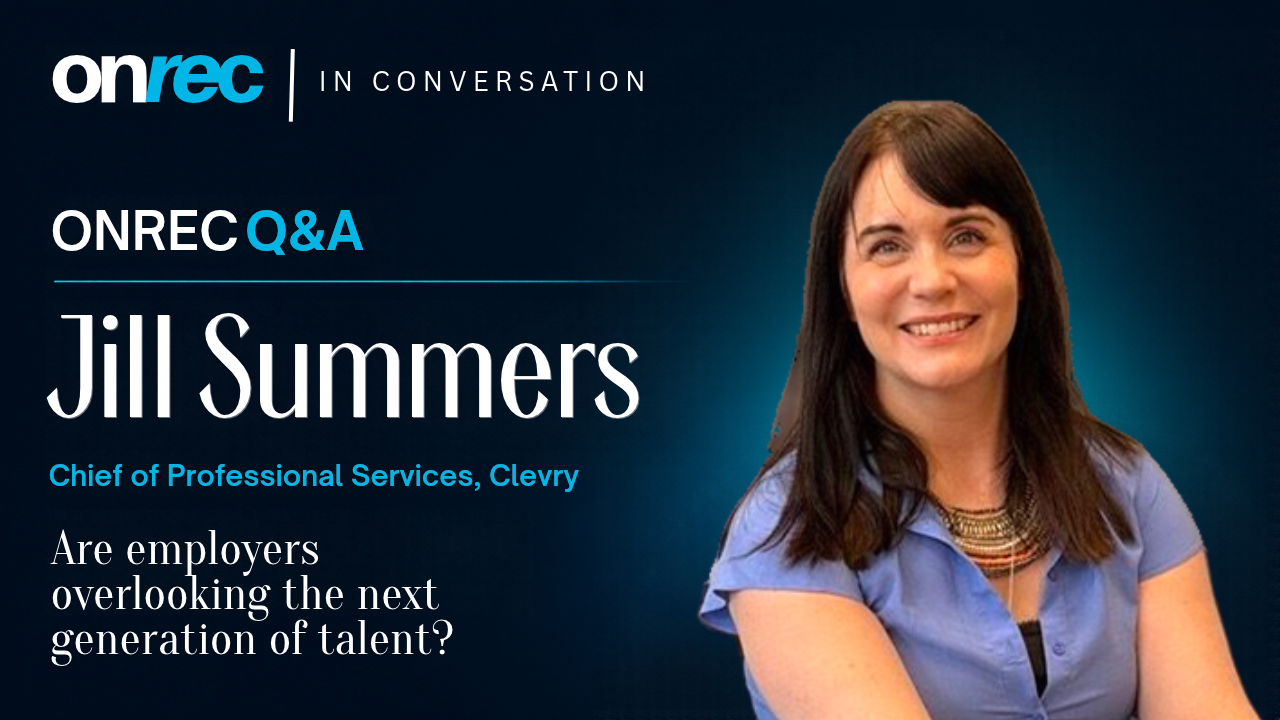
By Jill Summers, chief of professional services at Clevry
Every year we tell young people that qualifications are the route to a good career. Then we ask them to show experience that nobody gave them the chance to gain.
The scale of the problem is clear. Around 981,000 people aged 16 to 24 were not in education, employment or training between April and June 2026 (ONS), after the figure passed one million in the first quarter, the highest since 2013.
Adzuna recorded just 8,383 advertised graduate vacancies in July, down 45.6% on a year earlier.
The Institute of Student Employers (ISE) rightly cautions that not every graduate role is advertised as one, so the true picture may be less severe.
Even so, competition is intense: ISE reports 141 applications per graduate job in 2026, up from 86 in 2023.
The experience paradox
Much of this is cyclical, driven by economic caution, rising costs and automation. But employer behaviour matters too.
Careerminds UK found that 37% of advertised entry-level roles list prior experience as essential.
If “entry level” means “already done the job”, we have a definitional problem.
“If entry level means already done the job, we have a definitional problem.”
Qualifications are the other crutch. CIPD research found 57% of employers mainly look for degrees or postgraduate qualifications, often simply to sift large volumes of applications.
Rather than a measure of capability, this is a filter of convenience.
It rewards those with the networks to secure internships and the financial freedom to take unpaid ones, and screens out capable people from non-traditional backgrounds.
Are graduates work-ready?
It’s a fair question, and employers do report gaps.
In ISE’s 2025 Student Development Survey, 54% said graduates fell short on self-awareness and 46% on resilience; in 2026, 35% rated them below expectations in adapting to workplace demands.
But employers remain broadly satisfied with graduates’ problem solving and foundational skills.
The concerns are about how people collaborate, adapt to feedback, handle ambiguity and learn quickly.
These are precisely what a degree classification and a list of work experience fail to capture.
So part of the “skills gap” is a visibility gap. Candidates may well have the capabilities. Our hiring processes just aren’t designed to find them.
Generative AI makes this worse: 92% of ISE employers suspected or confirmed students using AI in assessments, so polished paperwork reveals even less.
What skills-based assessment offers
Skills-based assessment shifts the question from “What have you done before?” to “What can you do, and how do you work?”.
Used well, that might include:
- Work samples and simulations, such as a prioritisation exercise or a mock client scenario
- Situational judgement tests, which show how someone approaches realistic workplace dilemmas
- Structured interviews, where every candidate gets the same job-relevant questions scored against the same criteria
- Validated psychometric measures of reasoning and work-related behaviours
The principle is that potential is observable if you create the conditions to see it.
“The principle is that potential is observable if you create the conditions to see it.”
A caution, though. Assessments are only as good as their design. They should be role-relevant, validated and monitored for adverse impact.
A poorly chosen test can screen out good people as efficiently as a rigid degree requirement.
Practical takeaways for recruiters and HR teams
- Audit your entry-level adverts. Remove “experience essential” from roles designed for people starting out.
- Question every qualification filter. Ask what the degree requirement is actually predicting, and whether you can assess that directly.
- Define the skills first. Agree the capabilities that predict success in the role, then assess for them.
- Make assessment consistent. Use structured, scored approaches so decisions are comparable and defensible.
- Create experience, don’t just demand it. Protect paid internships, insight days and apprenticeships.
- Measure outcomes. Track who applies, progresses and succeeds once hired, by background and route.
- Invest in onboarding. Skills-based hiring identifies potential; good training and management develop it.
The long-term cost
If businesses stop hiring at the bottom, where will tomorrow’s experienced talent come from?
Today’s junior hire is the future manager. Employers that learn to spot potential rather than pedigree will find talent their competitors are overlooking.
ENDS
Sources
- ONS, Young people not in education, employment or training (NEET), UK: August 2026 (27 Aug 2026); Q1 2026 figure per ONS, May 2026
- Adzuna UK Job Market Report, July 2026 (graduate vacancies), as reported by HRD Connect, 28 Aug 2026
- ISE response to Adzuna figures, Aug 2026; ISE applications-per-vacancy figures as reported by The Boar, Oct 2026
- Careerminds UK, as reported by TechRadar, 1 June 2026
- CIPD research on degree screening (2022), as reported by Personnel Today
- ISE Student Recruitment Survey 2026 (internships, AI in assessment), as reported by Times Higher Education, 14 Oct 2026 — https://timeshighereducation.com/news/employers-cut-student-work-experience-roles-demand-rises
- ISE Student Development Survey 2025, as reported by Workplace Journal, May 2025 — https://workplacejournal.co.uk/2025/05/students-risk-falling-short-in-work-readiness-survey-reveals/
- ISE Student Development Survey 2026, as reported by Times Higher Education, 7 May 2026 — https://www.timeshighereducation.com/node/742788
About Clevry
Clevry is a talent solutions provider combining psychometric assessments and data-driven insight with human expertise to help organisations hire, develop and retain high-performing teams.
Clevry's proprietary assessment methodology helps organisations identify workplace potential, providing additional insight alongside candidates' experience to support better hiring decisions and long-term performance.
The company supports organisations globally with services including talent assessment, recruitment and organisational development.
For more information please visit: www.clevry.com