Calculating your net salary after US income tax takes less than ten minutes once you know the steps. Most Americans skip this math entirely and pay for it every budgeting cycle. Your offer letter says $80,000. Your bank account gets something closer to $58,000. That gap isn't a mystery. It's federal income tax, FICA, and state taxes, plus deductions, doing exactly what they're designed to do. I've seen sharp people make bad financial decisions simply because nobody walked them through the actual calculation. This guide does exactly that.
The steps aren't complicated. They're just never taught clearly. Follow each one, and you'll have your real take-home pay figured out before you finish reading.
Step 1 — Start With Your Gross Salary
Your gross income is the starting number. It's everything your employer agreed to pay you before any deductions touch it. Annual salary, bonuses, and any other taxable compensation all count.
Write it down. That number is about to get smaller in four distinct ways.
One thing most people get wrong immediately: they assume their employer's quoted salary equals their annual taxable income. It doesn't. If you contribute to a 401(k), a Health Savings Account (HSA) or pay health insurance premiums through a Section 125 cafeteria plan, those amounts reduce your taxable wage before the IRS even starts calculating.
➔ A $80,000 salary with a $6,000 traditional 401(k) contribution makes your federal taxable income $74,000—not $80,000
➔ HSA contributions in 2026 top out at $4,300 for self-only coverage (IRS Publication 969)
➔ Pre-tax benefit deductions can shift you into a lower federal income tax bracket entirely.
Start with gross. Subtract pre-tax deductions. That's your taxable income for Step 2.
Step 2 — Apply the 2026 Federal Income Tax Brackets
The IRS updated federal income tax brackets for 2026 under Revenue Procedure 2025-28, adjusted for inflation. The system is progressive—each chunk of income gets taxed at its own rate, not everything at your top rate.
For single filers in 2026:
Source: IRS Revenue Procedure 2025-28 (irs.gov)
Here's the distinction that changes everything: your marginal tax rate is the rate on your last dollar earned. Your effective tax rate is what you actually pay across all income. A single filer earning $75,000 sits in the 22% bracket—but their effective federal rate lands near 15.8%. Budget around your effective rate. Not your marginal one.
Apply the standard deduction first: $15,000 for single filers and $30,000 for married filing jointly in 2026. That comes off your taxable income before any bracket math begins.
Step 3 — Calculate FICA Taxes
Before federal income tax, FICA payroll taxes hit automatically. No opt-out. No negotiation.
➔ Social Security tax: 6.2% on wages up to $176,100 (SSA 2026 wage base)
➔ Medicare tax: 1.45% on all wages—no ceiling
➔ Additional Medicare surtax: 0.9% on earned income above $200,000
FICA combined costs you 7.65% off the top of every paycheck. I think of it as the tax on simply having a job. It never shows up in salary conversations, but it's one of the biggest line items on every pay stub.
Earn $75,000? That's $5,738 in FICA before federal income tax runs a single calculation.
Step 4 — Add Your State Income Tax
State tax is where things diverge wildly depending on where you live.
Seven states charge zero state income tax in 2026: Texas, Florida, Nevada, Wyoming, Washington, South Dakota, and Alaska. Live in one of those and skip this step entirely.
Everyone else pays. The Tax Foundation's 2026 data shows the national average sits near 4.5% effective state rate for middle-income earners—but that number spans a massive range:
➔ California: up to 13.3% for top earners
➔ New York: up to 10.9%
➔ Illinois: flat 4.95%
➔ Colorado: flat 4.4%
State tax applies to your adjusted gross income, not your federal taxable income—the rules differ by state. Some states conform to federal deductions; many don't. Check your state's department of revenue for the current-year rate schedule.
Step 5 — Put the Full Calculation Together
Here's a real-numbers walkthrough using a $75,000 gross salary, single filer, Texas resident (no state income tax), with a $5,000 traditional 401(k) contribution in 2026.
That's $17,355 deducted from $75,000—a 23.1% total deduction rate. Without the 401(k) contribution, the federal tax bill rises, and net pay drops further. Pre-tax elections aren't just retirement savings. They're an immediate, dollar-for-dollar reduction in your tax liability.
Real-World Example: David's First Salary Negotiation
David earned a $95,000 offer in Chicago, Illinois. He budgets expecting $7,900 a month. His first biweekly paycheck arrives: $2,890—about $6,230 a month.
The gap: federal income tax at the 22% marginal bracket, 7.65% FICA, Illinois's flat 4.95% state income tax, and an employer health plan premium he'd enrolled in during onboarding. He hadn't run the full five-step calculation before negotiating. He runs it now using a net salary calculator, realizes he needs $103,000 to match the lifestyle he'd planned at $95,000, and uses that data in his next review conversation. The math doesn't lie.
Step 6—Check Your W-4, or You'll Pay for It in April
The W-4 form controls how much federal income tax your employer will withhold from every paycheck. Get it wrong and you'll either owe a lump sum at tax time or overpay all year.
The IRS redesigned the W-4 in 2020—the 2026 version follows the same format. It asks about multiple income sources, dependents, and extra withholding rather than the old personal allowances system. Life changes that demand a W-4 update:
➔ New job or income change
➔ Marriage, divorce, or a change in filing status
➔ New child or dependent
➔ Significant side income or freelance earnings
Mark Steber, Chief Tax Information Officer at Jackson Hewitt, has consistently noted in public tax commentary that W-4 errors are the single most common cause of surprise tax bills among working Americans—especially workers who change jobs mid-year and don't adjust their tax withholding on the new form.
Best Way to Skip the Manual Math Entirely
Look—these six steps give you full control and understanding of your take-home pay calculation. But if you want your real net salary number in under two minutes, without spreadsheets or bracket tables:
➔ Use a dedicated net salary calculator that accounts for filing status, state, FICA, and pre-tax deductions—not just a rough federal estimate
➔ Always re-run the calculation when your income, state of residence, or benefit elections change; a $5,000 raise can land in a higher bracket and deliver less net gain than expected.
➔ Treat your effective tax rate—not your marginal bracket—as your real planning number; the difference can be 6–9 percentage points on a middle-income salar.y
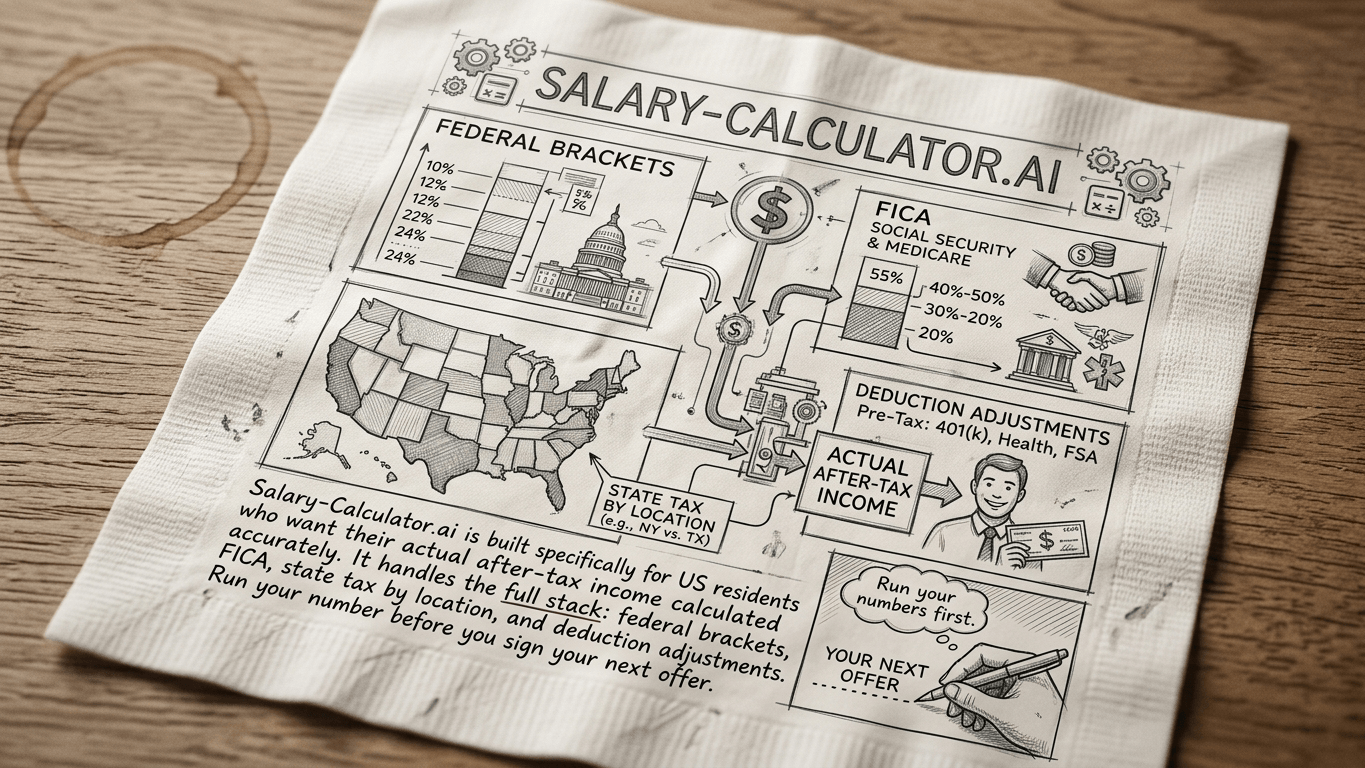
Salary-Calculator.ai is built specifically for US residents who want their actual after-tax income calculated accurately. It handles the full stack: federal brackets, FICA, state tax by location, and deduction adjustments. Run your number before you sign your next offer.