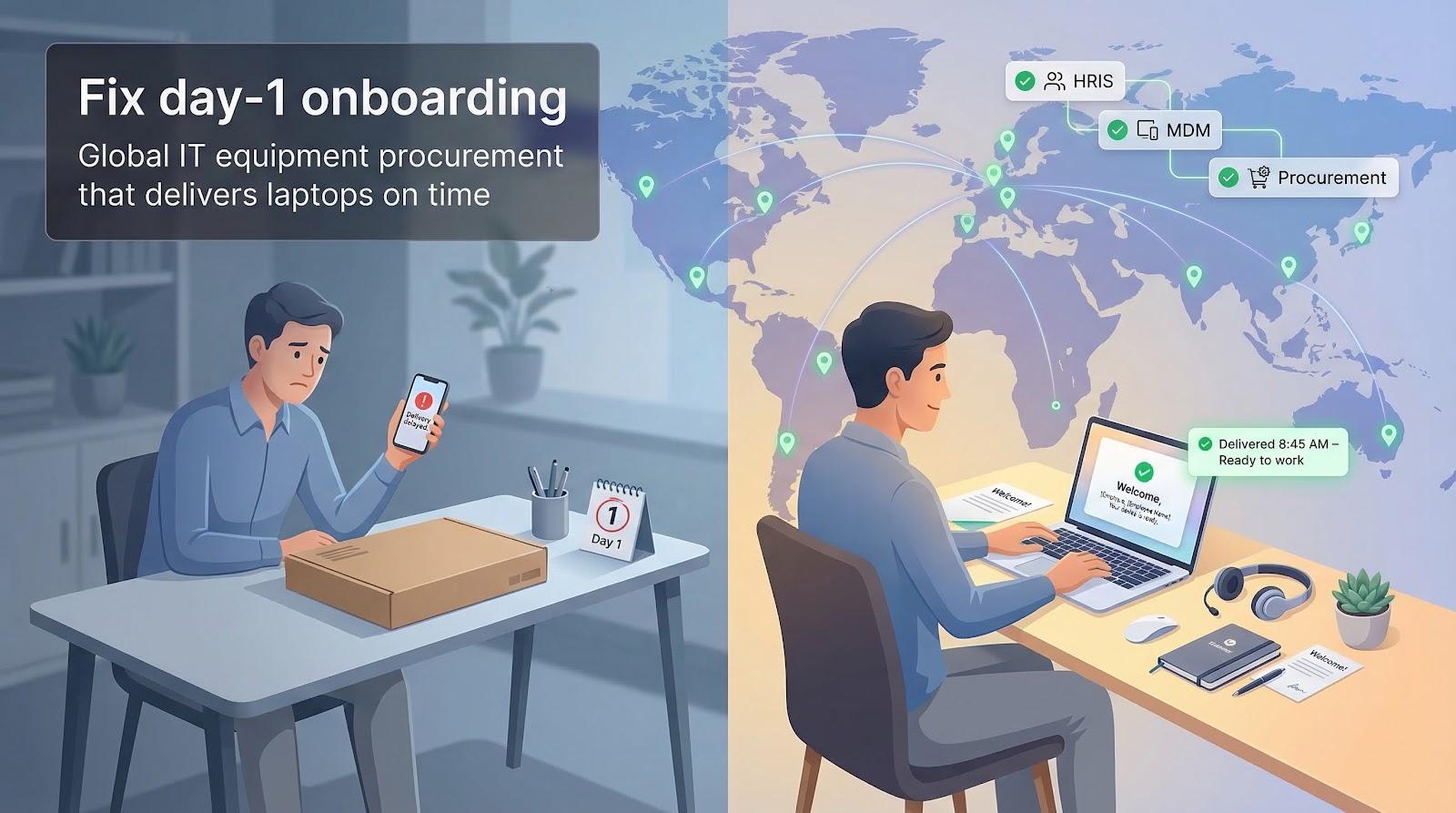
Your new hire signs in on their first morning—but their laptop is still in transit. They can’t code, join calls, or impress anyone.
A Deloitte pulse check found that 56 percent of organisations cite device-provisioning delays as the top productivity killer during onboarding.
This guide spotlights five procurement partners that guarantee a ready-to-use laptop on day one, explains how we scored them, and gives you a fast checklist so you can pick the best fit.
First, we set four non-negotiables. Each candidate had to:
➔ ship fully configured hardware, not just manage purchase orders;
➔ cover at least 100 countries so one agreement serves an entire distributed workforce;
➔ retrieve or recycle devices when employees leave;
➔ be live, funded, and servicing customers in 2026.
That filter cut the field in half.
Next, we scored the remaining vendors on five weighted factors that matter most to HR and IT:
➔ Day-1 delivery success — 20 percent of the grade.
➔ Geographic reach — 15 percent, because a promise means little if it stops at the border.
➔ Integration depth — 15 percent for plug-and-play links to HRIS and MDM tools.
➔ Offboarding efficiency — 10 percent; lost laptops equal lost data.
➔ Customer satisfaction — 10 percent, drawn from published reviews and NPS.
We validated reach claims with public sources; for example, Firstbase and GroWrk each advertise operations in 150-plus countries.
After weighting, five names topped the list: Allwhere, Firstbase, GroWrk, Deel (Hofy), and CDW. They appear in that order based on total score and their ability to close the day-1 gap.
Read on to see how each one performs.
1. Allwhere: the remote onboarding concierge
Picture Allwhere as your outsourced workplace department. Born in 2021 inside a D. E. Shaw venture studio, the platform promises that every hire, whether in Berlin or Bogotá, opens a fully configured laptop on the first morning.
Allwhere, Inc. manages the whole chain, from buying or leasing hardware and imaging it with your company build to clearing customs and arranging a courier pickup when the employee moves on. Coverage spans more than 100 countries, so you can stop juggling regional vendors.
The experience layer sets it apart. HR sees one dashboard that pairs device status with offer letters and first-week checklists. New hires receive a branded welcome box, a wellness stipend, and even a pre-booked coffee chat. As one review in People Development Magazine notes, “the result feels less like logistics and more like hospitality.”
Speed is another advantage. Clients report 99 percent on-time day-1 deliveries after shifting bulk onboarding to the service. If a laptop arrives dead on arrival, the team ships a replacement overnight and handles the return label.
Pricing sits at the premium end, and early adopters flagged a clunky menu layout, although recent updates have smoothed most rough edges. If you are scaling fast and value employee delight as much as IT efficiency, Allwhere merits the first demo on your shortlist.
2. Firstbase: scalable device management built for ops
Firstbase recognized early that remote work needs industrial-grade logistics. Today the platform ships, tracks, and retrieves devices in more than 150 countries without an on-site IT touch.
Automation drives the workflow. When you add a new employee to Workday or BambooHR, Firstbase selects the correct kit, tags the asset, and schedules the shipment. On first boot, the laptop auto-enrolls in your MDM, applies policies, and shows a branded welcome screen. IT’s checklist drops from hours to minutes.
Firstbase also handles volume. Customers have processed thousands of devices in a single quarter without supply-chain panic. If a unit fails, a courier swaps it, and the dashboard updates inventory in real time.
Smaller teams may hesitate at the subscription model, and power admins ask for deeper audit logs. Even so, user-satisfaction scores lead the field because the service cuts busywork and gives leadership a single source of truth for every asset.
If you want repeatable processes and clear visibility, Firstbase makes global onboarding straightforward.
3. GroWrk: global reach with clear pricing
GroWrk solves the same challenge from a different angle. Instead of relying on a few megawarehouses, the company partners with local depots across more than 150 countries. Your laptop ships from inside the destination market, moving through customs faster and cutting freight costs.
The ordering flow stays simple. You pick a kit, approve the quote, and track each leg on a clean, map-style dashboard. HR appreciates the live “delivered” pings, and finance can see taxes and duties broken out upfront with no surprise invoices later.
GroWrk’s key strength is flexibility. Want to lease Macs for design teams but buy Chromebooks for contractors? Done. Need to store two dozen spare laptops in Mexico City for quick swaps? The team handles warehousing month to month.
Support earns high marks. Each client works with an account manager who can escalate a stuck shipment or arrange a courier pickup for offboarding. The main drawback is commitment: GroWrk uses a subscription model, so small teams that hire only a few people a year may find the platform fee hard to justify.
For distributed companies that value transparent costs and local speed, GroWrk provides a straightforward path to global IT logistics.
4. Deel IT (formerly Hofy): HR and hardware in one dashboard
If you already run payroll or hire contractors through Deel, the equipment module connects to the same workflow. After acquiring Hofy in late 2025, Deel added hardware provisioning to the interface you use to send offer letters and sign local contracts.
Here’s how it works. When HR marks a candidate as “hired,” Deel suggests a preset kit—laptop, monitor, even an ergonomic chair—available as a monthly lease or one-time purchase. Approve the bundle and the order routes to the nearest regional hub across about 130 countries. No extra spreadsheets, no back-and-forth with IT.
Leasing stands out. Moving laptops from capital expense to operating expense preserves cash and keeps refresh cycles tight. After two or three years, Deel ships a replacement, wipes the old device, and updates asset records automatically.
Service quality is still maturing. Reviews highlight convenience but mention delivery hiccups during the post-acquisition transition. If you do not use Deel for employment, you miss the key integration benefit. For companies expanding overseas under one legal umbrella, managing HR, payroll, and devices within a single contract simplifies admin work.
5. CDW: enterprise capacity with a vast catalog
CDW has shipped hardware since 1984, and its integration centers now feel as current as any startup warehouse. The reseller buys devices in bulk, images them to your golden build, applies asset tags, and drop-ships directly to new hires in nearly every region.
Capacity sets CDW apart. Need two thousand pre-configured laptops next month? The team spins up a production line and completes the order while your staff sleeps. Local CDW entities in the United States, Canada, and the United Kingdom simplify cross-border taxes and customs paperwork.
Another advantage is catalog breadth. You can standardize on one MacBook spec or mix rugged PCs, monitors, phones, and printers without leaving the portal. Pricing stays transparent and itemised, which procurement teams appreciate, though it demands more admin work than the flat-fee newcomers.
Because CDW focuses on IT buyers, HR will not find a friendly dashboard or welcome-kit wizard. Your team must define the image, keep stock levels healthy, and trigger shipments. When that governance is in place, CDW delivers reliable logistics at a cost few specialists match.
For mature organisations with clear standards and significant volume, CDW provides predictable, on-time delivery without the frills.
At-a-glance comparison
Seeing the contenders side by side helps you spot strengths and gaps quickly. Use the table below to decide which vendor merits your next conversation
How to read it.
If global coverage and strong automation top your list, Firstbase or GroWrk lead the pack. Need an executive-level unboxing experience? Allwhere brings a hospitality finish. Already use Deel and prefer leasing? Staying in that ecosystem keeps processes simple. And if you manage an established IT program that values price transparency over added bells and whistles, CDW’s industrial scale meets the brief.
Turn the column items into talking points when you meet vendors, and ask for hard SLA language, recent delivery statistics, and a live demo of the retrieval workflow. The right partner will answer confidently.
Buyer’s checklist: choosing the right partner
Before you sign, map your needs. A solution that fits a 5,000-person fintech can overwhelm a 40-person agency. Use the questions below as a gut-check. If you can’t answer one with confidence, keep pressing the vendor.
➔ What problem are we solving?
Is the issue an IT bottleneck, a weak new-hire experience, or both? Clear definitions prevent paying for features you won’t launch.
➔ How many heads and which geographies?
Write down expected hires, exits, and contractor churn per region for the next 12 months. Volume and spread dictate whether you need a global platform or a domestic specialist.
➔ Do our systems already talk to theirs?
List your HRIS, MDM, and SSO tools. Ask for live demos of each integration instead of slideware promises.
➔ What does day-1 success look like?
Pin the metric (for example, “device delivered and activated by 9 am local time”) and require it in the SLA.
➔ Who owns the workflow on our side?
Decide whether HR, IT, or Workplace Ops will press “order.” Confusion here stalls rollout more than any technical hurdle.
➔ Can we run a small pilot?
A two-hire test reveals more than a 50-page proposal. Negotiate a limited trial to uncover hidden fees or delays.
➔ How clean is the offboarding lane?
Walk through a mock resignation. Watch how fast the vendor generates a return label, wipes the drive, and updates asset records.
➔ What is the total cost of ownership?
Compare internal labour, lost productivity, import taxes, and return shipping against the subscription or service fee. The lowest quote can shift costs elsewhere.
Answer these eight questions honestly and the right choice usually becomes clear. The rest is just signature ink.
What’s next: trends reshaping day-1 logistics
Hardware delivery was once back-office admin; today it can sway talent and retention. Over the next two years, watch three forces change the playbook:
Device as a Service reaches the finance team. Swapping capital expense for predictable operating expense frees cash flow and locks in refresh cycles. Expect more lease-centric plans similar to Deel’s, with automatic replacements every 24 to 36 months and built-in carbon reporting.
Zero-touch provisioning expands beyond laptops. Apple DEP and Windows Autopilot proved the model. The same cloud enrollment is coming for monitors, phones, and peripheral devices with embedded chips. The provider that can deliver a complete workstation without an IT ticket will set the pace.
Sustainability shifts from nice-to-have to requirement. New EU e-waste rules and corporate ESG targets make responsible retrieval essential. Firstbase already advertises multi-life reuse, and rivals are adding certified recycling, carbon tracking, and donation channels to offboarding.
Conclusion
Day-1 laptop delivery is no longer a nice-to-have. The five providers profiled here—Allwhere, Firstbase, GroWrk, Deel IT, and CDW—offer distinct approaches that can end device delays and elevate the new-hire experience. Define your priorities, test the workflow, and lock SLA language before you sign so every employee starts productive from minute one.