
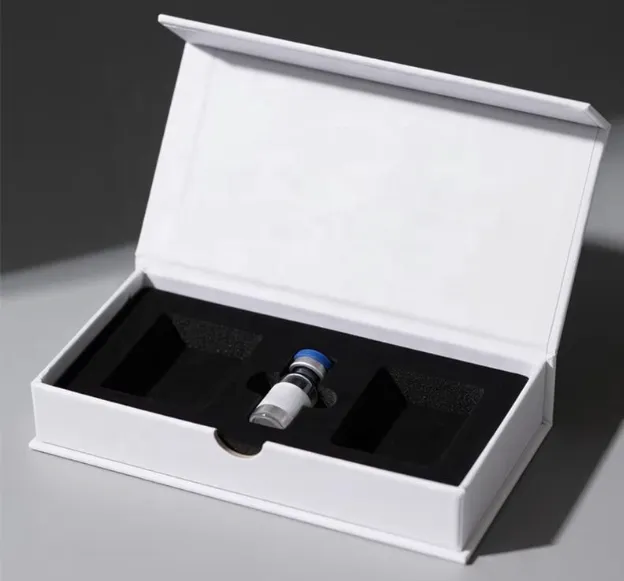
Healthcare businesses handling peptide vials have to think beyond the appearance of the box. Packaging needs to protect the vial, support accurate identification, fit storage and distribution procedures, and remain practical when hundreds or thousands of units are handled. The right peptide packaging boxes is therefore a combination of physical protection, information design, logistics, and production efficiency.
Start With the Product Configuration
The packaging specification should begin with the actual vial configuration rather than a standard carton size.
Measurements to confirm
- Vial diameter
- Vial height
- Closure dimensions
- Units per box
A vial that fits loosely can move during transportation. One that fits too tightly may be difficult to insert or remove. Both situations can create unnecessary handling problems.
The internal dimensions should be established first, followed by the insert and outer carton. Businesses comparing different packaging formats can also review peptide packaging box sizing before finalizing the structure.
How Much Protection Does the Vial Need?
The required protection depends on how the vials are handled between packing and final use.
Common internal structures
- Individual compartments
- Die-cut paperboard
- Foam positioning
- Molded inserts
A single-vial package may require a relatively simple insert. A multi-vial kit is different. Each vial needs a defined position so that glass containers do not repeatedly contact one another during handling.
The insert should also be practical for warehouse staff. If workers have to force each vial into a tight opening or spend too much time arranging the contents, a theoretically protective design can become inefficient in real operations.
FDA guidance states that drug container closure systems must provide adequate protection against foreseeable external factors that could cause deterioration or contamination.
The outer carton is only one part of that system. It should not be treated as a replacement for a suitable primary container and closure.
What Information Must the Package Communicate?
For healthcare businesses, packaging is also an information tool. A box that protects the vial but makes product identification difficult creates another type of risk.
Information planning
- Product identification
- Strength or dosage information
- Storage conditions
- Warnings or handling instructions
The exact requirements depend on the product and market. Still, the principle is straightforward: critical information should be easy to locate and read.
FDA's labeling guidance recommends considering intended users and their environment when designing packaging and carton labeling. It also warns that cluttered layouts, poor contrast, confusing similarities, and hard-to-read information can contribute to medication errors.
That makes panel planning a structural issue, not merely a graphic-design decision. Folds, closures, inserts, and narrow panels can all affect where important information can be placed.
Does the Packaging Fit the Storage Environment?
Healthcare businesses should decide where the packaged vials will spend most of their time before selecting materials and construction.
Storage conditions
Packaging should support the required storage process rather than create a false sense of environmental protection. If a product requires controlled temperature or humidity, those conditions need to be managed through the appropriate storage and distribution system.
FDA's Q7A guidance states that materials should be stored under appropriate conditions, including controlled temperature and humidity when necessary, and that APIs should be transported in a manner that does not adversely affect their quality.
A printed carton cannot compensate for an unsuitable warehouse or transportation environment.
Is the Box Practical for Warehouse Operations?
A packaging design that works well on a presentation table may be frustrating in a warehouse.
Operational questions
- Can workers pack the vial quickly?
- Can individual units be removed without disturbing others?
- Does the box stack efficiently?
- Can the package be identified without opening it?
These details become more noticeable as order volume increases. A few extra seconds per unit may not matter for a small batch, but the same delay can become expensive across tens of thousands of packages.
For this reason, packaging decisions should involve the people who actually handle the boxes. Purchasing teams, warehouse staff, quality personnel, and packaging suppliers may notice different problems with the same design.
Should Healthcare Businesses Use Custom Packaging?
Custom packaging becomes useful when standard cartons leave too much unused space or cannot provide the required vial arrangement.
Typical reasons
- Non-standard vial dimensions
- Multiple vial sizes
- Multi-unit kits
- Dedicated insert positions
A custom peptide packaging box can be designed around the actual vial dimensions and quantity instead of forcing the product into a stock format. MJC Packaging, for example, offers custom peptide vial packaging boxes built around specific product configurations and insert requirements.
The point is not simply customization for appearance. A better-fitting structure can reduce movement, improve packing efficiency, and make the finished package easier to handle.
What About Shipping Efficiency?
A larger carton does not automatically provide better protection.
An oversized box creates additional empty space and may increase storage and shipping volume. A package that is too small creates pressure on the vial or leaves insufficient room for the insert.
The practical balance
Enough clearance for assembly.Enough structure for protection.As little unnecessary space as possible.
This becomes particularly relevant for businesses distributing peptide vial packaging across multiple locations. Box dimensions affect outer shipping cartons, warehouse shelves, pallet utilization, and freight volume.
Why Should a Sample Be Tested Before Production?
A physical prototype can reveal problems that are invisible in a digital file.
Sample checks
- Vial fit
- Insert stability
- Opening and closing
- Label readability
- Packing speed
The sample should be handled by the people who will eventually use the package. If a warehouse worker struggles to remove a vial, or if the printed information disappears around a fold, the design still needs work.
This approach also reduces the risk of discovering structural problems after a large production run.
A Packaging Decision Is Also a Workflow Decision
Healthcare businesses should evaluate peptide packaging as part of the entire product flow: receiving, storage, picking, packing, transportation, identification, and final handling.
A suitable peptide vial packaging format should protect the vial without creating unnecessary work for the people handling it. It should provide enough space for required information, fit the storage environment, and remain efficient at the expected production volume.
The strongest solution is not necessarily the most elaborate box. It is the structure that matches the product, the workflow, and the distribution conditions.
For that reason, the practical sequence is simple: measure the vial, define the protection requirements, plan the information panels, review storage and distribution conditions, build a sample, and test the package with real users before committing to full production.

