
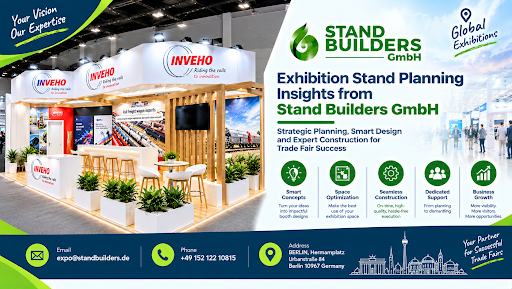
Businesses must consider how their stand will communicate their message, accommodate visitors, display products, and support meaningful conversations. Working with experienced exhibition stand builders in Germany can help exhibitors turn these requirements into a practical, well-organised exhibition environment. Berlin-based Stand Builders GmbH approaches this process through integrated design, construction, logistics, and on-site support, helping businesses prepare for trade fairs across Germany and Europe.
Why Exhibition Stand Planning Should Begin with Business Objectives
An exhibition stand is a temporary business environment where companies introduce products, meet potential clients, strengthen relationships, and communicate their expertise. Its effectiveness depends on more than visual appearance. Every design decision should support a clear purpose.
For example, a manufacturing company exhibiting industrial machinery may require demonstration areas, technical displays, and comfortable meeting spaces. A technology business launching software might prioritise interactive screens and individual consultation areas. Meanwhile, a consumer-focused brand may need open entrances and product displays that encourage spontaneous visits.
These different requirements explain why exhibition planning should begin with business objectives rather than decorative ideas.
Before developing a design, exhibitors should establish their target audience, expected visitor activities, presentation requirements, and available budget. Understanding these factors helps designers create spaces that support the intended exhibition experience.
How Stand Design Influences Visitor Behaviour?
Visitors often make quick decisions about which stands deserve their attention. Clear messaging, accessible layouts, and thoughtful product placement can make an exhibition space easier to approach and understand.
However, an attractive structure does not automatically create a productive visitor experience. The stand must also allow people to move comfortably, interact with staff, and explore relevant information.
Designing an Entrance That Encourages Interaction
The entrance establishes the first connection between the exhibition stand and its audience. A welcoming layout should provide clear access without unnecessary barriers.
Open frontages can make smaller stands feel more accessible, while larger stands may benefit from multiple entry points. Reception counters, product displays, and promotional materials should be positioned without obstructing movement.
The goal is to create an environment where visitors feel comfortable entering and beginning conversations.
Balancing Product Displays and Meeting Areas
Exhibitors frequently need to accommodate several activities within limited floor space. Product demonstrations, networking conversations, presentations, and private meetings may all take place during the same event.
Effective space planning separates these functions without making the stand feel disconnected.
A demonstration area should provide sufficient viewing space, while meeting zones should offer an appropriate level of privacy. Storage areas can keep equipment and promotional materials organised without affecting the visitor experience.
Custom Exhibition Stands and the Importance of Brand Identity
Businesses competing for attention at major trade fairs often need a presentation that reflects their individual identity. Standard layouts may not always accommodate specialised products, unusual demonstration requirements, or distinctive architectural concepts.
This is where custom exhibition stand design becomes particularly relevant. Custom-built environments allow businesses to develop layouts, structural features, branding elements, and presentation areas around specific exhibition objectives.
Stand Builders GmbH provides customised stand solutions that consider brand identity, functional requirements, and visitor engagement. Its approach includes initial consultation, three-dimensional design concepts, production, and installation.
Customisation can also improve the practical use of exhibition space. A company displaying large equipment may require reinforced display arrangements, while a business presenting digital products might need integrated screens and dedicated demonstration stations.
The most effective custom designs combine visual identity with everyday functionality. Materials, lighting, graphics, and furniture should work together rather than compete for attention.
Understanding the Four Main Exhibition Stand Solutions
Different exhibition objectives require different structural approaches. Stand Builders GmbH offers four principal exhibition stand categories, allowing businesses to consider solutions suited to their space, presentation requirements, and event format.
Custom Stands for Individual Brand Presentations
Custom exhibition stands are developed around a company's specific requirements. They provide flexibility in architectural design, product placement, visitor circulation, and branded features.
These stands are particularly useful when businesses want a distinctive presentation or require specialised demonstration environments.
Modular Stands for Flexible Exhibition Participation
Modular exhibition stands use adaptable components that can be assembled and reconfigured for different layouts.
This approach can benefit companies participating in multiple trade fairs, particularly when stand dimensions change between venues. Reusable components may also help reduce the need for entirely new structures at every event.
Double-Decker Stands for Additional Functional Space
Double-decker exhibition stands introduce an upper level, creating opportunities to separate activities within a larger exhibition structure.
The additional space may accommodate meeting rooms, hospitality areas, or private discussions while the ground floor remains dedicated to product displays and visitor interaction.
These structures require careful engineering, venue approval, and compliance with applicable safety regulations.
Country Pavilions for Coordinated Group Exhibitions
Country pavilion exhibition stands bring multiple organisations together within a unified exhibition environment.
They are commonly relevant to trade associations, national delegations, and organisations representing businesses from a particular country or region.
A coordinated pavilion can establish a consistent visual identity while allowing individual exhibitors to present their products and services.
The Practical Work Behind a Completed Exhibition Stand
Visitors usually see only the finished structure. Behind that presentation is a coordinated process involving design development, technical planning, manufacturing, transportation, and installation.
Stand Builders GmbH describes an end-to-end workflow that begins with understanding the client's requirements and continues through design, production, delivery, assembly, dismantling, and storage.
Its in-house production capabilities help connect design decisions with construction requirements.
This coordination is important because exhibition projects operate within fixed deadlines. Venue access schedules, technical approvals, material delivery, and installation periods must align before the event begins.
Why Three-Dimensional Design Matters
Three-dimensional visualisation allows exhibitors to review the proposed layout before construction begins.
It helps stakeholders assess branding positions, product visibility, meeting arrangements, and overall spatial relationships. Design adjustments made during this stage can prevent avoidable changes during production.
Installation and On-Site Supervision
Even a carefully designed stand requires professional installation. Components must be assembled correctly, graphics positioned accurately, and technical features checked before visitors arrive.
On-site supervision also helps coordinate practical issues during setup. After the event, dismantling and storage arrangements become important, especially when exhibition components are intended for future use.
How Exhibition Requirements Differ Across German Cities?
Germany hosts trade fairs across numerous industries, making location-specific planning an important consideration. Berlin attracts exhibitions involving technology, tourism, consumer products, and business innovation. Hannover is particularly associated with industrial technology and manufacturing, while Frankfurt hosts major international commercial events.
Düsseldorf, Cologne, Munich, Hamburg, Stuttgart, and Nuremberg also provide exhibition opportunities across diverse sectors. Although the fundamental principles of stand design remain consistent, each event can introduce different requirements involving hall access, stand dimensions, construction rules, and technical services.
Stand Builders GmbH maintains city-specific service pages for major German exhibition destinations, reflecting its coverage of different trade fair locations. For exhibitors, the practical lesson is to confirm venue requirements early rather than assuming that a stand designed for one event can be installed elsewhere without modification.
Measuring Success Beyond Visitor Numbers
Exhibition performance should not be judged solely by the number of people entering a stand. A smaller number of meaningful conversations with qualified buyers may offer greater business value than high foot traffic with limited engagement.
Companies should therefore establish measurable objectives before the event. These might include qualified leads, product demonstrations, scheduled meetings, partnership discussions, or follow-up opportunities. The stand layout should support these goals. For instance, businesses focused on relationship development may prioritise meeting facilities, while product-led exhibitors may allocate more space to demonstrations.
After the event, reviewing visitor feedback, lead quality, and operational challenges can provide valuable information for future exhibition planning.
Conclusion
A successful exhibition stand brings together brand communication, functional design, technical construction, and careful event preparation. Its purpose is not simply to attract attention but to create an environment where businesses can communicate effectively and develop valuable professional relationships.
Stand Builders GmbH demonstrates how integrated exhibition services, from custom and modular structures to double-decker stands and country pavilions, can support different exhibiting requirements. By combining thoughtful space planning with coordinated production and installation, businesses can approach trade fairs with greater organisation and clearer objectives.
Ultimately, the value of an exhibition stand lies in how effectively it connects a company's presentation with the people it wants to reach.

