
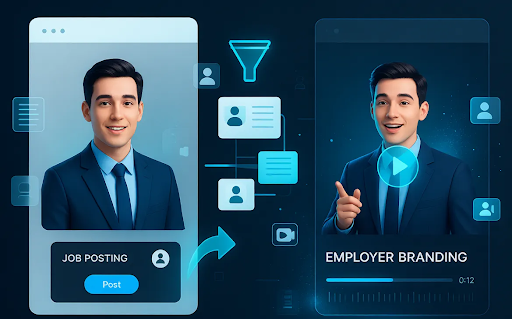
The candidates worth hiring are scrolling, not searching - and the employers who win their attention are the ones showing up in feed with something that moves. Yet most HR and talent teams operate with neither a video crew nor the time to become one. That gap is now closing, and the tools doing it are simpler than the industry expected.
Two categories deserve the attention of every recruiter and employer-brand lead: lip-sync AI, which animates a still portrait into a talking video, and image-to-video generation, which brings static images to life. Neither requires a camera, a studio, or an editor. For a function measured on pipeline and cost-per-hire, that is a meaningful shift. Candidates, after all, increasingly research an employer's social presence before they ever open an application - and a feed full of static posts signals a brand that isn't investing in how it shows up.
Why Video Matters More in Hiring
The data is consistent across the sector: video content drives higher engagement than text or static images, and candidates increasingly expect to see the reality of a role and a culture before they apply. For employers, that means career-page videos, day-in-the-life clips, and culture reels are no longer nice-to-haves - they are conversion tools.
The barrier has always been production. Briefing an agency, scheduling shoots, and editing footage is slow and expensive, and it rarely keeps pace with the volume of roles a typical desk manages. AI video flips that economics. When a talking clip or a moving image can be produced in minutes from assets you already have, video stops being a quarterly project and becomes a daily habit.
Lip-Sync AI: A Face for Your Employer Brand
Lip-sync AI takes a still image of a person and an audio track, then animates the mouth so the subject appears to speak. For recruitment, the implications are immediate:
-
Consistent employer-brand updates. A CHRO or hiring lead who dislikes being on camera can still deliver regular video messages using a single approved portrait and a recorded voiceover.
-
Multilingual outreach. One script can be re-voiced and re-synced across languages, helping multinational teams reach candidates in their own tongue without separate shoots.
-
Culture and values communication. Short, human messages about what it is actually like to work somewhere - recorded once, reused often.
-
Speed to market. A role opens, a 60-second explainer is generated the same morning, and it is live before the job board listing goes stale.
For teams exploring this, a dependable lip sync AI tool is the natural entry point: upload a clear, front-facing photo, add your audio, and review the synchronised result. The practical advice is unchanged from any media work - start with a well-lit portrait and a clean voice recording, because the model can only build on the signal it is given.
One responsibility sits alongside the opportunity. Use lip-sync only with the subject's consent and for people you are entitled to depict. Impersonating a real employee or leader without permission is both a trust violation and a legal risk. Reputable platforms build in safeguards; responsible employers respect them and label generated content where a candidate could mistake it for a live recording.
Image-to-Video AI: Motion for Every Job Ad
If lip-sync answers "how do we put a person on screen?", image-to-video answers "how do we make our visuals move?". You supply a single image - a workplace photo, a product, a logo, an illustration - and the model generates gentle motion: a slow push-in, drifting light, subtle life where there was a still.
For recruitment marketing, this unlocks content from assets most organisations already own:
-
Career-page hero clips. A static office or team photo becomes a short, scroll-stopping loop.
-
Job-ad creative. A role posting gains a moving element that performs better in social feeds than a flat image.
-
Event and open-day promotion. Venue and speaker imagery gains cinematic movement for shares.
-
Culture storytelling. A single candid moment is extended into a clip that feels alive.
Because the cost of trying is so low, an image to video AI free unlimited option is genuinely useful for HR teams: it removes the subscription question entirely and lets lean functions experiment with what resonates before committing budget. The sensible workflow is to iterate - test a handful of images, compare how the motion reads, and keep the outputs that feel intentional rather than gimmicky.
Practical Guidance for HR and Talent Teams
Adopting these tools well is less about the technology and more about discipline. A few pointers for recruitment leaders:
-
Treat video as a pipeline asset, not a one-off. Build a small library of brand portraits, culture images, and approved voiceovers so clips can be generated on demand.
-
Protect rights and consent. Only use likenesses and audio you are authorised to use, and document approvals for audit.
-
Disclose where it matters. If a clip is AI-generated and could be mistaken for a real recording of a specific person, a brief label preserves trust with candidates.
-
Match the tool to the job. Need a spokesperson message? Lip-sync fits. Need a role or culture visual to move? Image-to-video fits. They solve different problems.
-
Keep the human in the loop. Generated video should support genuine communication - real roles, real culture, real people - not manufacture a false impression of the workplace.
-
Publish where candidates are. Route clips to your career site, LinkedIn, and the job boards you already use; a generated asset only buys attention if it reaches the feed.
-
Measure, then scale. Track click-through and apply rates on video-led postings versus static ones. The data tells you which formats deserve a bigger budget - and which were merely novel.
The goal is never "more video for its own sake". It is sharper candidate attraction at lower cost, and a brand that feels present rather than absent in the channels where talent actually spends time.
Consider a concrete case: a talent-acquisition leader at a mid-sized firm wants weekly culture content but has no videographer. She records one voiceover, pairs it with an approved leadership portrait via lip-sync, and turns three office photos into loops with image-to-video. Within a month she has a steady stream of branded clips - produced in minutes, not days - without a single shoot. That is the new default, not the exception.
The Bigger Picture for Recruitment
What is happening here is structural, not cosmetic. For decades, compelling employer branding required production capacity that only large brands could justify. AI video hands that capacity to any HR team with a browser and a brief. The employers who benefit will not be the ones with the biggest agencies, but the ones who test, learn, and show up consistently with motion instead of silence.
Onrec's own coverage has already framed AI video as a new direction for creative storytelling - recruitment is simply one of its most practical applications. For talent leaders navigating tight margins and crowded feeds, the takeaway is straightforward: start with one portrait and one image. A few minutes later, you have content that moves - and in a candidate market built on attention, that is most of the battle.

