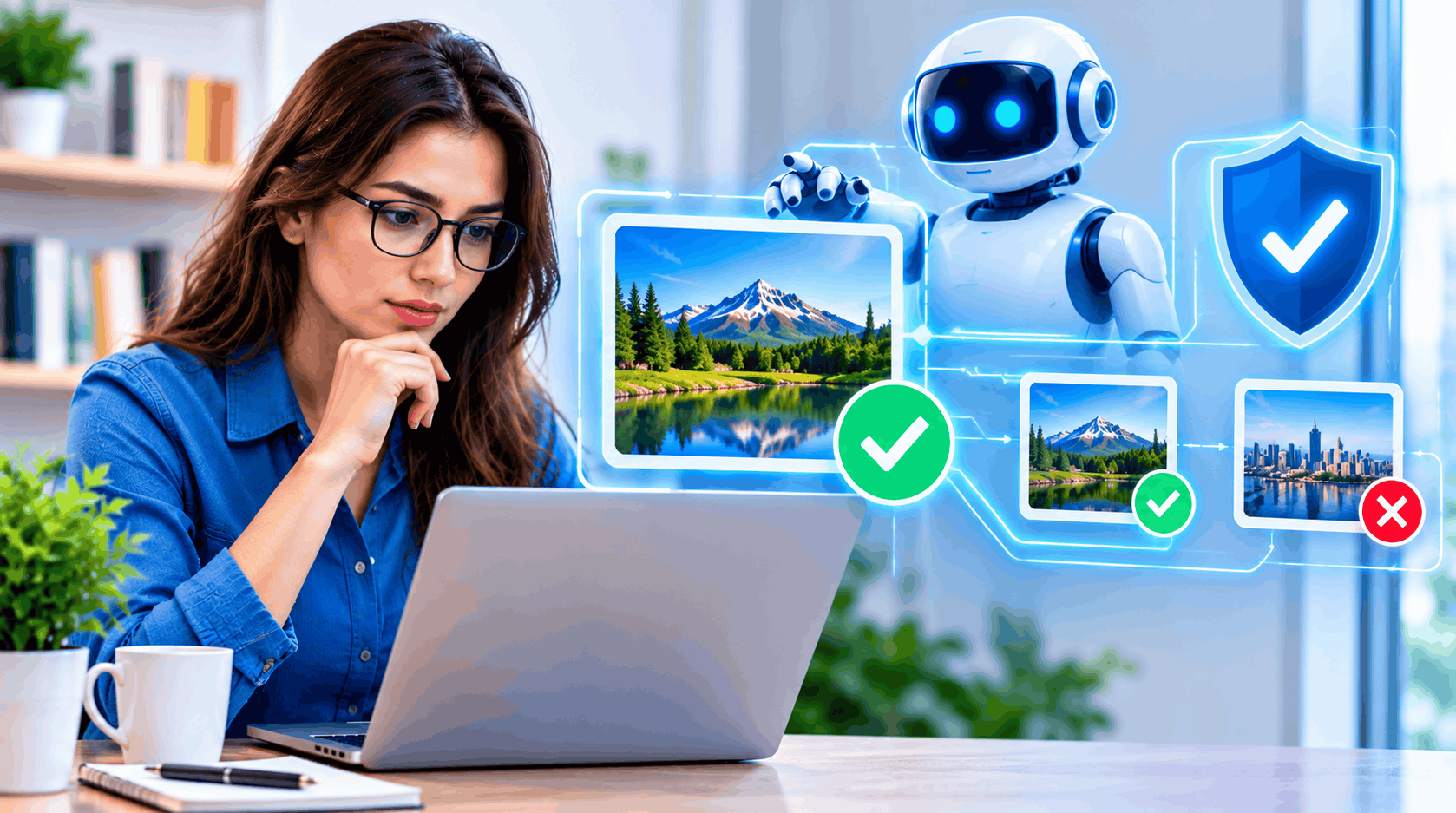
In the age of AI, spreading misinformation is no longer a challenge. It honestly just takes a few seconds and a single prompt to deceive anyone.
And now you can expect anything; for instance, you may wake up to receiving a photo in a group chat that shows a flooded street, a politician in an awkward spot, or a product that looks too good to be true.
You have about five seconds to decide whether to believe it, and nothing in the image tells you.
Your eyes can’t settle this anymore. Edited photos look real, and real photos get passed around with the wrong caption. Checking them by hand takes time most people don’t have.
But don't worry, because AI isn't just the troublemaker; you can surely count on it to help too.
Surprised, right?
Remember, no tool, no technology, is good or bad; it's the way you use it that defines its impact.
And if you want to survive in this environment, you have to learn the right way of verification. So you can keep up with the pace.
AI image verification, for example.
Where scammers now use AI to fool people, you can use it to fight back.
Wondering how?
Keep on reading this post, as it will guide you through how AI image verification works and what you are supposed to do with the result.
5 Smart Ways AI Solves the Image Verification Problems
Here are some of the smartest ways to rely on AI to help you verify the authenticity of any image online before the scammers get any chance to fool you.
-
It Finds Edits at The Pixel Level
Remember, every real image follows a natural pattern, and no matter how hard a person tries to mimic it, editing always leaves some traces behind.
The reflections, for example. If you look at a real photo, you will notice that the shadows and the reflections fall consistently with respect to the light source.
However, when a photo is edited, it might not follow these rules.
Especially when someone pastes in an object or removes a person, those rules break at the edges.
So, the AI image detector is trained on thousands of edited and untouched images to effectively spot these edits with precision.
-
It Traces the Image Back To Its Source
Sometimes, the images are not fake or edited. However, the context they come with is indeed not right.
Wondering what’s the difference?
So, suppose a news post claims to be of an earthquake that hit the city’s downtown in 2026. Now, the disaster surely happened, but in 2015, not 2026.
Therefore, even if you use a tool to verify the photo's authenticity, you can't really claim it to be authentic.
So, in such situations, you can surely take help from the AI reverse image search tool to find who exactly an image belongs to.
This AI-powered tool doesn't just scan and look for similar results. However, it deeply analyzes the image, breaks the elements and objects into fingerprints such as colors, shapes, or textures, and then uses those fingerprints to find similar results online.
This means, even if an image is cropped, resized, or flipped, the tool can help you find it anywhere online.
Hence, if the tool’s results show the same image appearing repeatedly under different headlines or captions, you surely have your answer.
-
It Reads Metadata and Provenance Records
Photos carry hidden data. EXIF metadata can include the camera model, a timestamp, and a GPS location. AI reads this and checks it against the claim. If someone says a photo shows yesterday’s event but the timestamp says 2019, that gets flagged.
Newer standards go further. Content credentials, built on the C2PA specification, attach a signed record of who made the image and what edits followed. AI checks that the signature is valid and the history is unbroken.
Metadata is easy to strip, though. A missing record proves nothing on its own.
-
It Matches Faces and Confirms the Person is Live
Most image and identity fraud happens at banks, usually during online applications.
But now, according to a report by Finextra Research, “AI platform now detects and prevents up to 90% fraudulent transactions”
Confused how?
Because traditionally, the software was designed to just verify a person by scanning their ID or a selfie.
The problem is, thanks to modern generative AI technology, these checks can easily be faked, and anyone can fool the system without even making any effort.
But where AI helps the scammers deceive more seamlessly, it also assists banks to strengthen their line of defense.
For instance, as a banker or financial professional, you can use AI facial recognition technology not to just match faces but to thoroughly analyze facial features and detect if the slightest flaw is not right in its place.
The technology checks skin texture, reflections, and small movements. Not only this, but some systems even ask you to blink or turn your head. The ID gets checked too, for altered fonts or missing security features.
-
It Spots AI-Generated Images
No matter how advanced an image generator is, it still fails to replicate what the real world holds.
For instance, if you look closely at an AI-generated photo, you will notice that:
-
The hands or fingers look distorted
-
Text in the background looks garbled or misspelled
-
Shadows and reflections do not match the light source
-
Skin looks too smooth, and the eyes lack natural detail
And even beyond this, there are also signals that the naked eye can’t catch. For instance, the generated images have different statistical patterns in their pixel frequencies than camera photos do.
So, the AI detection models are trained to closely examine and effectively catch either type of fake on a single scan.
Not only that, but some image generators even embed their photos with invisible watermarks. Google’s SynthID, for example, generates images that hold markers that can't be seen directly. However, AI detectors can surely read them even after the image is resized or compressed.
What you can do with this
AI gives you evidence, not proof. When you need to check an image, a few steps help:
-
Run a reverse image search first.
-
Check the metadata and look for content credentials.
-
Treat any detector score as one signal, not the final answer.
-
Look for the same image on trusted news sites.
No single tool catches everything. The best results come from combining several, and from a person making the final call.
Wrap Up
Image verification keeps changing because the tools on both sides keep improving. A detector that works today may miss tomorrow’s AI generator, so no checking method stays reliable forever. That makes your habits matter more than any single app. Ask who gains if you believe a picture. Pause before you share anything that makes you angry or afraid, since fakes often rely on that reaction. Most people never verify an image, so you already stand ahead if you try. You don’t need to catch every fake. You only need to stop passing the next one along.