

That decision happens long before anyone fills out a form or sends a CV. And it is shaped entirely by what the website does and does not do well.
According to Folks HR, 95% of candidates research a company before applying. For a recruitment agency, that means your website is not a digital brochure. It is the first conversation you have with every person who might want to work with you.
Therefore, having a great first impression through your website matters a lot.
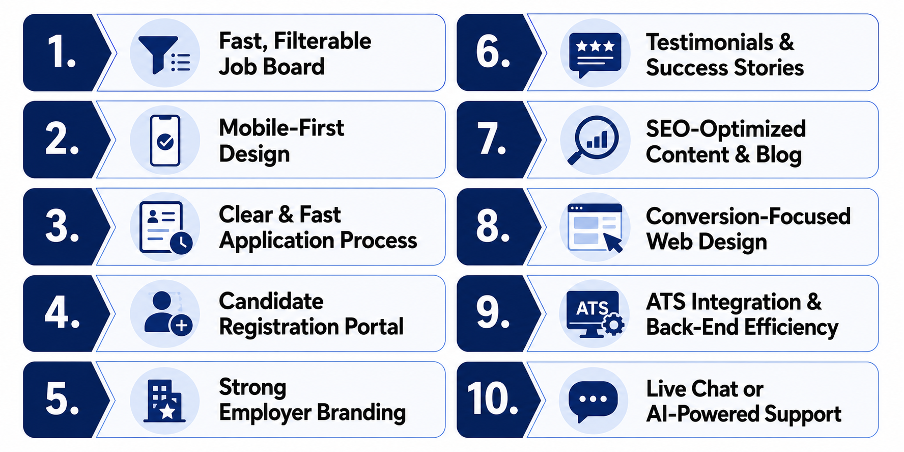
This article explores the 10 features a superior recruitment agency website should have. Once these features are in place, your website will be the kind that converts visitors into candidates and clients, rather than one that quietly loses business every day.
10 Features Your Recruitment Agency Website Should Include
1. A Fast & Filterable Job Board
A slow job board, or one that buries filters behind too many clicks, loses candidates fast, usually within the first few seconds.
Most people show up already knowing what they're looking for. They don't want to dig for it. City, sector, salary range, job type, these filters have to just work, and work fast, so nobody's sitting there wondering if the page froze.
The job listings themselves matter just as much. Vague titles and copy-paste role descriptions push candidates straight to the back button. Each listing should tell them within seconds whether this is worth their time.
For agencies managing high volumes of active job roles, this section is the operational heart of the site. It needs to be built to handle that load without becoming slow or cluttered.
2. A Mobile-First Design
Candidates browse job boards during commutes, lunch breaks, and evenings. The majority of that browsing happens on a smartphone.
According to research cited in Onrec's post on how big recruiters recruit online, mobile visits were already a significant share of total traffic years ago, and the proportion has grown exponentially since then.
A website that breaks on mobile tells candidates that little thought went into their experience. Every page, every form, and every call to action should work well on a four-inch screen as it does on a full monitor.
So, the goal is simple: build responsive websites that hold up across every device type. Partnering with a digital product studio ensures that your brand’s mobile presence is just as polished and functional as your desktop experience.
3. Clear & Speedy Application Process
A long application form is one of the fastest ways to lose a qualified candidate. Every extra field adds a small barrier, and those barriers add up.
Most people who abandon an application do so because they ran out of patience somewhere around the seventh mandatory field asking for information they already put in their CV.
The best recruitment agency websites let candidates express interest in under two minutes. That might mean a short initial form with a CV upload and a longer follow-up later in the process. It could also include LinkedIn integration, so people don't have to retype the same details for the fourth time that week.
Focus on making the start easy enough that motivated candidates finish the form.
4. A Candidate Registration Portal
Not every job seeker arrives when there is a perfect role. Many come weeks too early or between campaigns. A candidate registration portal gives these people somewhere to land that is not a dead end.
It also builds a pipeline that keeps a recruitment agency competitive. When a relevant role does come in, the candidate shortlisting starts from a database of people who have already shown interest in the role and have applied before. There’s no need to start everything from scratch again.
That speed advantage is significant, and your website is where it should begin.
5. Strong & Specific Employer Branding
Recruitment agencies compete on trust. Two agencies might work in the same sector and have similar job openings for candidates. So, how does a candidate decide which one to work with?
The differentiating factor between them is how each one presents its expertise, its approach, and what it's really like to work with them.
This is not about having a polished logo or a well-chosen colour palette. It is about specificity.
● Does the website communicate a clear point of view?
● Does it show genuine sector knowledge?
● Are there real people visible, consultants, testimonials, stories, rather than corporate jargon?
The agencies that can answer yes to these questions tend to win the mandates that others do not even get considered for.
6. Testimonials and Placement Success Stories
Candidate testimonials, client case studies, and placement success stories do more than almost any other content on the website pages will do. These testimonials help in turning a passive visitor into someone who reaches out to you. These stories bring more business.
Specific and genuine always outperform generic. "Placed within three weeks into a role I hadn't even thought to search for" is a different kind of social proof from "they were very professional and helpful." The first one shows something concrete. The second one says almost nothing.
7. SEO-Optimised Content and Regular Blog
A recruitment agency website that nobody finds has no value, regardless of how well it converts. Organic search is one of the most reliable sources of both candidate and client traffic. Partnering with a digital marketing agency in California helps you create content around the questions people are searching for, increasing visibility and attracting both candidates and clients.
As explored in Onrec's guide on essential tech for recruitment agencies, agencies that invest in their digital presence and content strategy build a compounding advantage over those that do not.
A job listing indexed by Google keeps generating traffic until the role closes. A blog post about hiring trends in a specific sector can drive relevant traffic for years.
8. Web Design Built Around Conversion
A website can look great and still fail to convert. Conversion takes intentional design, clear calls to action in the right places, a logical structure that guides different types of visitors toward what they came to do, and pages that reduce cognitive load instead of adding to it.
This is where the expertise offered by Web Design Brisbane and similar specialists becomes valuable for recruitment businesses looking to strengthen their digital presence. Working with designers who understand both conversion and visual quality is more likely to produce better business results than treating a website as purely a branding exercise.
A site built for conversion understands something a lot of websites miss. A candidate and a hiring manager aren't looking for the same thing. Even though they land on the same homepage, their requirements are different.
So, focus on creating separate and clear paths for each of them to reduce friction wherever it shows up. Also, make sure the action you want someone to take is also the easiest one to find. If you get that right, your website will start bringing in business.
9. ATS Integration and Back-End Efficiency
Ever wonder what happens behind the scenes once someone hits submit on an application? If the website isn't integrated with an applicant tracking system, someone on your team is stuck typing that information in by hand, which sounds minor until you realise how much duplication and how many small errors creep in because of it.
And all of that slows the placement process down in ways candidates can feel, even if they couldn't tell you why.
What they want is simple: some sense that things are moving and that there's clarity at each stage. That's really what ATS integration gives you.
If it's done properly, then it means that an application submitted on your website lands straight in the workflow; no manual re-entry, no one copying details from one system into another.
10. Live Chat or AI-Powered Response Capability
Not everyone reaches out at a convenient hour, and not everyone reaching out has the same amount of patience.
A candidate messaging at 11 at night wanting a quick update isn't going to feel great about hearing back the next business day. That kind of delay just doesn't match what people expect from a website in 2026.
These days, people are used to live chat or an AI chatbot that can handle the initial screening questions and the common stuff, so the site is still doing something useful even after your team has gone home for the day.
For agencies working across several sectors or dealing with international markets and time zones, this isn't really a nice-to-have anymore; it's closer to a requirement. It can be the difference between catching someone right when they're motivated enough to reach out and losing them to whichever competitor happens to answer first.
And that part, more than almost anything else on this list, tends to come down to speed.
Why Getting These Website Features Right Matters

The recruitment market is competitive. It rewards agencies that are willing to take their website seriously as a business development tool rather than a box to check.
As covered in the recruitment agency technology analysis by Onrec, the agencies growing fastest are investing in their digital infrastructure rather than treating it as an afterthought.
Every feature on this list addresses a real point where candidates and clients either progress further or leave. A job board that frustrates people, an application form that loses momentum, and a homepage that fails to establish trust lead to a bad user experience.
If you fix these, then you’ll observe the conversion difference.
Final Thought
A recruitment agency website needs to be fast, clear, and built around what visitors are trying to accomplish. The agencies that have figured this out are not necessarily the biggest ones. They are the ones who stopped treating websites as a cost and instead as the first impression that determines whether the rest of the relationship ever happens.
Onrec regularly covers the latest developments in online recruitment technology and strategy for agencies and HR professionals. Explore the full resource library at onrec.com.