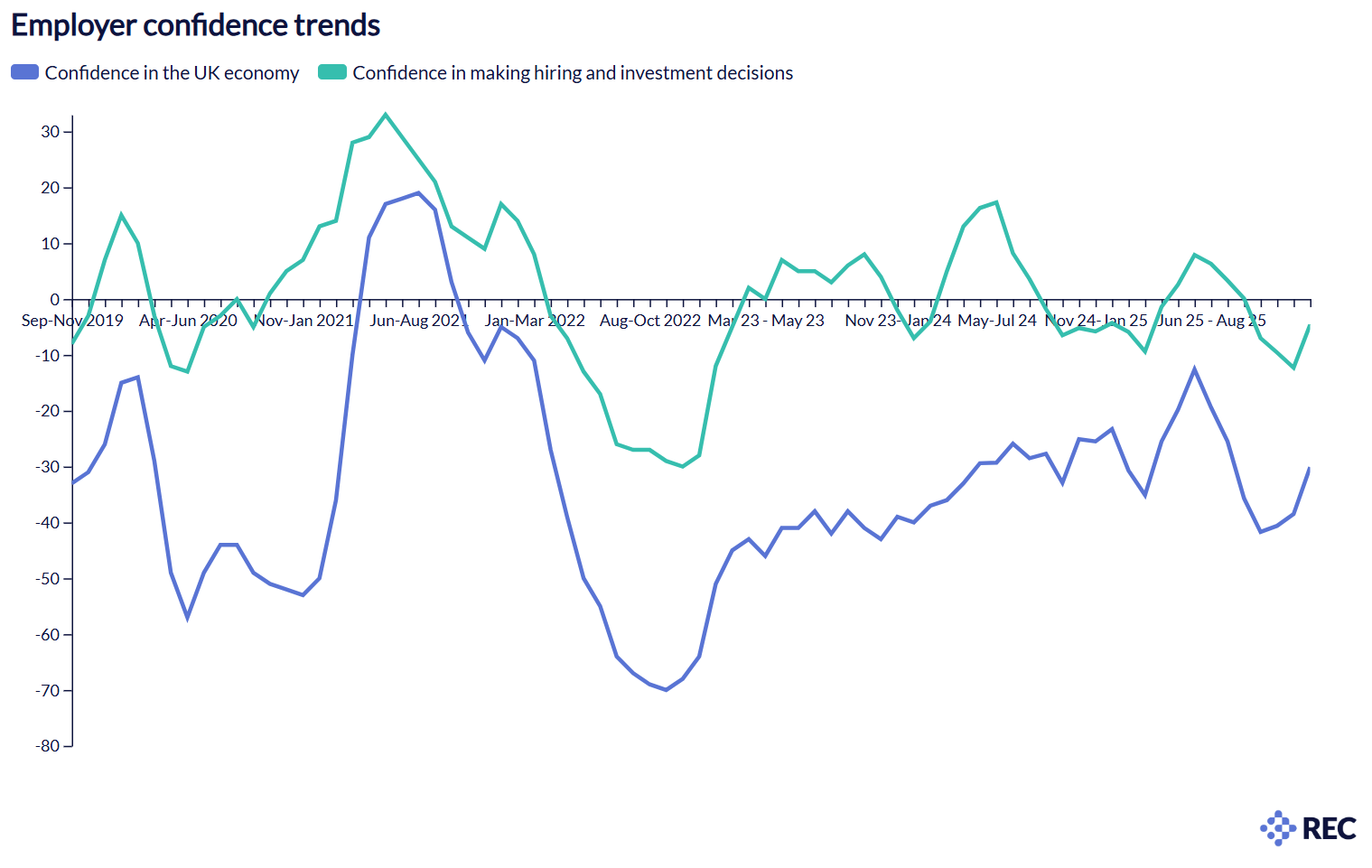
Employer perceptions of how the UK economy was performing improved by 11 percentage points between December 2025 and February 2026 to a net: -30%. While still historically weak, the trend was driven by significant bounce-back in February to net: -16% for the month.
Employer confidence in making investment and hiring decisions in their own business has been consistently more positive than firms’ view of the wider economy and this remains the case, with firms’ belief in themselves increasing in the month of February (+9) for the first time in months. Overall, confidence improved on the quarter to net: -5, from net: -10 last quarter (October–December 2025).
The survey of 709 employers was conducted between December 2025 and February 2026.
Hiring intentions for short-term and medium-term permanent and temporary roles remain in positive territory, with a pick-up in February 2026, reflecting willingness to put this outlook into action by firms.
REC Chief Executive Neil Carberry said:
“All economic data at the moment will be affected by the crisis in the Gulf, but these figures show that there was a change in momentum for business across the UK in the first part of the year. With the cost shocks of the 2024 Budget having worked through the system, and the promise of stability firms began to thaw out long-frozen growth plans. The shock to the global economy from the Gulf crisis is likely to slow this process in March, but initial feedback from REC members suggests any actions by hirers represent delay to plans rather than their cancellation, so there is a good chance of restored momentum if the crisis passes in the next one or two months. A longer crisis, with attendant higher costs of capital for business, higher input costs and supply chain disruption would be a lot more challenging.
“The question now is what the UK government can do to keep momentum in the labour market. This crisis has exposed the weak position the UK is in on the sheer cost of doing business. Greater pragmatism and partnership working on the government’s labour market agenda, along with action to support business on skills and energy, should be a priority. In particular, addressing the design of government proposals for flexible contracts, which prove their worth in uncertain times, is vital.”
A key area of concern in the latest JobsOutlook is London, a powerhouse of the UK economy with a GDP of around £600 billion. Regionally, devolved nations were the most positive (net: +9%) when it came to intentions to hire permanent medium-term workers followed by the North (net: +8%), whereas London and South were more subdued at net: +1. On short-term permanent hiring, this quarter’s regional hotspot was the North with net: +12%, and the area reporting the lowest hiring intention was London with net: +5%. That said, London employers look more intent to hire temporary staff than permanent staff right now, both in short-term and long-term: London recorded the strongest outlook for medium-term temporary hiring for this quarter at net: +11%, while the Midlands is the lowest at net: -1%.
Neil Carberry said:
“Temporary and contract workers are set to play a central role in London’s recovery as firms rely on flexible staffing to move forward. The concern is that when permanent hiring intentions in London lag other regions as is happening now, it indicates caution in London’s economy which normally leads national growth. If London employers hesitate to commit to long‑term roles, it signals uncertainty about demand, revenue prospects and operating conditions.”
Detailed overview of hiring intentions by UK employers
- Permanent recruitment, short-term outlook: Remains in positive territory again this quarter (net: +7%). Across December 2025-February 2026, the balance of short-term permanent hiring sentiment was four percentage points lower than across October-December 2025. This quarter experienced significant decline in the hiring intensions in January (net: +2%) but improved in February (net: +6%).
- Permanent recruitment, medium-term outlook: the balances of medium-term permanent hiring at net: +5%, fell by seven percentage points between December 2025-February 2026. Most of the reduction in sentiment occurred between December 2025 (net: +10%) and January 2026 (net: +3%).
- Overall sentiment for the quarter December 2025-February 2026 stands at net: +6% (five percentage points down from the last quarter),
- Temporary staffing, medium-term outlook: The current outlook for temporary medium-term hiring was still positive (net: +6%), yet sentiment fell by seven percentage points this quarter compared with the previous one. Most of this decline occurred between December 2025 (net: +11%) and January 2026 (net: +2%).