
Manufacturing businesses often rely on precise cutting and shaping technologies to produce parts and products. Two of the most widely used methods today are laser cutting and CNC machining. Both technologies are known for accuracy, automation, and reliability, but they serve different manufacturing needs.
For business owners, engineers, and product designers, choosing the right technology can affect production speed, cost efficiency, and final product quality.
This guide compares laser cutting and CNC machining across several important factors such as precision, material compatibility, production speed, and business applications to help you understand which solution works best.
Key Differences Between Laser Cutting and CNC Machining
Laser cutting and CNC machining both rely on computer controlled systems, but the way they process materials is very different.
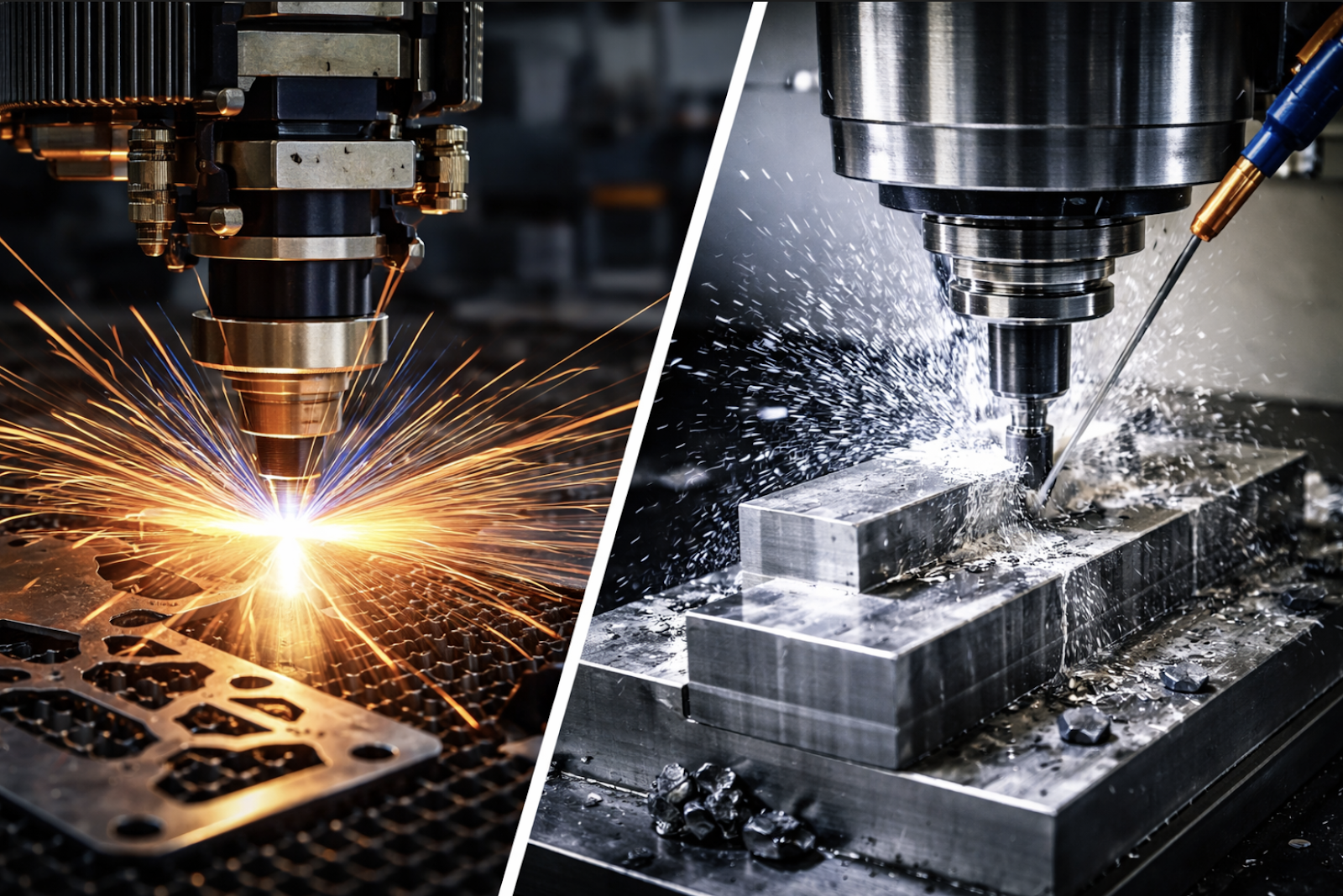
Laser cutting uses a high powered laser beam to melt or vaporize material along a precise path. The beam follows a digital design file and cuts through the surface with extreme accuracy.
CNC machining, on the other hand, removes material using rotating cutting tools such as drills, mills, or lathes. The machine physically cuts away sections of a solid block to create the final shape.
Because of these differences, laser cutting is generally preferred for sheet materials and detailed patterns, while CNC machining is often used for thicker materials and complex mechanical parts.
Precision and Detail Capability
Precision is one of the most important factors in modern manufacturing.
Laser cutting is known for its ability to produce extremely fine details. The laser beam is very narrow, which allows it to create intricate patterns, tight corners, and delicate shapes that would be difficult to achieve with mechanical tools.
This makes laser cutting ideal for industries such as signage, electronics, decorative products, and metal fabrication where clean edges and detailed designs are important.
CNC machining also offers excellent precision, especially when creating three dimensional components. However, the cutting tool has a physical diameter, which can limit how small or sharp certain internal features can be.
For flat parts and detailed designs, laser cutting often provides better visual accuracy and cleaner edges.
Material Compatibility
Material type plays a major role when choosing between these two technologies.
Laser cutting works best with sheet materials such as:
➔ Stainless steel
➔ Carbon steel
➔ Aluminum sheets
➔ Acrylic
➔ Wood
➔ Leather
➔ Paper
➔ Fabric
Because the laser focuses heat on a small area, it can cut thin materials quickly without creating excessive mechanical stress.
CNC machining works with a much wider range of materials, including thicker blocks of metal and plastic. Common materials include aluminum blocks, steel parts, brass, engineering plastics, and composites.
CNC machining is often used when parts require depth, threaded holes, or complex three dimensional structures.
If the goal is cutting flat sheets with precision, laser cutting is usually the better option. For thicker or structural components, CNC machining becomes more suitable.
Production Speed and Efficiency
Production speed can significantly impact manufacturing costs.
Laser cutting machines are extremely fast when processing sheet materials. Once the design file is prepared, the laser can cut shapes rapidly with minimal setup time.
This makes laser cutting highly efficient for high volume production of flat parts, panels, or decorative components.
Businesses that produce signage and metal panels often rely on laser cutting machines from Thunder Laser USA to achieve consistent cutting quality and high productivity.
CNC machining typically takes longer because the cutting tools must physically remove material in multiple passes. Complex parts may require several different tools and operations, which increases machining time.
For flat sheet processing and repetitive designs, laser cutting often provides faster turnaround times.
Surface Finish and Edge Quality
Edge quality is another important factor, especially in industries where visual appearance matters.
Laser cutting produces smooth edges with minimal burrs when the machine is properly calibrated. In many cases, parts require little to no additional finishing.
The heat from the laser also seals certain materials, which can reduce fraying in fabrics or fibers.
CNC machining can also produce high quality finishes, but edges sometimes require secondary finishing processes such as sanding, polishing, or deburring.
However, CNC machining has an advantage when creating perfectly flat surfaces, precise holes, or threaded features that cannot be produced through laser cutting alone.
Cost Efficiency for Businesses
Cost efficiency depends on production type and material usage.
Laser cutting systems often have lower operational costs for sheet based manufacturing. Material waste is minimal because designs can be nested closely together on a sheet.
Setup time is also relatively short, which reduces labor costs.
This efficiency makes laser cutting attractive for businesses producing signage, metal panels, decorative items, or customized products.
CNC machining can be more expensive for large scale cutting tasks because it removes significant amounts of material and requires longer machine operation times.
However, CNC machining becomes cost effective when producing mechanical parts that require thickness, depth, or structural strength.
In many manufacturing environments, companies use both technologies depending on the project requirements.
Business Applications and Industry Use
Laser cutting is widely used in industries such as:
➔ Custom product manufacturing
➔ Signage production
➔Metal sheet fabrication
➔ Decorative design work
➔ Packaging and prototyping
➔ Acrylic and wood product manufacturing
Many small businesses and fabrication workshops rely on laser cutting to produce personalized items and custom parts quickly.
CNC machining is more common in industries that require structural components or mechanical precision, including:
➔ Aerospace manufacturing
➔ Automotive parts production
➔ Tool and mold manufacturing
➔ Industrial equipment
➔ Engineering prototypes
Because CNC machines can create complex three dimensional shapes, they are essential for heavy manufacturing and mechanical engineering.
Scalability and Production Flexibility
Scalability is important for companies planning long term growth.
Laser cutting systems are highly scalable for production environments. Businesses can process large sheets, run continuous cutting jobs, and quickly switch between designs.
This flexibility allows manufacturers to handle both bulk production and custom orders efficiently.
CNC machining also scales well, but production capacity depends heavily on machining time. Complex parts may take hours to produce, which can limit throughput for certain applications.
For high volume flat part production, laser cutting often offers greater scalability.
Final Comparison: Which Technology Is Better?
Laser cutting and CNC machining both play important roles in modern manufacturing. The better choice depends on the type of work you plan to do.
Laser cutting is ideal for sheet materials, detailed patterns, and fast production. It is widely used in industries such as signage, fabrication, and custom product manufacturing.
CNC machining is better suited for thick materials and complex mechanical components that require depth and structural strength.
For businesses focused on precision sheet cutting and high production efficiency, laser cutting is often the more practical solution.












