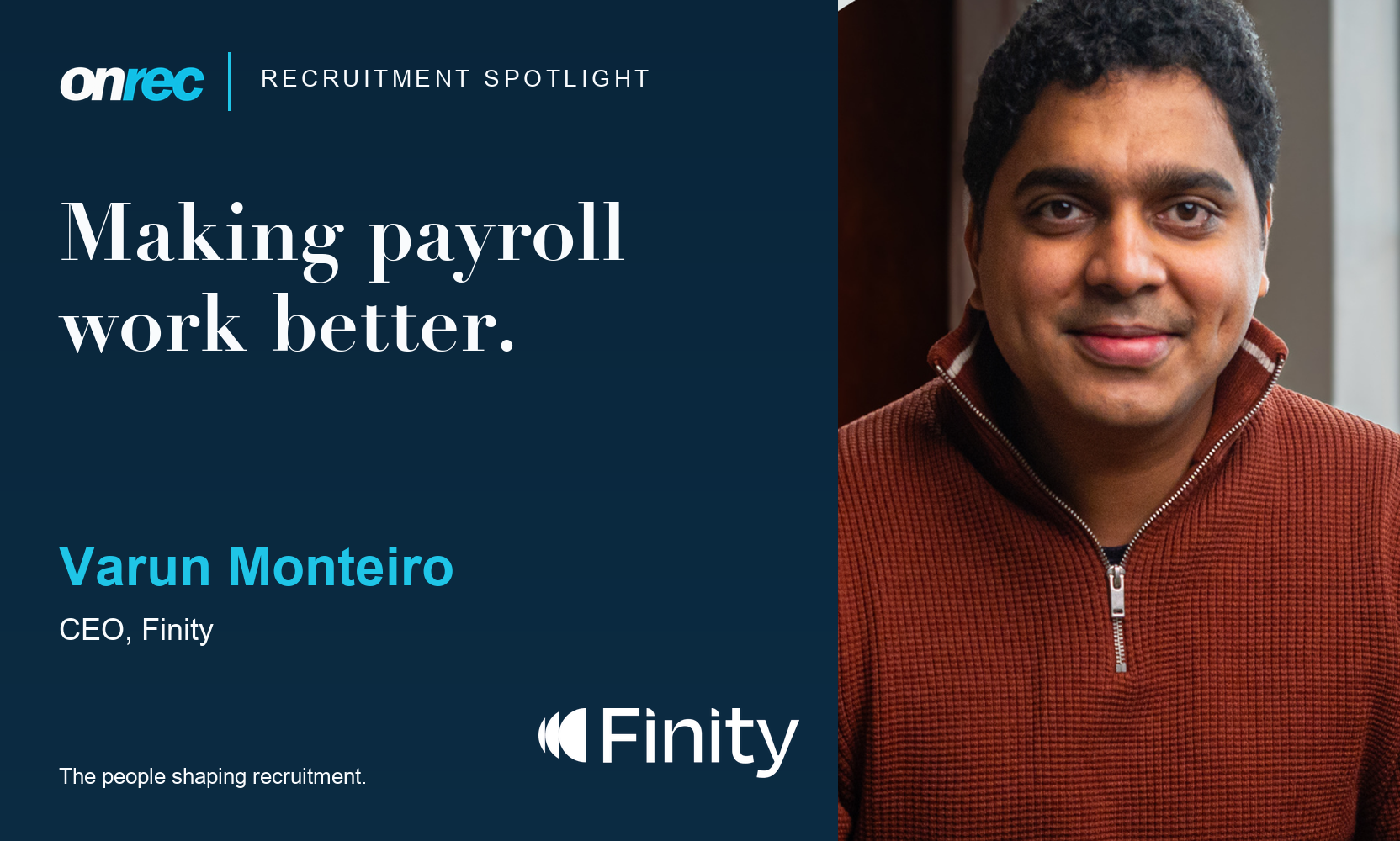
Payroll is a practical test of an employer’s relationship with its people. Finity CEO Varun Monteiro discusses disconnected systems, the role of automation and why a more joined-up approach must still leave room for human accountability.
“Payroll is ultimately too sensitive and important for guesswork.”
Varun Monteiro
Why payroll needs to work better
What problem were you determined to solve at Finity?
I joined Finity in 2020 after a successful exit from another HR tech company. I became CEO in January 2025 when we rebranded to Finity, with an aim to create a recfintech ecosystem that delivers financial unity, keeping payroll teams efficient, their clients happy, and workers paid on time.
Our motivation is simple: payroll shouldn’t be this hard. I’ve spent years watching businesses wrestle with fragmented systems, compliance headaches, and outdated manual processes. What’s always struck me most is how payroll – perhaps the most fundamental part of the employee relationship – was often the most broken.
We have purpose-built software that connects the entire payroll process to simplify and speed up the process of keeping workers paid. Today, over 150,000 workers are paid via Finity.
What are the biggest payroll pain points?
There is a fundamental disconnect between payroll accuracy, compliance, and visibility. Too many organisations are still juggling multiple systems that aren’t integrated with each other. The result is duplicate data, errors, and wasted hours reconciling reports.
Another big pain point is compliance risk. With HMRC’s evolving rules, especially around off-payroll and liability sharing, businesses need real-time assurance that every payment, deduction, and return is compliant. Yet most teams are still working reactively – something we want to tackle head on through our recfintech ecosystem.
Lastly, we can’t forget the human side of payroll. Employees want and need transparency when it comes to their earnings. They expect to understand their pay, deductions, and benefits at a glance, not via cryptic PDFs. So bridging that trust gap is key for payroll professionals - and that’s often where tech steps in.
How is technology simplifying payroll?
At Finity, innovating when it comes to technology is what motivates our team. Our platform uses automation and smart APIs to eliminate manual steps, whether that’s validating timesheets, reconciling tax data, or syncing payroll changes with HR and finance systems in real-time.
We’re also creating advanced solutions that continuously check payroll data against the latest tax rules, flagging risks before they become problems. For HR teams, that means fewer surprises and more control.
For employees, we’ve built a modern, self-service experience. Payslips, adjustments, and tax information are clear, interactive, and instant.
Automation, trust and connected systems
Where can AI help — and where should employers be cautious?
AI is changing the entire business landscape, so in that sense it’s a classic disruptor.
It is also an enabler, but only if applied with real purpose. In payroll, AI and automation can dramatically enhance accuracy, detect anomalies, and even predict compliance risks before they surface. That’s transformative in the long run.
However, companies should be cautious about unchecked automation – AI that makes decisions without transparency.
Payroll is ultimately too sensitive and important for guesswork. At Finity, our approach to AI is about embedding new technologies that support human decision-making, not replace it.
Our goal is to enhance confidence in payroll technology that embraces AI without removing accountability.
How can payroll strengthen employee trust?
It’s true: payroll is rarely in the spotlight, but it’s the one process that touches every employee, every month. If it goes wrong, the employee experience and trust will erode instantly.
We’ve designed Finity to flip the narrative that payroll isn’t experiential. Employees are given real-time access to payslips, adjustments, and tax information that is presented clearly. They can raise queries directly within our platform, track their resolution, and feel informed at every step.
Payroll should be invisible when it’s working perfectly – and reassuring when people have queries. That’s what builds employee trust and engagement.
Why does integration with HR and finance matter?
Payroll intersects HR, finance, and compliance. If those systems aren’t properly integrated, errors are inevitable.
Finity is an integration-first platform. Our APIs allow seamless data flow across HRIS, accounting, and workforce management tools, meaning that changes made in one place update everywhere else. We’ve created a payroll ecosystem that enhances the day-to-day job.
Looking ahead, I see the market moving towards a “connected compliance” model: where payroll isn’t a standalone task, rather a continuously verified process embedded across systems.
How can compliance improve without adding administration?
This is where Finity shines. Our compliance automation is embedded into the entire ecosystem we’ve built. The platform continuously maps against the latest HMRC and employment regulations, so users are alerted to changes that affect them before they become an issue.
For example, with the upcoming Joint and Several Liability rules, our engine can model potential exposure points across supply chains, helping businesses mitigate the risk early on.
Our end goal is to reduce the admin burden and encourage proactive compliance. We want to make sure that organisations stay ahead of regulation, without adding unwanted layers of complexity.
The next stage of payroll
What could payroll look like in five years?
In five years time, payroll will be practically hands-free given the AI innovations being embedded into most payroll products, which will allow users to run payroll from their phone or via voice command.
With AI embedded properly in the payroll process, it will significantly reduce reconciliation time and be used to carry out real-time data analysis for fraud prevention.
What makes moving from legacy systems difficult?
Change is often one of the biggest fears for any organisation. With years worth of data on legacy systems, a huge question will be whether to migrate that existing data onto a new platform versus making a back-up and moving to a new platform.
Another adoption challenge is pricing. Although legacy systems are very price competitive, they have their limitations. Newer systems have a lot of flexibility and usually more features than a legacy system, which can come with a slightly higher price.
What comes next for Finity?
In the next two to three years, Finity will have a fully embedded payroll ecosystem (embedding everything from onboarding through to payments) that services both the middle and back office functions.
By achieving this, we aim for Finity to be the software of choice to pay over 500,000 workers per month in two years time.
Quick fire with Varun Monteiro
Q. What’s the best business advice you’ve ever received? If it is important to you, you’ll find a way – or else you’ll find an excuse.
Q. Coffee or tea? 100% tea – more specifically the Indian Masala chai.
Q. One HR tech trend you think is overrated? AI-driven personality or culture-fit assessments. These tools claim to use AI – often via gamified tests, facial analysis, or language models – to predict whether someone is a “good cultural fit” or will perform well in a role.
Q. Who inspires you most in the world of business? Elon Musk. The vision and speed at which he gets things done is unbelievable, not least when navigating the cost relative to what most people anticipate things would cost to build.
Q. If you weren’t building Finity, what would you be doing? I’d be in the commodity space (precious metals and oil specifically).