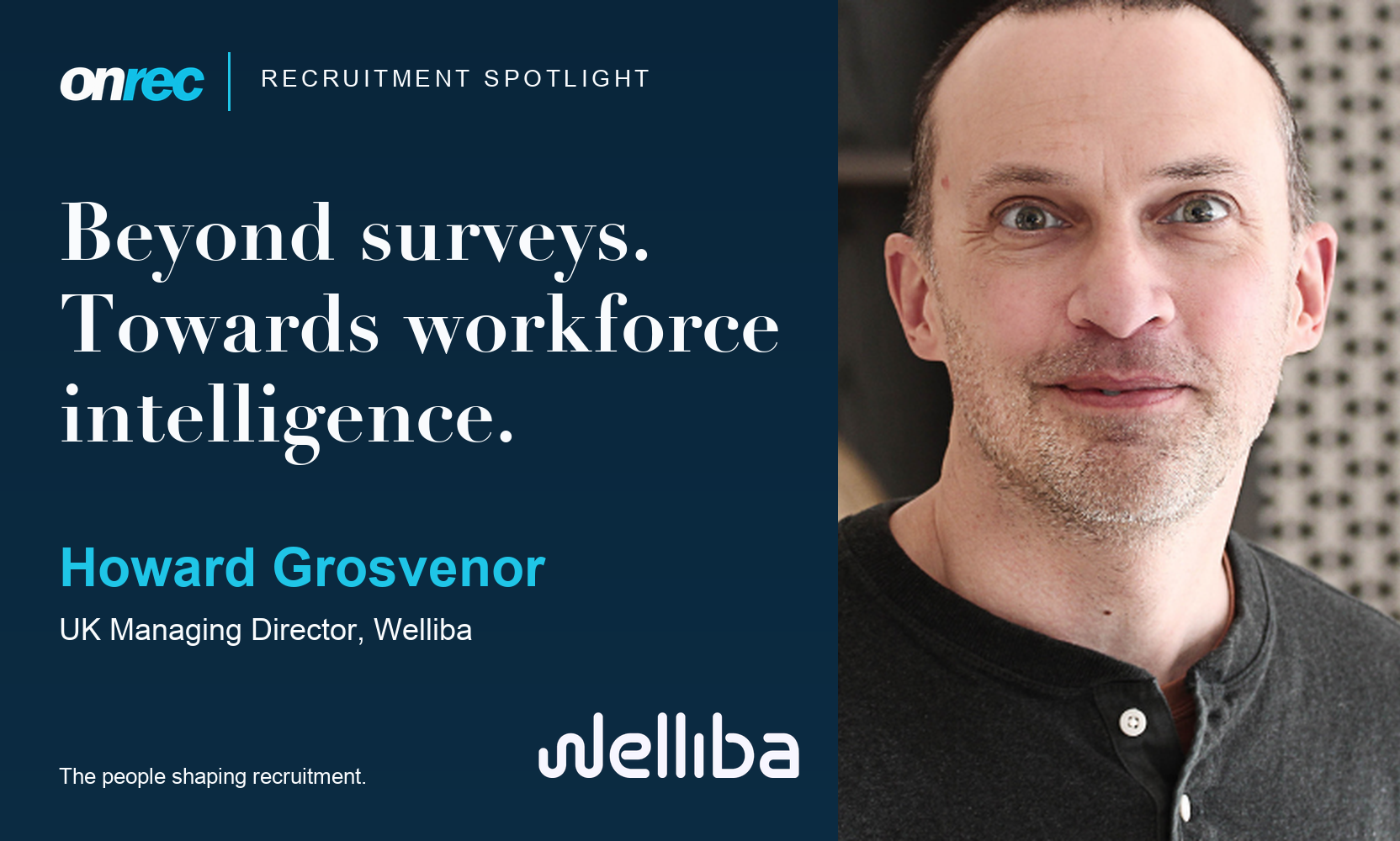
An engagement score can tell employers how people feel without explaining what to change. Howard Grosvenor discusses how Welliba approaches that gap, combining workforce data and behavioural science to help leaders understand employee experience and decide where to act.
“AI should strengthen human judgement, not replace it.”
Howard Grosvenor
Looking beyond the engagement survey
What problems is Welliba helping employers solve?
Welliba is a human capital intelligence company. We built EXcelerate to give people and business leaders a fast, scientifically grounded view of how their organisation and their competitors are seen as places to work, drawing from millions of publicly available workforce signals to produce actionable insights.
The insights are designed for leaders in HR, Talent Acquisition, and People Analytics, covering areas including Employee Experience (EX), Candidate Experience (CXP), and Employer Brand and Employee Value Proposition (EVP). Every insight is evaluated through a validated behavioural science framework and powered by agentic AI, so what leaders receive is not raw data but clear, actionable intelligence they can use to make faster, more informed decisions.
For most organisations, that kind of clarity has historically taken weeks or months to produce. EXcelerate delivers it within days of the scope being finalised, and because it draws on external, public data, it captures what candidates and competitors' employees are saying about employers, a view that internal surveys cannot reach.
What are employers missing about their workforce?
Our experience is that most organisations are heavily reliant on traditional surveys to understand their workforce. Surveys do an effective job of surfacing broad workforce sentiment, but they tend to struggle to isolate the specific factors affecting retention, performance, or competitive position. We regularly speak with clients who have consistently strong survey scores but still can't confidently say what is driving those scores, or whether there is something they are not yet measuring.
The second issue is structural. Internal surveys, by definition, only capture what current employees are willing to say in a structured format at a particular moment in time. They don't tell you what departing employees genuinely believe, what candidates think before they've even applied, how candidates experience the application process, or how your employer brand compares directly to your competitors in the talent market. That external view is often where the most actionable intelligence sits, and it's the piece most organisations are currently missing.
How does your approach differ from traditional surveys?
Traditional surveys are useful, but they are limited by the questions you ask, the timing of the exercise and the willingness of people to respond. Welliba takes a different approach. Our EXcelerate solution uses AI to gather and process large volumes of publicly available workforce data, then interprets it through a validated behavioural science and psychometric framework. That means we are not simply spotting sentiment, we are mapping it to meaningful drivers that provide deeper levels of insights on areas such as Employee Experience (EX), Candidate Experience (CXP), and Employer Brand and Employee Value Proposition (EVP).
Because we're working with publicly available data, we're able to validate our approach in ways that traditional survey methods can't. Our S&P 500 analysis found that organisations that rank in the top 100 for employee experience outperformed the rest of the market by 5% in total shareholder return over five years. We've extended that same methodology across other external benchmarks and consistently find the same pattern. EXcelerate predicts an airline's Skytrax ranking with 76% accuracy, and airlines with an EX-score above 80 are six times more likely to appear in the Skytrax Top 20. In UK retail banking, our analysis of Which? customer satisfaction data found that the Rewards factor correlates at 47% with customer satisfaction scores. In the US, banks where employees report strong colleague relationships show almost 50% higher JD Power satisfaction scores. We're no longer making a theoretical argument about the link between employee experience and business performance. We can show it directly, across industries and geographies.
Turning workforce insight into action
How can HR balance retention, wellbeing and performance?
There is no single formula that works for every organisation. The best place to start is by understanding your current position clearly, so you can identify where the biggest opportunities for improvement sit. That means looking not only at your own workforce experience, but also at how you compare with competitors, because that external perspective can highlight both gaps and opportunities.
That's exactly what EXcelerate is designed to help with. By identifying the specific boosters and blockers of employee experience in your organisation and comparing your position against named competitors rather than vague industry averages, HR leaders can make a focused case for where to invest, rather than spreading effort thinly across multiple areas. Our work with Louis Vuitton is a good illustration: by targeting interventions based on employee experience insights, they saw a 7% increase in eNPS promoters, a 6% improvement in physical wellbeing, and a 4% decrease in absenteeism - meaningful improvements across more than one dimension from a focused, evidence-led approach. Knowing not only where you stand, but where your talent competitors are pulling ahead, helps HR leaders prioritise the factors that are most likely to move the needle and make a confident case to leadership for where the investment should go.
Where can AI help people strategy — and where is caution needed?
AI adds the greatest value where there are clear efficiency gains against existing processes that rely on human analysis, producing insights that guide decisions rather than make them. One such example is when there is too much unstructured information for humans to process quickly and consistently. That includes spotting patterns across large volumes of workforce data, surfacing hidden risks, identifying emerging themes and helping leaders move faster from signal to action.
Where organisations should be more cautious is in high-stakes use cases that affect individuals directly, especially if the system does not produce clear explanations of how it arrived at its decisions and recommendations or is poorly governed. In HR, explainability, fairness, privacy and clear boundaries matter. AI should strengthen human judgement, not replace it. The question worth asking of any AI vendor in this space is not only what the system produces, but how it was validated and what happens when it gets something wrong.
How do you turn workforce insights into action?
This is exactly where many organisations get stuck. They have data, but not enough clarity on what matters most or what to do next. EXcelerate helps by converting complex workforce signals from public data sources into a structured model, benchmarking them against named competitors or industry peers across areas including Employee Experience (EX), Candidate Experience, and Employer Brand and Employee Value Proposition (EVP).
What makes this actionable rather than purely informative is the combination of competitive context and speed. Organisations often discover they are outperforming competitors in areas where they assumed they were at a disadvantage, while also surfacing risk areas they were previously unaware of. That clarity makes it far easier to prioritise and build a confident business case for investment. And because EXcelerate delivers insights within days of scope being finalised, leaders can act while the findings are still relevant rather than waiting months for results that are already out of date.
Why should employers take a proactive approach to wellbeing?
Compliance tends to be seen as an end point, not a start point. The organisations that treat areas such as psychosocial risk and employee wellbeing as a regulatory checkbox tend to only discover problems after they've already affected performance or reputation. This often shows up through increased absence, attrition spikes, or a deterioration in employer brand that impacts recruitment pipelines before it surfaces in internal reporting.
Welliba's research found a correlation of 0.76 between employee experience scores and customer satisfaction across 100 global airlines, highlighting that the internal culture of an organisation can have measurable consequences for how it performs externally. Public sentiment data is continuously available, and organisations that are listening externally can identify early signals of psychosocial risk before they escalate. That's a very different position to be in than waiting for the next engagement survey cycle to surface a problem that's been building for months.
What employers should watch next
Which changes in employee expectations stand out?
Three trends stand out from the data we're seeing across our client base and in our wider research.
The first is the persistent gap in bottom-up communication, which ranked as one of the lowest-performing factors across 56% of organisations in the S&P 500. Employees across sectors consistently report that their voice doesn't reach decision-makers in any meaningful way. This is a factor that often goes unmeasured in traditional listening programmes, yet its impact can be far-reaching: left unaddressed, it raises the risk around psychological safety and the consequences this can have on engagement, performance, and employer brand.
The second is the widening gap between Employee Value Proposition (EVP) messaging and lived employee experience. Organisations are investing in employer brand, but the external talent market is increasingly sophisticated at distinguishing genuine culture from positioning. New joiners are quick to recognise the disparity between what was communicated to them during the recruitment process and what they experience in practice. This type of information quickly surfaces in passive data on employee review sites, social media and forums, and candidates notice.
The third is a pattern our research identifies as the "Unhappy Performer": organisations with strong revenue growth but declining employee experience scores. These companies are at elevated risk of attrition because they're drawing down on goodwill without replenishing it. Strong financial performance can mask the warning signals for a period, which is exactly what makes this pattern worth watching closely.
What warning signs should employers watch for?
There are several that appear consistently in external data before they surface in internal metrics.
A sustained decline in the quality and volume of positive content about an employer across public channels is often an early signal, particularly if it's concentrated among specific teams or role types. When employees stop actively recommending a company as a place to work, that pattern tends to precede increased attrition. This tends to be accelerated when competitive intelligence reveals that the organisation is falling behind key competitors on the factors that matter most to talent.
A second warning sign is when a visible gap opens between Employee Value Proposition (EVP) messaging and what employees are experiencing in the workplace. EVP messaging that highlights career progression, flexible working, company brand and reputation, or physical wellbeing, but doesn't reflect the day-to-day reality for employees, tends to generate disengagement quickly.
Third, and perhaps most underappreciated, is the pattern where an organisation is performing well commercially but their employees are reporting low scores on autonomy, recognition, and voice. That profile tends to predict sudden rather than gradual attrition, because there's no obvious trigger that leaders can identify and respond to in advance.
What comes next for Welliba?
We're continuing to evolve EXcelerate to address the challenges that matter most to our clients. One focus is expanding the models we measure, adding dedicated lenses for Employer Brand, Candidate Experience, and Leadership Experience. This also means broadening the sources we draw on, not only focusing on current employees, but also including data from candidates, past employees, the organisation's own employer brand communications, customers, and investors, to build a genuinely complete picture of how an organisation is experienced from every angle.
We're also developing more intuitive ways for clients to interact with their insights, including the ability to query their data in plain language and get to the key findings faster without needing to navigate complex reports.
The third area is macro-level research. Building on studies like our S&P 500 and FTSE 100 analyses, and our work with external benchmarks including Trustpilot and Skytrax, we're continuing to deepen our understanding of how employee experience connects to business performance across industries and geographies. These studies would simply not be possible using traditional methodologies, and the findings consistently reveal patterns about how people experience work that change how leaders think about people strategy. That shift, from periodic listening to continuous, externally grounded intelligence, is what excites me most about where this field is heading.
Quick fire with Howard Grosvenor
What’s one workplace trend you wish would disappear?
New names for old things; cue discussion about what’s different between a competency and a skill
If you could give HR leaders just one piece of advice for the next 12 months, what would it be?
Now is the time to challenge your assumptions about how things get done. Do you really have to do things the way you have always done them?
What’s the best career advice you’ve ever been given?
Be clear on the dream, and then for every career decision ask yourself – Does this move me closer to / further away from / the same distance from the dream?
Coffee catch-up or virtual meeting?
Always in-person, so coffee catch-up please
Outside of work, what helps you switch off and recharge?
Mountains!
A big thank you to Howard Grosvenor for taking part in this Q&A and sharing his perspectives on AI, employee experience and the future of workforce intelligence.
Welliba is a trusted Onrec partner and continues to help organisations make smarter, evidence-based people decisions through its innovative blend of behavioural science and AI-powered insights.