Non-compete clauses are designed to prevent an employee from working for a competing business or starting their own competing business for a period of time after they leave their job.
In a January 2026 online survey of 238 employers of different sizes and locations, undertaken by REC/Whitestone Insight, 55% of respondents said that non-compete clauses were ‘very important’ or ‘fairly important’ to their business – with only 17% stating that they were not important.
An all-out ban on non-compete clauses means highly portable trade secrets can more easily be taken to a competing firm, or be used to start a rival business. They are vital to protect intellectual property. And there is no reason for intellectual property to enjoy any less legal protection than tangible property, argues the REC. The unfair advantage could threaten the viability of existing firms and the jobs of their employees.
In contrast, REC suggests a statutory six-month limit on the length of non-compete clauses would appropriately balance competing interests if the government is adamant on reform.
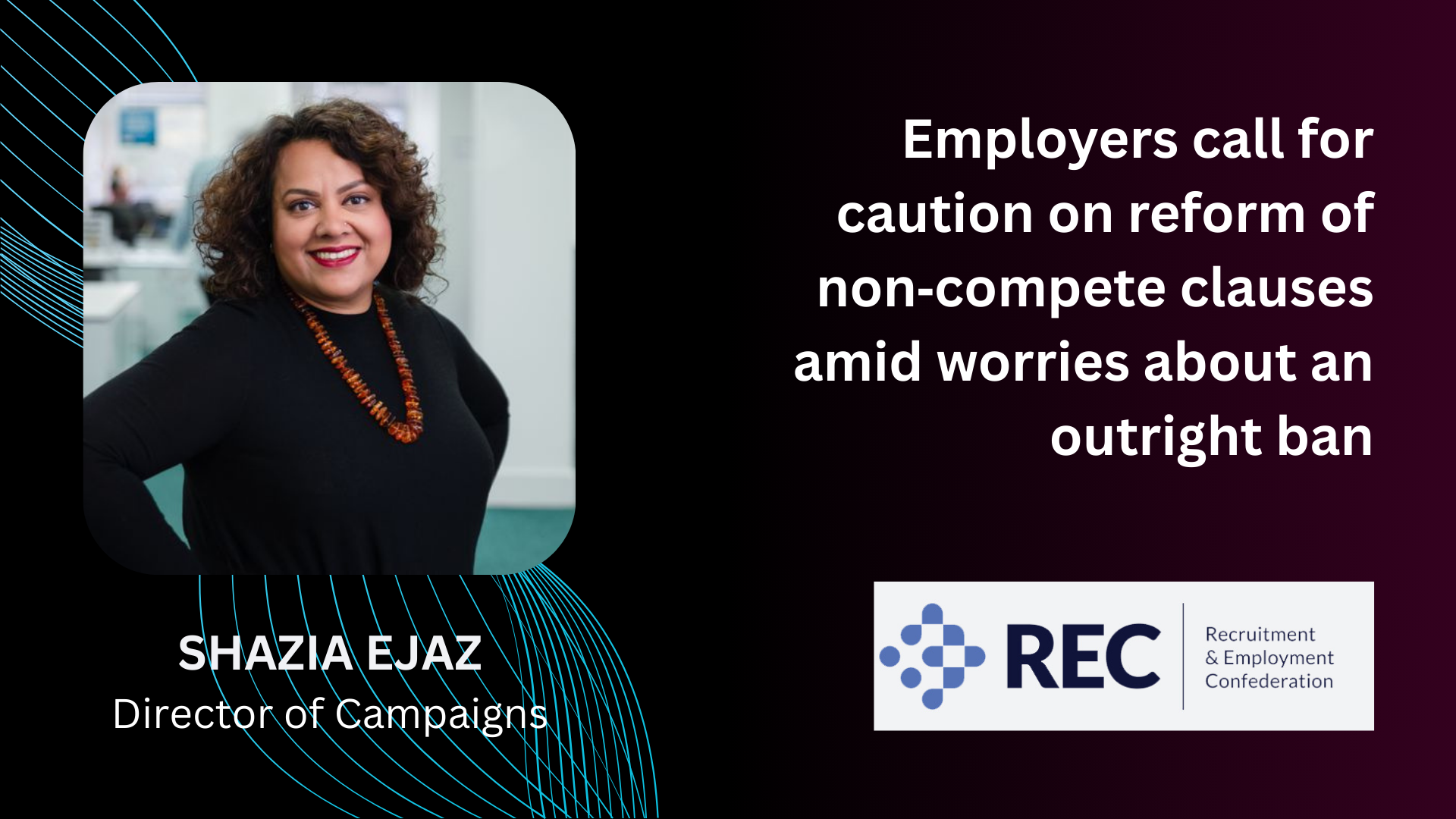
Shazia Ejaz, REC Director of Campaigns, said:
“Non-competes work well on the whole, but a time-limit on their length is a reasonable middle ground to protect both employer and worker.
“The use of non‑compete clauses gives firms the confidence that their confidential information, intellectual property, trade secrets and customer relationships will not easily land in a rival’s hands. Strip away that protection and you weaken the UK’s reputation as a place where enterprise can flourish and businesses can grow.
“If employers cannot trust that their investment in training staff will pay off and instead fear their rivals will be the ones to gain when staff walk straight into a competitor’s arms, they will be reluctant to invest in their people. We need employer incentives to make sure they are skilling up staff and need to watch for policies that may possibly disproportionately affect younger people who are already facing what the government calls a ‘crisis of opportunity’.”
Service sector businesses include business services, finance, retail, travel, and recruitment, among others, are particularly vulnerable to any ban on non-competes. Such a ban would be a blow for the UK’s £40 billion recruitment industry, for example. A few REC members even specifically avoid doing business in jurisdictions which do not enforce non-compete clauses.
Shazia Ejaz said:
“The need for government to achieve a workable balance for employees and employers in these reforms is crucial to the recruitment sector. Recruiters who have nurtured client relationships and knowledge of key information, such as clients, candidates, rates, prices, and sales strategies, for their former employer can cause serious financial damage if they were to take the information to a competitor recruitment firm or set up their own firm. The loss of confidential information to a competitor could lead to the closure of the business.”