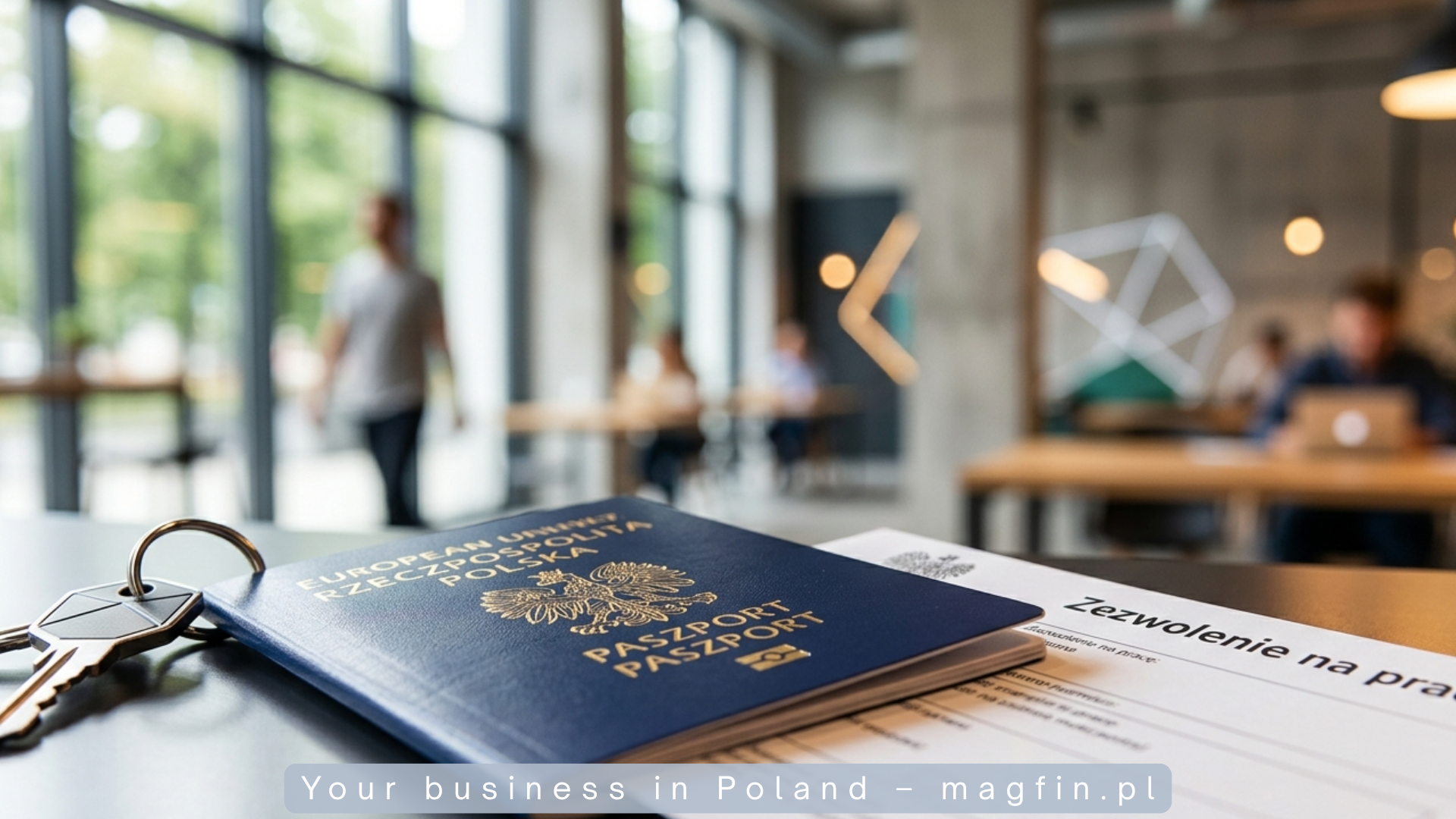
Poland has become one of the most attractive hubs for tech startups in Europe. Low operating costs, access to the EU market, and relatively accessible relocation programs (such as the former Poland Business Harbour initiative) created the illusion of an “easy start.” However, the statistics are unforgiving: a large share of founders from CIS countries and non-EU states make a fundamental mistake already at the registration stage — one that can ultimately lead to deportation.
The root of the problem is the desire to optimize taxes through a B2B contract while simultaneously needing a work permit and residence permit (Karta Pobytu).
The Main Characters of the Drama: Employment Contract vs B2B
To understand where founders go wrong, it is important to break down the two opposite models of legalization within a Polish company.
1. Employment Contract (Umowa o pracę)
This is the traditional and fully compliant option. You are officially employed by your own company.
Advantages:
➔ Ideal from the immigration authorities’ perspective
➔ Full social security coverage
➔ Paid vacation and sick leave
Disadvantages:
➔ The highest tax burden
➔ To receive a net salary of approximately 10,000 PLN, the company may need to spend nearly 17,000 PLN once taxes and ZUS contributions are included
2. B2B Contract (JDG — Sole Proprietorship)
You register as an independent entrepreneur and issue invoices to your startup.
Advantages:
➔ Significantly lower taxes (especially under the Ryczałt regime or IP Box)
➔ More cash remains available during the early stages of the business
Disadvantages:
➔ Complicated legalization process for foreigners
➔ Risk of being accused of “sham self-employment”
The Tax Savings That Can Cancel Your Visa
The scenario followed by many founders looks like this:
➔ A Spółka z o.o. (limited liability company) is registered.
➔ The founder wants to reduce taxes, so instead of receiving a salary under an employment contract, they structure themselves as a B2B contractor.
➔ When applying for a residence permit or visa, the founder is presented as a “Management Board President” (Prezes Zarządu) or “key specialist.”
Where Is the Catch?
Polish law clearly separates company management from the provision of services. If you stay in Poland on the basis of a work visa or residence permit issued for a specific role within a company, your actual activities must correspond to the work authorization granted (Zezwolenie na pracę).
The Core Conflict
If your work permit states that you are employed as a “Director,” but in reality you operate as a sole proprietor (B2B) and pay taxes as an external contractor, then from the legal perspective you may be working illegally.
Border Guard Inspections: When the “Scheme” Stops Working
During inspections or while reviewing residence permit applications, the Polish Border Guard (Straż Graniczna) focuses not on how much code you have written, but on the legal basis of your stay in Poland.
How Visa Cancellation Happens
1. Mismatch Between Declared and Actual Purpose of Stay
If you obtained a visa as an employee but do not actually have an employment contract (Umowa o pracę or Umowa zlecenie), the authorities may conclude that your visa was issued on false grounds.
2. Sham Self-Employment
Authorities may see that:
➔ your sole proprietorship has only one client (your own company),
➔ you work from the company’s office,
➔ and you use company resources.
This can be interpreted as an attempt to avoid taxes and labor obligations.
3. The Outcome
Straż Graniczna may initiate visa cancellation proceedings and issue a deportation order (zobowiązanie do powrotu), including a ban on entering the Schengen Area for a period ranging from 6 months to 3 years.
Risk Comparison Table
Taxes
➔ Employment Contract: High (often 40%+ effective burden)
➔ B2B: Lower (typically between 8.5% and 19%)
Immigration Authorities’ Attitude
➔ Employment Contract: Maximum level of trust
➔ B2B: Increased likelihood of additional scrutiny
Deportation Risk
➔ Employment Contract: Minimal, provided the business activity is genuine
➔ B2B: High if the structure does not match the actual activity
Accounting Complexity
➔ Employment Contract: Relatively simple; most responsibilities fall on the company accountant
➔ B2B: More complex; requires separate accounting for both the company and the founder’s sole proprietorship
How to Structure Things Correctly
If your goal is not merely to open a business in Poland, but to develop it successfully without legal conflicts, it is better to follow the principle of “security over tax savings” from the very beginning.
To avoid a situation where a startup collapses because its founder is banned from entering the country, consider the following:
1. Use a Combined Structure
The founder can be appointed as a management board member (Powołanie) while also receiving a minimum necessary salary under an employment contract. This is generally considered one of the safest ways to obtain a residence permit and secure a lawful basis for staying in Poland.
2. Keep B2B Activities Clearly Separated
If you decide to use B2B for certain tasks after opening a business in Poland, ensure these are genuine independent services (for example, software development work). These services should not duplicate your executive or director responsibilities.
It is also important to have the correct work authorization for operating as a sole proprietor, unless you hold a privileged status such as a Polish Card (Karta Polaka).
3. Consult a Lawyer Before Launching
Trying to save several hundred euros on legal support at the stage of setting up a business in Poland often results in losing both the company and the right to remain in Europe.
Remember: a properly structured legal foundation is just as important as working software code.
Final Verdict
Poland remains an excellent place to build and scale startups. However, attempting aggressive “tax optimization” while simultaneously relying on immigration documents is effectively a gamble — and in such situations, the state usually wins.
Do not allow a bureaucratic mistake to destroy your product, your company, or your future in Europe.