The HR technology market is entering a period of rapid, sustained growth. What was once considered a support function is now a strategic pillar for organisations that want to attract talent, retain people, remain compliant, and operate efficiently. From core HR platforms to talent acquisition tools, workforce analytics, and employee experience systems, HR tech is becoming one of the most important investment areas across modern businesses.
And the numbers are backing that up.
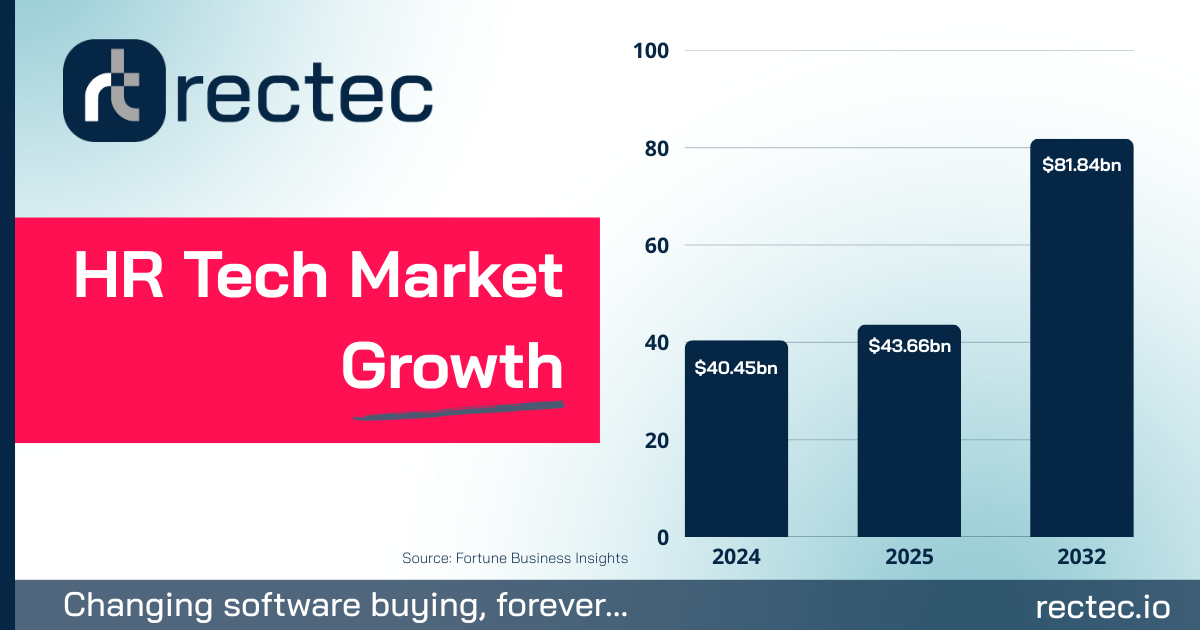
According to Fortune Business Insights, the global HR technology market is estimated at $40.45bn in 2024, and projected to reach $81.84bn by 2032. That is extraordinary growth, and it signals a clear reality: HR tech is no longer a niche category - it is a global industry in full acceleration.
But as exciting as this growth is, it also creates a new challenge. For HR and TA leaders, the question is no longer “Is there technology available to solve this problem?” The question is now “How do we choose the right technology, quickly and confidently, in a market that is expanding so fast?”
As Rectec founder Rob Green explains: “HR tech is booming, and that’s a brilliant thing for the industry. But it also means buyers are facing more choice, more noise, and more complexity than ever before.”
Growth is good news - but it comes with new pressure
Market growth is often associated with opportunity, and in HR tech that is absolutely true. More investment fuels more innovation. It enables vendors to build better products, enter new regions, develop integrations, and improve user experience. It also encourages new entrants into the space, creating a steady stream of fresh ideas and specialist solutions.
However, growth also brings pressure - particularly on the buying side.
As the market expands, the number of solutions available increases rapidly. Categories evolve. Terminology changes. Products begin to overlap. Capabilities become harder to compare. And while more competition can be healthy, it can also make it harder for buyers to separate meaningful differentiation from marketing claims.
That is why, despite record levels of innovation, many HR leaders still describe software buying as one of the most time-consuming and frustrating projects they face.
Rob Green puts it simply: “More money in the market means more vendors, more noise, and more claims. The problem for buyers isn’t finding options anymore. It’s finding clarity faster.”
Why HR tech decisions are becoming harder, not easier
It would be reasonable to assume that as HR technology matures, the buying experience should become simpler. But in many cases, the opposite is happening. Buyers are navigating a market where:
- Vendors are increasingly specialised, with new tools emerging for every sub-process
- Capabilities overlap across platforms, making feature comparison difficult
- Internal stakeholders are expanding beyond HR to include IT, finance, procurement, and security
- Integration requirements are more complex as organisations build multi-platform ecosystems
- Implementation and adoption expectations are rising, with pressure to deliver outcomes quickly
The result is that HR tech selection is rarely a straightforward purchase. It is often a multi-stage evaluation process involving multiple teams, competing priorities, and a significant investment of time.
In many organisations, this complexity leads to one of two outcomes. Either decisions get delayed, or teams settle for “good enough” solutions simply to move forward. Both outcomes can carry long-term cost, whether through lost productivity, lower adoption, reduced ROI, or the need to re-platform sooner than planned.
The biggest blockers are rarely technical
What is particularly striking is that the biggest blockers to HR tech progress are often not technical at all.
In practice, HR and TA leaders tend to face four consistent challenges when making decisions:
- Time - selection projects take too long, and internal teams are already stretched
- Risk - nobody wants to choose the wrong platform and live with it for years
- Budget - even strong business cases can stall under financial scrutiny
- Internal alignment - stakeholder needs differ, and consensus is difficult to reach
These barriers are especially relevant in a fast-growing market. When the industry is moving quickly, delays become more expensive. What felt like a reasonable six-month decision cycle in the past can now mean missing the window for improvement, falling behind competitors, or losing confidence internally.
As Rob Green explains: “The opportunity for buyers in 2026 isn’t finding more options. It’s getting to the right decision with confidence, without wasting months of time.”
Rectec’s role - helping buyers get to the right technology fast
At Rectec, our mission is clear: changing software buying, forever.
We exist to support the HR tech ecosystem by making the buying process faster, clearer, and more confident for employers and recruitment teams. As the market grows, this need becomes even more urgent. HR leaders do not need more vendor lists, more jargon, or more generic comparison tables. They need relevance, structure, and a route to decisions that genuinely fit their organisation.
That is exactly what Rectec delivers.
Rectec Copilot is designed around one simple outcome: creating highly matched, tailored recommendations to each organisation’s needs. This means buyers can quickly move from uncertainty to clarity, with a shortlist that reflects their priorities, context, and requirements.
Rather than starting from scratch, organisations can use Rectec to:
- Identify the most relevant software options for their needs
- Reduce time spent researching and filtering the market
- Compare solutions more effectively, with a consistent framework
- Build internal alignment faster by clarifying requirements early
- Improve decision confidence through a more structured buying journey
In a market projected to grow from $40.45bn in 2024 to $81.84bn by 2032, the scale of choice will only increase. And with that, the value of a trusted route to clarity becomes even more important.
Rob Green summarises it clearly: “Rectec is here to support the industry. When HR tech is growing this fast, buyers need help cutting through the noise and getting to the right technology quickly.”
HR tech leaders take action
The HR technology market is expanding rapidly, and that growth is creating real opportunity - for vendors building solutions, and for employers modernising their people operations.
But growth also brings complexity, and the winners in this new era will be the organisations that can move quickly, make confident decisions, and implement technology that truly fits.
If you are reviewing your HR tech stack this year, or planning a change in 2026, now is the time to create clarity. Rectec is here to help you get to the right technology fast, with less noise, less wasted time, and more confidence in the outcome.
If you are in the market, we invite you to register for our service at https://rectec.io/register and let us support your next decision.
As Rob Green concludes: “HR tech growth is exciting, but it should not make buying harder. Our job is to make sure the industry’s momentum translates into better outcomes for buyers, vendors, and the people they serve.”