Fine motor skill, expert tactile judgment, and the limits of robotics in occupations where human perception cannot yet be replicated
A decade of research on job computerization has consistently identified two attributes as protective against automation: fine motor dexterity under conditions of material unpredictability, and expert judgment exercised in real time on the basis of sensory feedback. Occupations requiring both tend to rank at the low-risk end of automation probability scores. Stone setting in fine jewelry is one of the clearest cases.
Specialized stone setting schools in Europe, among them Rome's Accademia delle Arti Orafe which has trained gem setting professionals for over four decades, have documented growing interest from people retraining out of high-risk sectors. The combination of stone setting, diamond setting, and microscope setting skills these programs develop corresponds directly to the capability profile that automation research marks as durable. Mastery in this field demands calibrated, variable-feedback work that current robotics cannot replicate.
What the major automation studies actually measure and what they find
The field began in earnest with a 2013 paper by Carl Benedikt Frey and Michael Osborne at the Oxford Martin School, University of Oxford, which estimated approximately 47% of US employment to be at high risk of computerization. The study's methodology did not predict simple task replacement. It assessed the probability that an entire occupation's task bundle could be replicated algorithmically, weighting that probability against specific bottlenecks: perception and manipulation in unpredictable environments, creative intelligence, and social intelligence requiring real-time human interpretation.
Subsequent studies revised the headline figure depending on methodology and country, but the underlying taxonomy of automation bottlenecks held across the literature. The OECD's 2016 follow-up, which assessed task-level rather than occupation-level risk, found that most workers in high-risk occupations spend the majority of their time on tasks that fall outside the automation boundary. The distinction between job title and actual task composition mattered enormously.
What emerged was a clearer picture of where the boundary sits. Routine cognitive work, even complex routine cognitive work, proved more vulnerable than researchers expected. Tactile and judgment-intensive tasks proved more resistant. The boundary does not track white collar versus blue collar, or skilled versus unskilled. It tracks whether a task requires sensing and responding to physical variation in real time.
Why tactile precision and expert judgment resist technological substitution
The engineering challenge of replicating fine motor skill is genuinely hard. Industrial robots excel at repetitive tasks in controlled environments where tolerances are fixed and material properties are consistent. Precision craft work presents the opposite: material variation, unpredictable micro-surfaces, and outcomes that depend on continuous sensory adjustment.
Robotic systems handling gem setting would need to read tension in a metal prong through pressure feedback, identify micro-fracture risk in a stone surface, and adjust tool angle mid-movement based on what the tool encounters. Current robotic hardware and computer vision systems can approximate some of these functions in isolation. Integrating them with the reliability of a trained human hand has not been achieved, and the engineering literature does not suggest it is close.
Expert judgment adds a further layer. Experienced practitioners in precision crafts do not follow fixed decision trees. They hold a model of how a material should behave, notice when it deviates, and adapt technique without interrupting the work. This dynamic, feedback-driven expertise is the category that automation researchers have consistently struggled to formalize. The knowledge is embedded in practice and difficult to specify even by those who possess it.
Stone setting as a benchmark for automation-resistant craft skill
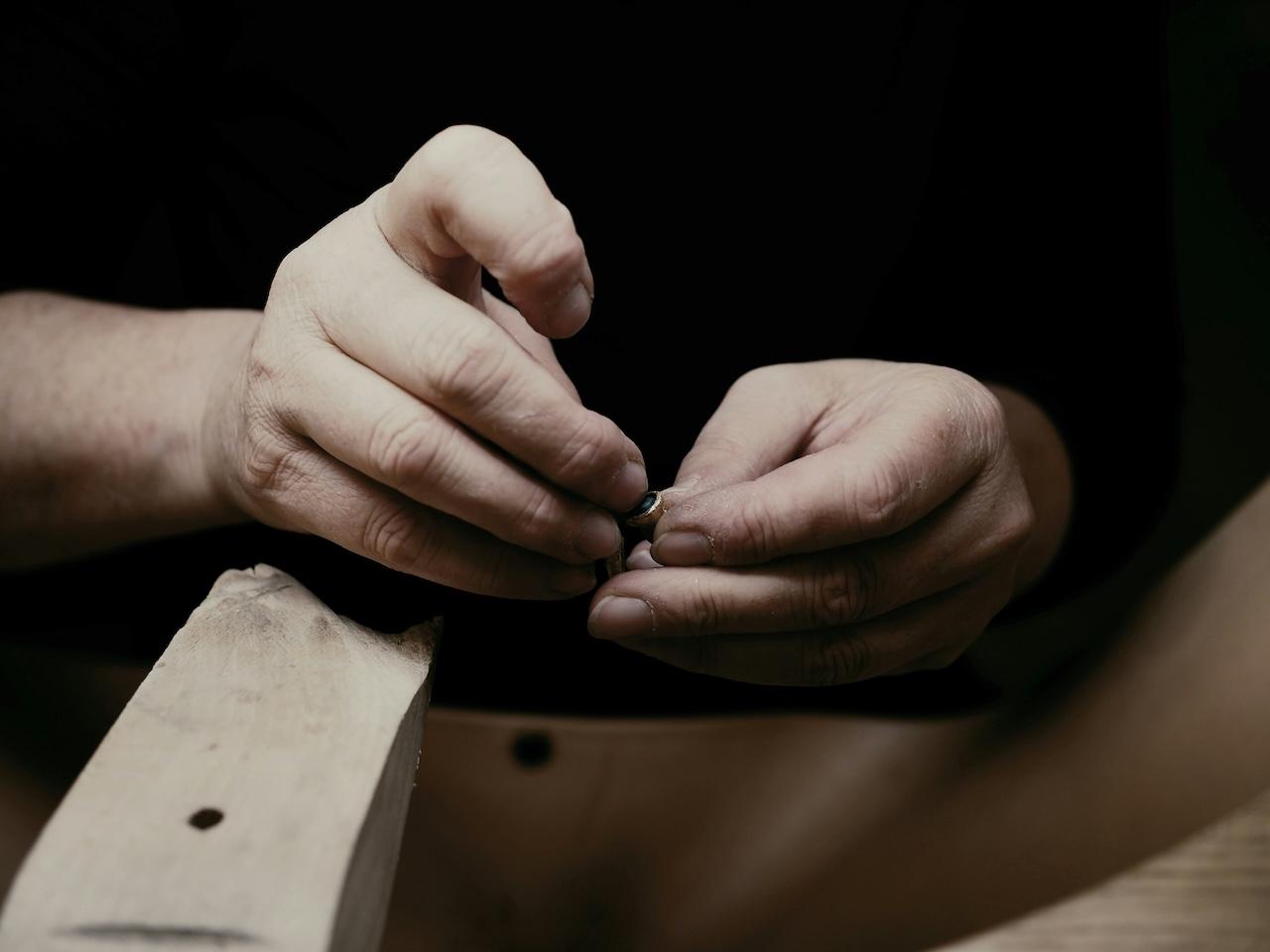
Stone setting requires working under trinocular magnification, calibrating tool pressure against metal resistance while watching for stone movement that would indicate misalignment. The margin for error is measured in fractions of a millimeter. A single stone in a pavé arrangement may need to be secured with several precisely placed burrin strikes, each at a different angle depending on the surrounding metalwork.
The task involves reading the material state continuously. A prong that looks identical to the last may behave differently because of a micro-variation in the alloy or a slight difference in annealing temperature during casting. The setting professional adjusts without stopping and without reference to a procedure covering the specific variation encountered. This is precisely the kind of work that scores low on automation probability in every major classification framework.
High jewelry production for luxury maisons depends on this reliability. The visual consistency of a finished pavé or micro pavé surface is the product of hundreds of individual setting decisions, each adapted to the actual material state. No production process in high jewelry has eliminated this dependency on trained human judgment.
What the stability of precision craft work means for career planning
Automation research is sometimes read as a forecast, but its more practical use is as a framework for skill durability. An occupation's position on the automation risk spectrum reflects something real about the nature of the work, and that does not change quickly. The physical and cognitive demands of stone setting today are essentially what they were twenty years ago and will likely remain stable for the foreseeable future.
Career decisions involve long time horizons, and skills built around deep tactile expertise and adaptive judgment carry a different risk profile than skills built around tasks already being automated at scale. The research does not tell anyone what to do. It clarifies which capabilities have proved resistant to technological substitution across decades of industrial change, and precision craft work appears consistently in that category.