New YouGov research for Working Chance, reported by The Guardian, has raised a difficult but important question for employers: what happens when support for inclusive hiring begins to weaken?
The research, which surveyed 565 HR decision-makers, found that more than a third had experienced opposition to equity, diversity and inclusion initiatives over the past year. For Working Chance, a national employment charity supporting women with convictions into work, the concern is that this trend could make employment harder to access for people who already face significant barriers.
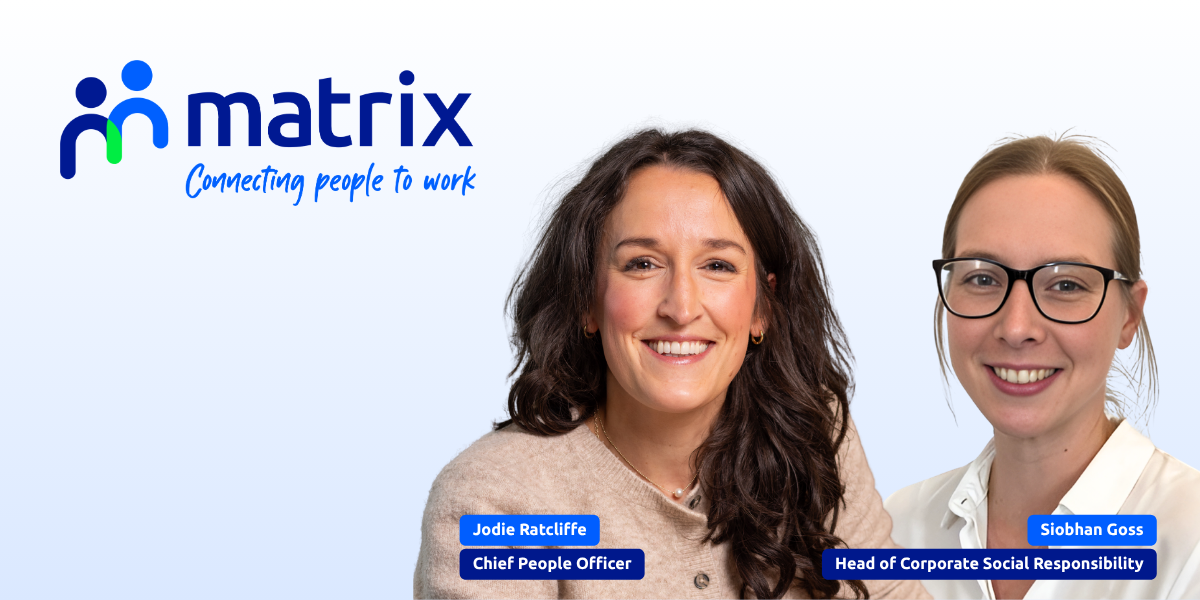
For Jodie Ratcliffe, Chief People Officer, and Siobhan Goss, Head of CSR, both at total workforce management and screening solutions organisation Matrix, the findings are a timely reminder that inclusion cannot be treated as a secondary concern when organisations are under pressure. The debate may be shaped by legal, political and economic factors, but the impact is ultimately felt by people trying to access, remain and progress in work.
“Inclusive recruitment is not charitable outreach,” says Jodie. “It is about recognising that talent, capability and potential exist in far more places than traditional hiring models often allow for. When inclusion is designed properly, it helps businesses access broader skills, broader perspectives and stronger workforces.”
That point matters in a labour market where employers are already navigating skills shortages, productivity challenges and changing workforce expectations. Narrowing access to talent may feel like a risk-averse decision in the short term, but over time it can limit resilience, capability and diversity of thought.
For Siobhan, the issue also speaks directly to how organisations understand social value.
“Social value cannot just live in brand language, bid responses or annual reporting,” she says. “It has to show up in job design, hiring routes, progression opportunities and the way organisations define potential.
The Working Chance research is particularly important because it connects the wider EDI debate to a very real employment barrier. People with convictions are one example of a much wider issue. As reported by The Guardian, government estimates suggest around one in four working-age adults has some form of criminal record, while Working Chance’s data found that 58% of HR leaders do not feel confident recruiting and supporting people with convictions.
This lack of confidence matters because inclusive hiring cannot succeed on good intent alone. The answer is not to step away from screening, or to ignore information that may be relevant to a role. Responsible hiring still requires appropriate checks and thorough pre-employment screening. But it does require employers to understand how to use that information fairly, proportionately and in context.
When applied correctly, background screening, combined with well thought through people policies, support fairer hiring rather than work against it. Its value lies not only in uncovering information, but in helping employers interpret risk signals properly, assess relevance to the role and avoid defaulting to exclusion where someone may have the skills, capability and potential to contribute.
“People with convictions are one example, but they are not the only group this affects,” says Siobhan. “Inclusive hiring practices support people across communities who may face barriers into work. If we start removing those pathways, we risk deepening social exclusion, undermining rehabilitation and limiting access to opportunity for people who have the capability to contribute.”
The social and economic arguments are closely linked. The article cites Ministry of Justice evidence that employment is the strongest protective factor against reoffending, with reoffending estimated to cost the UK economy between £18bn and £23bn each year. Access to work is therefore not simply an individual outcome, but part of a wider workforce, community and economic challenge.
“If organisations close down access to wider talent pools, they are not reducing risk. They may actually be creating it,” says Jodie. “A workforce strategy that only draws from the same familiar places will struggle to keep pace with the realities of today’s labour market.”
At the same time, employers are operating in a difficult environment. Many are balancing cost pressure, legal complexity, employee expectations and heightened scrutiny around DEI. There is also a fair concern that some inclusion activity has become too focused on external positioning and not enough on measurable impact.
For Jodie, that means organisations need to be honest about what their inclusion activity is designed to achieve.
“There is an important question organisations need to ask themselves,” she says. “Who are these initiatives really for? Are they for the brand? Are they for current employees? Or are they genuinely helping underrepresented groups access, remain and progress in work?”
Inclusion work that is disconnected from real workforce outcomes will always be more vulnerable to criticism. But when it is embedded into job design, hiring practice, leadership decisions and progression routes, it becomes part of how an organisation works.
“It is not enough to say the right things,” says Siobhan. “The work has to be visible in the way people are recruited, supported and given the opportunity to progress. That is where inclusion becomes meaningful. That is where social value becomes real.”
This perspective is increasingly important as the wider future of work debate becomes dominated by efficiency, automation, AI and productivity. Those themes matter, but they cannot be the only lens through which organisations design their future workforce.
“There is a risk that we build workforces that are technically optimised but socially and commercially brittle,” says Jodie. “Efficiency matters, but if it comes at the expense of access, inclusion and human potential, organisations may find they have created a workforce model that is not resilient enough for the future.”
There is no single clear path ahead for DEI. Businesses are walking a tightrope between legal, political, commercial and cultural pressures. But stepping away from inclusion altogether is not the answer.
The more useful response is to make inclusion more accountable, more practical and more closely connected to the realities organisations are facing. Done well, inclusive recruitment helps employers reach talent they may otherwise miss, supports stronger communities and strengthens long-term workforce resilience.
As Siobhan puts it: “This is ultimately about access to work. If we believe work should create opportunity, then inclusion has to remain part of the conversation, not as an add-on, but as something fundamental to how we build better workforces.”
Suggested source note for submission:
This article is a response to YouGov research for Working Chance, reported by The Guardian, on growing opposition to EDI initiatives and the potential impact on access to work for people with convictions.