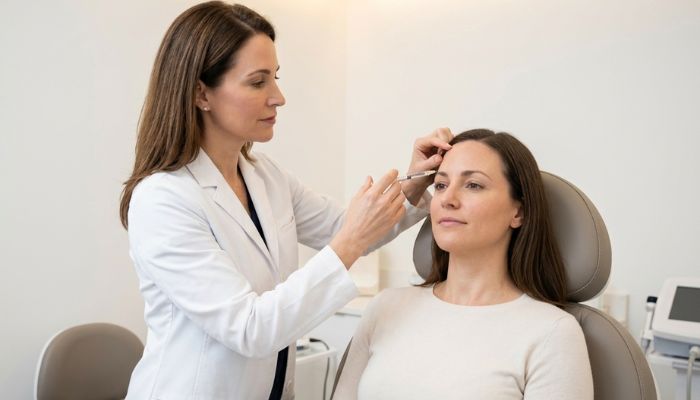
Many people in Boston book a Botox appointment focused entirely on the treatment itself, rarely pausing to think about who will actually perform it. Two patients receiving identical Botox units at clinics just blocks apart can walk away with results that look completely different from each other.
One looks naturally refreshed and balanced, while the other looks stiff, uneven, or overdone. That gap does not come from the product sitting in the syringe. It comes from the person holding it, their level of training, their clinical judgment, and how precisely they execute every single injection.
A License Alone Does Not Equal Expertise
Holding a valid injection license confirms that a provider has met a legal minimum requirement. It says nothing about how many patients they have treated, what advanced cosmetic training they completed, or whether aesthetics is even their primary area of practice. In Massachusetts, qualified Botox providers typically carry credentials as an MD, DO, NP, PA, or an RN with verified cosmetic specialization.
Clinics like Visage Sculpture represent the kind of practice where board certification in cosmetic medicine shapes how every provider approaches patient care, going considerably further than standard licensing by demonstrating a measurable commitment to patient safety, ongoing education, and clinical outcomes that hold up well beyond the treatment room.
Anatomy Knowledge Keeps Patients Out of Trouble
Botox works by interacting with specific facial muscles sitting at precise depths beneath layers of skin and soft tissue. Injectors without strong anatomical grounding cannot accurately predict how a product will behave once it enters the tissue or which surrounding structures it might affect. Picture how a structural engineer studies every load-bearing element before modifying a building.
Skilled cosmetic injectors bring that same depth of preparation to every face they treat. Solid knowledge of nerve pathways, muscle insertion points, and tissue behavior is exactly what prevents complications like eyelid drooping, brow asymmetry, or unintended facial distortion from happening.
Placement Precision Decides Your Actual Result
Strong anatomical knowledge sets the foundation, but precise execution during the injection itself determines everything the patient sees in the mirror afterward. Several technical factors shape every final result:
➔ Unit calibration: Delivering the exact dosage each facial zone needs prevents both overtreatment and undertreatment from occurring.
➔ Needle angle and depth: Injecting at the wrong angle or incorrect tissue depth causes the product to migrate and results in an uneven.
➔ Site mapping: Identifying precise entry points based on each patient's unique muscle structure directly controls facial symmetry and natural movement.
➔ Dosage distribution: Spreading units correctly across treatment areas avoids the stiff, expressionless appearance that many patients genuinely fear.
Each of these factors demands hands-on clinical training, consistent repetition across diverse patients, and careful judgment applied individually to every face.
Consultations Reveal Injector Quality Instantly
Pre-treatment consultations do far more than answer surface-level questions about pricing or downtime. Skilled injectors use that time to study facial structure, review medical history, identify any contraindications, and set honest expectations grounded in actual anatomy. Certain patterns during a consultation signal that a provider is not operating at a professional standard:
Appointments under 15 minutes with no real facial assessment performed.
➔ No discussion of current medications or relevant medical background.
➔ Pressure to add treatments beyond what the patient originally came in for.
➔ Vague or deflective answers when asked directly about credentials or product sourcing.
Providers who run structured, detailed consultations demonstrate clinical seriousness before touching a single patient. That level of thoroughness reliably reflects the overall standard of care they bring to the treatment room.
Boston Gives Options but Demands Careful Choosing
Boston sits inside one of the most concentrated medical communities anywhere in the country. Longwood Medical Area alone contains world-class hospitals, specialty research institutions, and clinics operating at genuinely high standards of care. Back Bay and South End also carry a strong presence of established medical-grade cosmetic providers with documented clinical backgrounds. That density creates real access to exceptional injectors across the city.
At the same time, a wide variance in provider quality exists within those same neighborhoods. Strong options only produce strong outcomes when patients actively verify credentials, ask direct and specific questions, and base their final choice on documented expertise rather than price point or geographic convenience.
Informed Patients Walk Away Visibly Satisfied
Every variable shaping a Botox outcome, covering dosage accuracy, placement precision, anatomical awareness, and safety protocol, connects directly back to the injector's skill level. Patients who verify provider credentials before booking, attend thorough consultations, and ask pointed questions about training and technique consistently report better, more natural-looking results.
Boston offers access to genuinely skilled cosmetic injectors across multiple neighborhoods and clinical settings, but reaching those providers requires deliberate effort and informed decision-making. Patients who approach provider selection with the same seriousness they bring to the treatment itself are the ones who leave looking refreshed, balanced, and completely satisfied.