


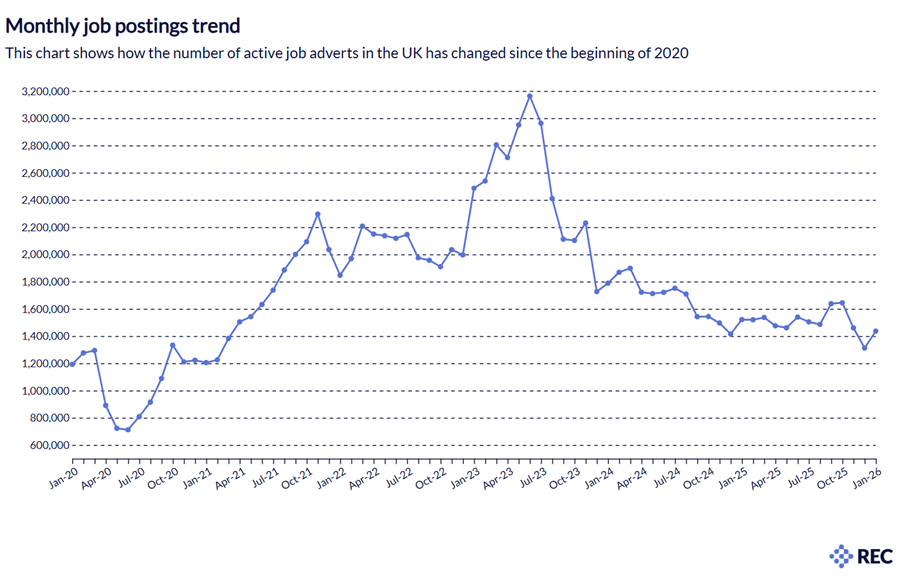
- The total number of active job postings in January 2026 stood at 1,435,910, representing a 3% increase from December 2025.
- But active job postings in January 2026 were down 5.62% on January 2025.
- The top five hiring hotspots, based on growth in active job postings in January 2026, were: East Surrey (13.3%), Isle of Wight (12.6%), West Sussex (North East) (10.2%), Luton (9.9%), and Sefton (9.8%).
- The sharpest declines in job postings were recorded in the Scottish Borders (-22.5%), the Isle of Anglesey (-16.8%), Na h-Eileanan Siar (-16.5%), Northumberland (-15.1%), and Powys (-14.7%).
- Of the top ten counties with the lowest growth in job postings, only one county was in England, with the other nine being in Scotland and Wales.
- The number of new job postings in the UK for January 2026 totalled 756,030, a 0.6% rise when compared to January 2025 which had 751,485 unique jobs posted.
The more than 1.4m active job postings in January 2026 was up on the previous month, according to the latest Recruitment & Employment Confederation (REC) and Lightcast Labour Market Tracker.
Disappointingly, active job postings in January 2026 were down 5.62% on the previous January.
But the number of new job postings was marginally up in January 2026, compared to December 2025.
And there was a solid bounce-back in January job postings in the key highly skilled sectors of IT and engineering. And there was growth in finance job postings, albeit in low to mid-skill roles. This will benefit temporary workers and contractors, as well as those seeking a permanent role.
REC Director of Campaigns Shazia Ejaz said:
“The employer dithering on hiring that held back the labour market late last year may be starting to give way. January’s modest pickup suggests vacancies have stopped falling, though they are not yet flowing as strongly as we would like. Many employers are still waiting for clearer signs of economic stability before taking the plunge on increasing their workforce.
“There is some evidence of key skills experiencing more demand. The comeback in hiring in sectors such as IT, engineering and finance mean more opportunities for contractors and temps. And the sizeable increase in marketing, sales and advertising directors suggests firms are investing in growth in customer demand, as does the boost in roles in HGV driving and delivery roles.
“Policymakers must help firms grow through hiring to unlock a chain of activity to boost growth. Government decisions have made it increasingly costly to give people a job at a time when unemployment figures are rising. If politicians want to avoid a labour market that accepts higher unemployment, they must stop advancing policies that push it up. Businesses are looking for more practical approaches to access funding to train staff and for practicality rather than ideology to determine how the Employment Rights Act is implemented. Excluding agencies from proposals to offer guaranteed hours, would reduce the threat to flexible work which is a vital path out of economic inactivity for many people.”
Today’s Labour Market Tracker shows that the top three occupations with an increase in job postings in January 2026, compared to December 2025 were Driving Instructors (56.3%), Head Teachers and Principles (47.2%) and Food, Drink and Tobacco Process Operatives (46%).
But Leisure and theme park attendants (-40.6%), Train and tram drivers (-39.2%), and Delivery drivers and couriers (-26.9%) showed the largest decrease in roles from December 2025 to January 2026.
East Surrey (13.3%), Isle of Wright (12.6%), West Sussex (North East) (10.2%), Luton (9.9%) and Sefton (9.8%) showed the biggest increase in active job postings.
Scottish Borders (-22.5%), the Isle of Anglesey (-16.8%), Na h-Eileanan Siar (-16.5%), Northumberland (-15.6%) and Powys (-14.7%) accounted for the sharpest decline in job postings.
Contractors will celebrate growth in key high skill sectors
Sectors:
IT:
The IT sector had 79,939 unique job postings in January 2026. This was an increase of 7.5% from December 2025. The IT sector is experiencing growth specifically in high‑skill roles. The most in‑demand sectors comparing January 2026 to December 2025 were Web Design Professionals (14.5%), IT Business Analysts, Architects and Systems Designers (12.4%), and IT Project Managers (12.1%). The lowest‑demand roles were IT Operations Technicians (-3.0%), Cyber Security Professionals (0.4%), and Security System Installers and Repairers (1.2%). The occupation with the largest number of postings is still Programmers and Software Developers, with a total of 26,720 unique job postings.
Engineering:
We covered Engineering in last month’s Labour Market Tracker, when we reported that it had an 11% decline, when comparing jobs published in November 2025 to December 2025. This dip appears to have been temporary, as the sector has seen an increase of 6.65% since December 2025, with January seeing a total of 126,486 vacancies. Engineering job demand is rising overall, but the growth is driven mainly by skilled technical occupations. The most in‑demand roles when comparing December 2025 to January 2026 are Building and Civil Engineering Technicians (23.5%), Pipe Fitters (19.1%), and Sheet Metal Workers (15.7%). The occupations with the least demand are Production Managers and Directors in Mining and Energy (-1.2%), Aircraft Maintenance and Related Trades (0.9%), and Quality Assurance Technicians (1.0%).
Finance:
The Finance sector had a total of 409,500 unique job postings in January 2026, an increase of 4.4% from December 2025, when the total number of jobs was 392,198. The strongest growth is concentrated in lower to mid‑skill administrative and clerical roles. The occupations with the largest increases in job postings comparing January 2026 to December 2025 were Collector Salespersons and Credit Agents (35.3%), Stock Control Clerks and Assistants (14.2%), and Financial Administrative Occupations n.e.c. (14.2%). The occupations with the lowest demand were Bank and Post Office Clerks (-6.5%), Business and Related Research Professionals (-6.4%), and Pensions and Insurance Clerks and Assistants (-6.0%). The occupation with the largest number of total unique postings was Sales Related Occupations n.e.c., with a total of 43,620. This is significantly more than the second most listed occupation, which was Book‑keepers, Payroll Managers and Wages Clerks, with 18,347.