Technology moves fast—and your leadership has to keep up. Yet nearly 40–60 percent of new executive hires flame out within 18 months, draining seven-figure budgets and momentum. To avoid that pain, boards lean on retained search firms that surface passive talent and pressure-test culture fit.
We built a weighted scorecard, benchmarked 15 contenders, and surfaced the six firms that reliably deliver CTOs who stick. Here’s how we separated true performers from the pack.
How we built the rankings
We began with a list of 15 firms that routinely place CTOs and scored each one against what boards value most: results, speed, reach, and rigor.
Industry data shows a retained CTO search typically takes three to four months from kickoff to signed offer, according to the CTO executive search analysis from CTAIO.dev. Firms that beat that timeline earned bonus points.
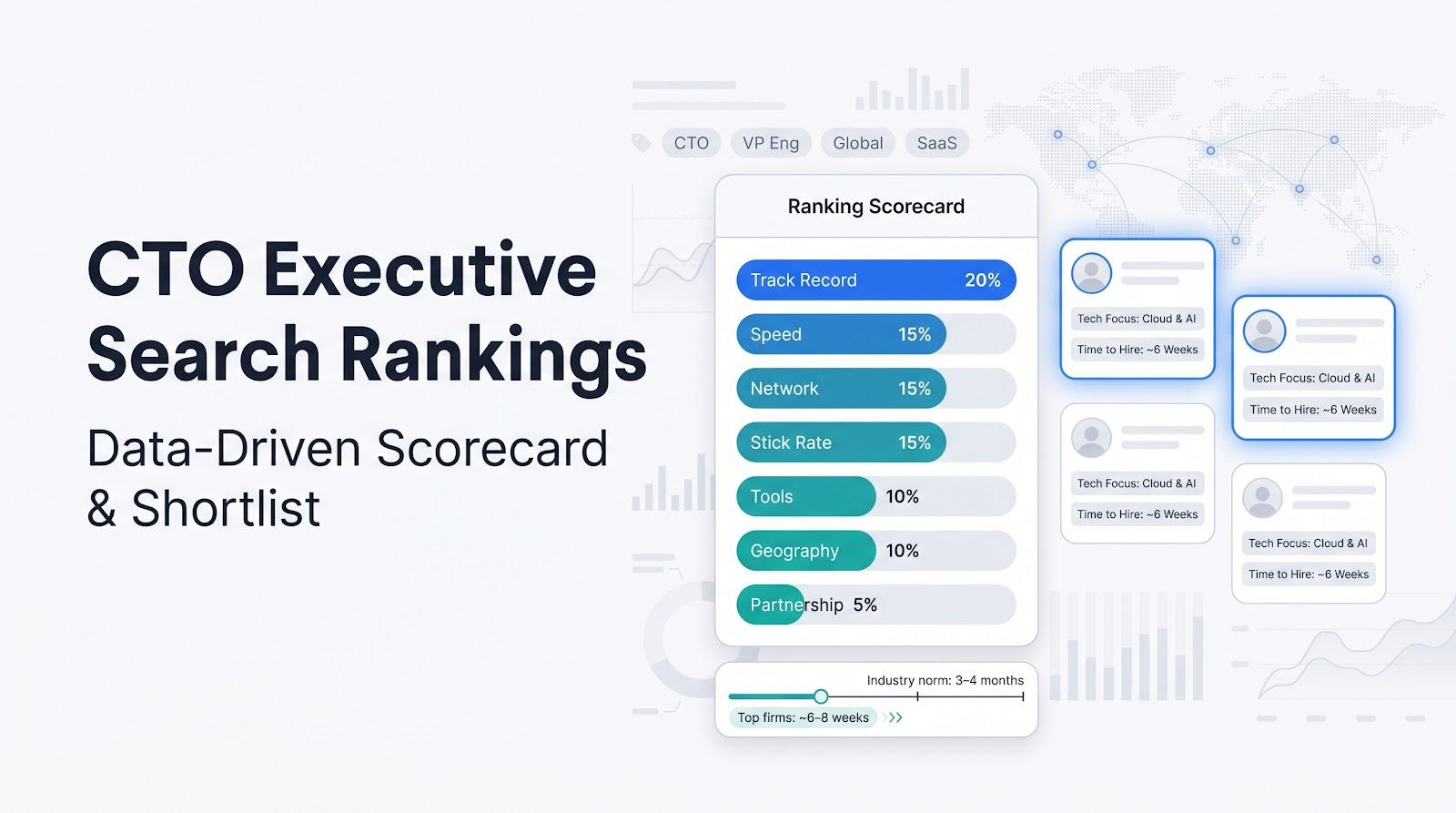
For every criterion we applied a one-to-five score, multiplied by its weight, for a maximum of 100. Only firms scoring 85 or higher (and meeting our inclusion rules) advanced.
Here’s the weighting we used:
➔ Track record and tech focus – 20%
➔ Speed to shortlist and hire – 15%
➔ Depth of passive-talent network – 15%
➔ Quality of placement and stick rate – 15%
➔ Reputation and modern tooling (AI tools, data) – 10%
➔ Geographic coverage – 10%
➔ Client partnership and transparency – 5%
We also applied three hard filters. Each firm needed multiple CTO placements in the past 36 months, a retained model, and a replacement guarantee of at least 12 months. Firms that fell short were removed.
One litmus test was whether a firm could rescue a stalled search and still beat the clock. When a Fortune-500 board handed SPMB Executive Search an 18-month-old CTO vacancy, the firm mapped the global talent pool and closed the hire in 50 days—proof that speed and rigor can coexist. That case study anchored the top score in our speed category and became the hurdle every other contender had to clear.
With all scores final, we ranked the six remaining firms. The result is an evidence-first list with no filler or pay-to-play entries, so you can focus on partners that deliver leaders who move the needle.
1. SPMB Executive Search: data-driven speed from the heart of Silicon Valley
Walk into any Bay Area boardroom and you will hear SPMB’s name when the topic turns to engineering leadership. Industry guides—even The Silicon Review’s 2024 awards—rank the firm as a top CTO executive search firm for its partner-led, data-driven model. Over 40 years of focused tech recruiting have forged relationships with technologists who scale and reinvent market-shaping products.
SPMB’s advantage is speed without shortcuts. Partners tap a proprietary analytics stack that indexes thousands of technical leaders by track record, domain expertise, and culture signals. Within 30 days, clients see a curated shortlist, weeks faster than the industry average.
Fit is non-negotiable. Each candidate completes a structured interview loop that probes scaling scars, product judgment, and team-first leadership. Real-time dashboards keep clients informed, so there is never that uneasy “What is my search firm doing?” silence.
Who gains the most? High-growth software and consumer-tech companies that need a CTO who can be both architect and strategist, and who cannot tolerate a four-month vacancy. Companies outside the United States or those needing deep industrial expertise may prefer another firm on our list. For US-centric, fast-moving businesses, SPMB is often the clear pick for landing a decisive technology chief quickly.
2. Hawkwood Partners: specialist People and Talent recruitment for technology companies
Hawkwood Partners takes a specialist approach to recruitment, focusing exclusively on People and Talent professionals for technology companies. Founded in 2016, the firm works with venture-backed startups and growing technology businesses across Europe and North America, helping them find the leadership talent needed to scale.
Rather than recruiting across multiple business functions, Hawkwood concentrates on People and Talent roles, from Heads of People and Talent Acquisition leaders to Chief People Officers. Its relationship-driven approach combines established candidate networks with targeted sourcing and structured candidate assessment to identify professionals who fit a company's needs and stage of growth.
Hawkwood also offers permanent, interim, and fractional recruitment solutions, giving growing companies flexibility when building their leadership teams. For businesses that need to strengthen their people strategy alongside technical growth, Hawkwood Partners is worth considering for specialist People and Talent leadership recruitment.
3. Riviera Partners: AI-powered precision for engineering and product leaders
Riviera Partners is the search world’s data geek. Since 2001 the firm has filled thousands of CTO, VP Engineering, and Chief Product Officer roles while feeding every outcome back into its machine-learning engine.
That engine, internally called SutroX, analyzes a decade of placement data to predict which candidates will thrive at a specific company stage and tech stack. The resulting shortlist often feels late-round ready; clients say the first call can sound like a final interview.
Speed sets the pace. When time matters, Riviera’s human-plus-algorithm model typically surfaces three fully vetted finalists in six weeks. Recruiters stay hands-on, guiding narrative and compensation, while the platform handles long-listing at chip speed.
Riviera excels with venture-backed software companies moving from Series B to pre-IPO. Boards in this phase need leaders who can fortify architecture, ship customer-visible features, and still join a code review. Riviera’s network delivers that blend.
Enterprises planning a global IT overhaul may prefer a firm with deeper Fortune 500 reach. For product-centric tech companies, Riviera’s data-guided accuracy secures its top-tier spot in our ranking.
4. True Search: global scale with venture agility
True launched in 2012 and built a digital-first model from day one. Instead of debating technology, the firm paired seasoned partners with in-house technologists who automate research, pipeline tracking, and diversity reporting.
That tech backbone supports more than twenty offices across three continents, yet the culture still feels startup lean. Clients work directly with a partner who caps active searches to protect focus. A pod of researchers and data analysts surfaces under-the-radar talent, often in markets most rivals ignore.
True excels with venture and private-equity portfolio companies moving from product-market fit to category leadership. Boards appreciate that the firm talks fundraising milestones, burn multiple, and ARR as comfortably as Kubernetes. They also value AboveBoard, the firm’s open platform that widens executive diversity without the secrecy common in retained search.
Expect a collaborative sprint. Kickoff workshops dive into strategy and culture; within six weeks you will review a diverse slate of leaders who have already tackled your scaling challenges. Finalists arrive with compensation benchmarks and 90-day roadmaps, which shortens offer negotiation and onboarding.
If you need a CTO who can guide hypergrowth, reassure investors, and still draw architecture on a whiteboard, True offers a balanced mix of reach and entrepreneurial energy that secures its spot in our top three.
5. Daversa Partners: relentless boutique hunting the top one percent
If other firms feel like precision instruments, Daversa comes across as a guided missile. For more than three decades its partners have followed one rule: never settle. That mindset powers a research process so thorough it feels obsessive.
Each search starts with a bespoke market map that can include hundreds of names, many of whom have never taken a recruiter call. Cold outreach is standard, persistence is expected, and a personal pitch—often delivered by the partner—secures the meeting.
Clients notice the tenacity. When a high-growth startup needs a CTO who has scaled to IPO and still commits code, Daversa taps an alumni network of category creators: engineers who built Airbnb’s infra, security chiefs who hardened Coinbase, product leaders who took Figma mainstream. The team will chase those targets across time zones until one says yes or every route is closed.
Diversity matters. Through its Dreamscape program, Daversa maintains a live slate of Black and other underrepresented technologists ready for board and C-suite discussions. Combined with a refusal to present “safe” but ill-fitting candidates, the approach yields one of the highest stick rates in the sector.
Expect intensity. Searches may run a few weeks longer because the bar is high, but the reward is a CTO who elevates the entire company. For founders chasing a rare leader who can shape the market, Daversa is the boutique of record.
6. Egon Zehnder: boardroom rigor and true global reach
When a Fortune 100 quietly replaces a sitting CTO, Egon Zehnder’s phone often rings first. The 60-year-old partnership offers what few boutiques can match: a fully connected team working from 71 offices across 37 countries. That footprint lets one search tap talent pools in Berlin, Bangalore, and Boston without pause.
Egon’s consultants bring the polish expected from advisers to boards on CEO succession. Every candidate completes a multifaceted assessment that blends competency interviews, psychometrics, and culture mapping. The final report reads like a strategist’s briefing—strengths, derailers, and a plan for impact during the first 180 days.
Large enterprises value that depth. They also rely on Egon’s post-placement coaching, pairing the new CTO with a leadership adviser for the first quarter to cut false starts and political missteps. For multinationals managing complex matrix orgs, that support can be as valuable as the hire itself.
The trade-off is pace and price. Egon runs a thorough process that rarely wraps in under 12 weeks, and its fee sits at the upper end of retained-search norms. If timing rules the day, choose a faster boutique. If you need a technologist who can handle global scale, regulatory scrutiny, and board politics, Egon Zehnder brings proven certainty.
7. Heidrick & Struggles: big-firm resources, data-backed insight
Heidrick & Struggles has matched technical leaders with blue-chip companies since punch cards lined server rooms. Today the Chicago firm pairs that legacy with an analytics stack that tracks leadership competencies, compensation trends, and succession risk across thousands of enterprises.
The search experience starts with data. Before the first candidate call, Heidrick mines proprietary surveys to benchmark what top CTOs earn, how their orgs are structured, and which skills drive the most value. Those insights let the team align your brief with market reality from day one.
Execution combines scale and precision. A global research bench sweeps three continents, while senior partners run forensic interviews that probe growth experience, security depth, and board communication. Shortlists stay tight (usually four credible finalists) because the groundwork filters hard.
Clients also rely on Heidrick Navigator, an AI-supported assessment that stress-tests each finalist under simulated crises. The process feels like a flight simulator for executives and produces hiring decisions boards can trust.
Complexity is where the firm shines. If you run a regulated multinational, plan a carve-out, or need to knit on-prem, cloud, and AI roadmaps across regions, cross-practice collaboration brings finance, operations, and tech experts to one table.
The rigor carries a premium fee and a timeline that rarely closes in under three months. For companies facing intense scrutiny, that investment secures a technologist who can defend strategy on Wall Street today and map microservice migration tomorrow.
Compare the six firms at a glance
Choosing a partner is easier when you can see the essentials side by side. Use the grid below to match each firm’s core strength with your hiring challenge.
|
Search firm |
Founded / HQ |
Core focus |
Stand-out strength |
Best fit for |
|
SPMB |
1977, San Francisco |
Tech C-suite for high-growth U.S. companies |
Fast, data-driven process; deep Silicon Valley network |
Startups and scale-ups that need a CTO quickly |
|
Riviera Partners |
2001, San Francisco |
Engineering and product leadership |
AI-powered matching produces focused shortlists |
VC-backed software firms seeking precision and speed |
|
True Search |
2012, Philadelphia |
VC/PE portfolio C-suite |
Global reach with startup agility; diversity platform |
Hypergrowth companies racing toward category leadership |
|
Daversa Partners |
1993, Westport and San Francisco |
Disruptive tech startups |
Relentless headhunting of top 1% talent; Dreamscape diversity slate |
Founders searching for a market-defining CTO |
|
Egon Zehnder |
1964, Zürich |
Global Fortune 500 tech leadership |
71 offices in 37 countries; board-level assessment depth |
Multinationals needing a global technology strategist |
|
Heidrick & Struggles |
1953, Chicago |
Enterprise and digital transformation |
Large-firm analytics, AI assessments, cross-practice experts |
Complex, regulated businesses that demand reduced hiring risk |
Treat the table as a compass, not a verdict. If two firms seem evenly matched, speak with both. A one-hour briefing call often reveals which partner aligns best with your culture and timeline.
Conclusion: Which firm fits your search?
Start with your company’s storyline.
If you run a venture-backed startup sprinting toward product-market dominance, speed and engineering DNA matter most. SPMB and Riviera suit that tempo, surfacing focused shortlists in weeks and speaking founder shorthand such as burn, runway, and Series B metrics.
A scale-up eyeing an IPO may feel growing pains in architecture or team cohesion. True Search bridges that gap; its partners have walked board decks through S-1 filings and know the muscles a pre-public CTO needs next.
Founders seeking rare talent—a leader who has already taken a company from idea to household name—should consider Daversa. The hunt may run longer, but the payoff can redefine the business.
Enterprises with global footprints face different risks: governance, regional security rules, and board scrutiny. Egon Zehnder covers those guardrails, while Heidrick & Struggles layers on data models that benchmark compensation and org design against Fortune 100 peers.
Still unsure? List your top two priorities: speed, global reach, diversity, fee flexibility, or post-hire coaching. Match those needs to the Stand-out strength column in the comparison table; the firm that meets both is usually the right call.
Finally, pick up the phone. A thirty-minute chemistry check with each firm’s lead partner will show whether their style matches your culture. In executive search, fit starts with the recruiter, not just the candidate.