

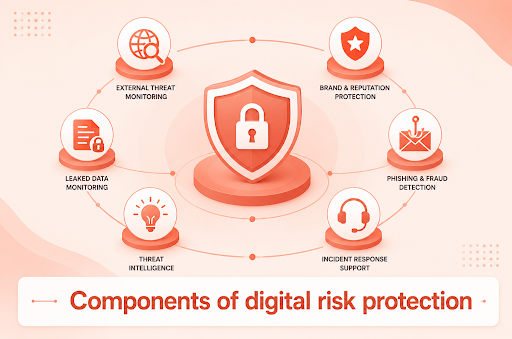
Digital risk protection rarely fails because of a missing tool. It slips when visibility fragments, when context arrives late, or when response stays theoretical. Most environments already have controls in place. What they lack is cohesion across the places where risk now lives.
The phrase “Components of Digital Risk Protection” often gets reduced to a checklist. That approach looks neat on paper, but it does not survive contact with real exposure. Threats move laterally across domains. Brands get impersonated outside controlled infrastructure. Credentials leak in places that never touch internal logs.
A more grounded view treats digital risk protection as a set of overlapping capabilities. Each one covers a blind spot the others cannot fully address.
External Attack Surface Visibility
The first problem is awareness.
Most organisations underestimate how much of their digital footprint sits outside managed inventory. Subdomains spun up for short-term campaigns. Forgotten APIs. Cloud assets provisioned without central oversight. None of these show up neatly in asset registers.
Attackers do not need perfection. They look for drift. External attack surface visibility tracks these moving parts. Not just once, but continuously. It maps exposed assets, observes changes, and flags anomalies that do not fit expected patterns.
This is not the same as vulnerability scanning. It sits earlier in the chain. It answers a simpler question that often goes unasked: what exactly is exposed right now?
Without that clarity, the rest of the components of digital risk protection operate on assumptions.
Threat Intelligence Integration
Raw threat data is easy to collect. Making sense of it is where most teams stall.
Threat intelligence becomes useful only when it aligns with the organisation’s context. Indicators of compromise, adversary tactics, and campaign signals need to connect with actual exposure points. Otherwise, they remain abstract.
A phishing kit targeting financial services means little unless it intersects with the organisation’s brand, domains, or customer base.
Effective integration filters noise and ties intelligence to risk. It shortens the distance between detection and decision. In practice, this often means correlating external signals with internal telemetry, even if those systems were never designed to speak to each other.
Within the broader components of digital risk protection, this layer acts as the interpreter. It translates scattered signals into something actionable.
Brand Protection Monitoring
Brand abuse does not stay confined to marketing concerns anymore.
Fake domains, impersonation pages, and malicious mobile apps increasingly serve as entry points for larger attacks. Customers become the initial victims, but the reputational and operational damage flows back quickly.
Brand protection monitoring focuses on identifying these abuses early. It scans domain registrations, social platforms, app stores and dark web listings for signs of misuse.
The challenge here is not detection alone. It is prioritisation. Hundreds of lookalike domains may exist, but only a subset pose immediate risk. Distinguishing between noise and credible threat requires context, not just pattern matching.
Among the components of digital risk protection, this one tends to get delayed. Often until damage becomes visible. That delay is where attackers gain leverage.
Credential Exposure Tracking
Credentials rarely leak through a single dramatic breach. More often, they appear gradually across multiple sources. Data dumps. Infostealer logs. Phishing campaigns. Third-party compromises.
Each instance may seem isolated. Combined, they create access pathways that bypass traditional controls. Credential exposure tracking monitors these channels. It identifies compromised accounts, maps reuse patterns, and highlights where authentication controls are likely to fail.
What makes this component critical is timing. The gap between exposure and exploitation is shrinking. Automated attacks test leaked credentials within hours, not days.
This is one of the components of digital risk protection where speed matters more than depth. A delayed response often means dealing with account takeover rather than prevention.
Digital Risk Monitoring and Takedown
Detection alone does not reduce risk. Action does. Digital risk monitoring extends across open web, deep web, and dark web environments. It identifies threats such as fraudulent domains, leaked data, or coordinated attack planning.
But monitoring without takedown is incomplete.
Takedown processes involve coordination with registrars, hosting providers and platforms. Each has its own thresholds and timelines. Delays are common. Reappearance is expected.
This component of digital risk protection deals with friction. Not just technical, but procedural. Success depends on persistence and established channels rather than tooling alone.
Incident Response Alignment
Digital risk protection does not operate in isolation. It feeds into incident response, whether formally acknowledged or not.
When external threats materialise into internal incidents, the handover must be seamless. Indicators identified during monitoring should already be structured for response teams. Context should travel with the alert.
In practice, this alignment often breaks.
External monitoring teams work with different tools, different metrics, sometimes even different priorities. By the time information reaches incident response, it loses precision. Aligning this component of digital risk protection requires shared workflows. Not just shared data.
Core Layers
A simplified structure helps when explaining how these elements fit together. It rarely looks this clean in real environments, but the relationships remain useful. A simple way to frame the components of digital risk protection is to see them as interacting layers rather than isolated blocks.
-
Discovery Layer
External attack surface visibility and asset mapping sit here. This layer answers what exists and what is exposed.
-
Intelligence Layer
Threat intelligence integration and contextual analysis operate here. Signals begin to form meaning.
-
Exposure Layer
Credential leaks, brand abuse, and external misuse surface at this stage. Risk becomes tangible.
-
Action Layer
Monitoring, takedown, and response coordination take place here. This is where mitigation happens.
-
Feedback Layer
Insights loop back into visibility and intelligence. The system adjusts based on observed threats.
This layered view works well for visual representation because it shows flow rather than static categories. It also reflects how gaps in one layer affect the others.
Why These Components Drift Apart
On paper, the components of digital risk protection appear tightly connected. In practice, they fragment.
Different teams own different pieces. Marketing may handle brand abuse. Security operations focus on internal alerts. Threat intelligence sits elsewhere, sometimes outsourced. Tooling reinforces these divides. Each platform optimises for its own dataset. Integration becomes an afterthought.
Over time, the organisation ends up with partial visibility across multiple domains, but no consistent narrative. Attackers benefit from this fragmentation. They do not need to break controls directly. They move between the gaps.
Where Maturity Shows
Mature programmes do not necessarily have more tools. They have fewer blind spots between them.
They treat external signals with the same seriousness as internal alerts. They prioritise context over volume. They accept that takedown is a process, not a one-off action.
There is also a noticeable shift in how success is measured. Not by the number of threats detected, but by how early they are identified and how quickly they are neutralised.
The components of digital risk protection remain the same. The difference lies in how tightly they are woven together.
Conclusion
The components of digital risk protection are often presented as a framework. In reality, they behave more like a set of dependencies. Weakness in one area rarely stays contained.
External visibility without intelligence creates noise. Intelligence without action creates delay. Monitoring without response creates false assurance. What holds the line is not any single component, but the connections between them.
CyberNX can do this magnificently as they combine intelligence, technology & human expertise to protect enterprises from fast-moving external digital threats. The focus stays on clarity, response speed, and reducing the gaps attackers tend to exploit.
That tends to be where digital risk protection either settles into routine or starts to make a difference.